

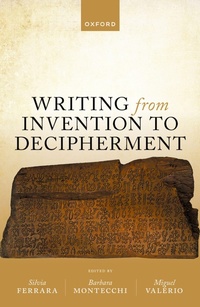
Writing from Invention to Decipherment
Published on 1. October 2024
Book
Hardback
350 pages
978-0-19-890874-6 (ISBN)
Description
This is an open access title available under the terms of a CC BY-NC-ND 4.0 International licence. It is free to read on the Oxford Academic platform and offered as a free PDF download from OUP and selected open access locations.
Writing from Invention to Decipherment contains a wealth of global scholarship on ancient writing systems from China, Mesopotamia, Central America, and the Mediterranean, to more recent newly created scripts such as the Rongorongo from Easter Island, the Caroline Island scripts, as well as the alphabet. The aim is to dig into the foundations of writing, showcasing the complexities and varieties of scripts, from their invention to the potential decipherment of poorly understood scripts.
The volume offers state-of-the-art research on undeciphered scripts from the Aegean (as for example, Cretan Hieroglyphic and Linear A) or not completely deciphered (as for example Maya) scripts. From a methodological perspective, these contributions lay out how and why writing was invented, who used it, and to what ends. Here writing is presented as a multi-modal cultural phenomenon, that intersects and transcends neat discipline boundaries, within an inclusive approach bridging archaeology, linguistics, epigraphy, and cognitive studies.
Writing from Invention to Decipherment contains a wealth of global scholarship on ancient writing systems from China, Mesopotamia, Central America, and the Mediterranean, to more recent newly created scripts such as the Rongorongo from Easter Island, the Caroline Island scripts, as well as the alphabet. The aim is to dig into the foundations of writing, showcasing the complexities and varieties of scripts, from their invention to the potential decipherment of poorly understood scripts.
The volume offers state-of-the-art research on undeciphered scripts from the Aegean (as for example, Cretan Hieroglyphic and Linear A) or not completely deciphered (as for example Maya) scripts. From a methodological perspective, these contributions lay out how and why writing was invented, who used it, and to what ends. Here writing is presented as a multi-modal cultural phenomenon, that intersects and transcends neat discipline boundaries, within an inclusive approach bridging archaeology, linguistics, epigraphy, and cognitive studies.
Reviews / Votes
This is a valuable collection. The Aegean-focused chapters will perhaps be of most interest to scholars working within that field, especially those with narrow remits, butoverall, there is much to benefit a wider, varied audience. We learn that decipherments are long and ongoing processes, not sudden watersheds, and that writing is not a monolithic technology but rather a conceptual tool that can be shaped to meet many human needs in different contexts. * Philippa M. Steele, European Journal of Archaeology *More details
Language
English
Place of publication
Oxford
United Kingdom
Target group
College/higher education
Product notice
sewn/stitched
Cloth over boards
Illustrations
numerous black and white figures
Dimensions
Height: 236 mm
Width: 163 mm
Thickness: 26 mm
Weight
771 gr
ISBN-13
978-0-19-890874-6 (9780198908746)
Copyright in bibliographic data and cover images is held by Nielsen Book Services Limited or by the publishers or by their respective licensors: all rights reserved.
Schweitzer Classification
Other editions
Additional editions
Silvia Ferrara | Barbara Montecchi | Miguel Valerio
Writing from Invention to Decipherment
E-Book
09/2024
OUP eBook
€109.99
Available for download
Silvia Ferrara | Barbara Montecchi | Miguel Valerio
Writing from Invention to Decipherment
E-Book
08/2024
OUP eBook
€109.99
Available for download
Persons
Silvia Ferrara is Professor of Philology and Civilizations of the Aegean and Pre-Classical Mediterranean at the University of Bologna and PI of the ERC Consolidator Grant INSCRIBE Invention of Scripts and their Beginnings.
Barbara Montecchi specialized in Aegean Archaeology at the Italian Archaeological School at Athens and then earned a PhD in History and Archaeology of the Ancient World from the University of Florence. She was Assistant Professor and INSCRIBE team member at the University of Bologna from 2019 to 2022. Currently, she works for the Museums of the University of Florence, dealing with museum communication, accessibility, and public engagement.
Miguel Valerio is a Maria Zambrano postdoctoral researcher at the Universitat Autonoma de Barcelona (Department of Prehistory). He was trained in Archaeology and earned a PhD in 'Languages and Cultures of the Ancient World and their Survival' at the University of Barcelona. His primary academic activities and publications focus on the archaeology of early state societies, the origins of writing, and undeciphered scripts.
Barbara Montecchi specialized in Aegean Archaeology at the Italian Archaeological School at Athens and then earned a PhD in History and Archaeology of the Ancient World from the University of Florence. She was Assistant Professor and INSCRIBE team member at the University of Bologna from 2019 to 2022. Currently, she works for the Museums of the University of Florence, dealing with museum communication, accessibility, and public engagement.
Miguel Valerio is a Maria Zambrano postdoctoral researcher at the Universitat Autonoma de Barcelona (Department of Prehistory). He was trained in Archaeology and earned a PhD in 'Languages and Cultures of the Ancient World and their Survival' at the University of Barcelona. His primary academic activities and publications focus on the archaeology of early state societies, the origins of writing, and undeciphered scripts.
Editor
Professor of Philology and Civilizations of the Aegean and Pre-Classical MediterraneanProfessor of Philology and Civilizations of the Aegean and Pre-Classical Mediterranean, University of Bologna
Independent scholarIndependent scholar
Maria Zambrano Postdoctoral ResearcherMaria Zambrano Postdoctoral Researcher, Universitat Autonoma de Barcelona
Content
Silvia Ferrara, Barbara Montecchi, and Miguel Valerio: Introduction
PART I: BEGINNINGS OF WRITING
1: Mattia Cartolano: Cognition, iconography, and graphic communication systems on portable objects in the Near Eastern Neolithic
2: Paola Dematte: The origins of Chinese writing
3: Aaron J. Koller: The failure and success of the early alphabet
4: Willemijn Waal: Closing the gap: writing in the Aegean from the Late Bronze Age to the Iron Age
5: Alex de Voogt: The Caroline Islands Script: how one script informs five debates
PART II: THE FUTURE OF UNDECIPHERED SCRIPTS
6: Ignasi-Xavier Adiego: Deciphering a writing system: luck, intuition, or method?
7: Judith Weingarten: The cat in the Cretan Hieroglyphic script: ma, what it means, and where it leads
8: Giorgia Baldacci: The Phaistos disk: placing an enigmatic artefact in its cultural context
9: Barbara Montecchi: Design and origins of Linear A picture-based signs
10: Miguel Valerio: The Rongorongo 'lunar calendar' of Rapa Nui (Easter Island) and the type of script
PART III: CURRENT APPROACHES TO EARLY WRITING AND READING
11: Christian M. Prager, Katja Diederichs, Antje Grothe, Nikolai Grube, Guido Krempel, Mallory Matsumoto, Tobias Mercer, Cristina Vertan, and Elisabeth Wagner: IDIOM - A digital research environment for the documentation and study of Maya hieroglyphic texts and language
12: Sarah Finlayson: Looking for readers in the Bronze Age Aegean
13: Louis Godart: Looking for writers in the archives of King Nestor
PART I: BEGINNINGS OF WRITING
1: Mattia Cartolano: Cognition, iconography, and graphic communication systems on portable objects in the Near Eastern Neolithic
2: Paola Dematte: The origins of Chinese writing
3: Aaron J. Koller: The failure and success of the early alphabet
4: Willemijn Waal: Closing the gap: writing in the Aegean from the Late Bronze Age to the Iron Age
5: Alex de Voogt: The Caroline Islands Script: how one script informs five debates
PART II: THE FUTURE OF UNDECIPHERED SCRIPTS
6: Ignasi-Xavier Adiego: Deciphering a writing system: luck, intuition, or method?
7: Judith Weingarten: The cat in the Cretan Hieroglyphic script: ma, what it means, and where it leads
8: Giorgia Baldacci: The Phaistos disk: placing an enigmatic artefact in its cultural context
9: Barbara Montecchi: Design and origins of Linear A picture-based signs
10: Miguel Valerio: The Rongorongo 'lunar calendar' of Rapa Nui (Easter Island) and the type of script
PART III: CURRENT APPROACHES TO EARLY WRITING AND READING
11: Christian M. Prager, Katja Diederichs, Antje Grothe, Nikolai Grube, Guido Krempel, Mallory Matsumoto, Tobias Mercer, Cristina Vertan, and Elisabeth Wagner: IDIOM - A digital research environment for the documentation and study of Maya hieroglyphic texts and language
12: Sarah Finlayson: Looking for readers in the Bronze Age Aegean
13: Louis Godart: Looking for writers in the archives of King Nestor