

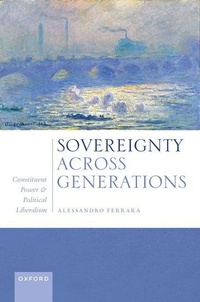
Sovereignty Across Generations
Constituent Power and Political Liberalism
Published on 28. February 2023
Book
Hardback
336 pages
978-0-19-287107-7 (ISBN)
Description
Every cohort of voters may dream of being 'the people' under the sway of serial visions of sovereignty; or understand itself, more modestly, as co-author of a constitutional project in a cross-generational sequence rooted in the past and extending into the future. Sovereignty Across Generations offers a theory of democratic sovereignty and constituent power grounded in John Rawls's political liberalism.
Neither exegetic nor abstractly analytic, this book assumes that 'political liberalism' is broader than Political Liberalism. In answering the question 'How is it possible for there to exist over time a just and stable society of free and equal citizens, who remain profoundly divided by reasonable religious, philosophical, and moral doctrines?', the paradigm implicit in Political Liberalism enables us to address facets of that question that Rawls sidelined in the context of his time.
Following populist threats to democracy, which were still latent in 1993, this book responds to the urgency of clarifying the proper relation of 'the people' (as transgenerational author of the constitution) to its pro-tempore living segment in its capacity as electorate and as co-author of the constitution. An explanation of that relation brings 'constituent power' into the picture and unfolds in seven steps that form the conceptual backbone of this book.
By taking new steps in updating and revisiting political liberalism, this book reconstructs Rawls's implicit view of constituent power beyond the pages dedicated to it in Political Liberalism and brings that view into conversation with major constitutional theories of the twentieth century. This book is a must read for all those interested in the fields of politics, philosophy, and constitutional law.
Neither exegetic nor abstractly analytic, this book assumes that 'political liberalism' is broader than Political Liberalism. In answering the question 'How is it possible for there to exist over time a just and stable society of free and equal citizens, who remain profoundly divided by reasonable religious, philosophical, and moral doctrines?', the paradigm implicit in Political Liberalism enables us to address facets of that question that Rawls sidelined in the context of his time.
Following populist threats to democracy, which were still latent in 1993, this book responds to the urgency of clarifying the proper relation of 'the people' (as transgenerational author of the constitution) to its pro-tempore living segment in its capacity as electorate and as co-author of the constitution. An explanation of that relation brings 'constituent power' into the picture and unfolds in seven steps that form the conceptual backbone of this book.
By taking new steps in updating and revisiting political liberalism, this book reconstructs Rawls's implicit view of constituent power beyond the pages dedicated to it in Political Liberalism and brings that view into conversation with major constitutional theories of the twentieth century. This book is a must read for all those interested in the fields of politics, philosophy, and constitutional law.
Reviews / Votes
Highly recommended. Graduate students and faculty. * Choice * I regard Sovereignty Across Generations to be an extraordinary work fully deserving of the honors that have been bestowed upon it. The greatness of the book is to be found not only in its fidelity to the Rawlsian project but in its willingness to go beyond it. * David M Rasmussen, Philosophy and Social Criticism * I consider Sovereignty across Generations (SAG) a fine, informative, important and impressive book. * Johan van der Walt, Philosophy and Social Criticism * Alessandro Ferrara's Sovereignty Across Generations: Constituent Power & Political Liberalism (henceforth SaG) is the most comprehensive and probing reconstruction I have come across of constituent power in a Rawlsian key. * Hans Lindahl, Ethics & Politics * Great quality and depth. * Sebastiano Maffettone, Ethics & Politics * Alessandro Ferrara's book, Sovereignty Across Generations,1 is a magisterial work by a master in his profession. * Iddo Porat, Jerusalem Review of Legal Studies * Fantastic, lucid, full of insights, illuminating, well-reasoned, well-written. * Roberto Gargarella, Jerusalem Review of Legal Studies * In Sovereignty Across Generations, Ferrara shows a mastery of every discipline he addresses, and the depth of analysis offered is remarkable. * Greta Favara & Roberta Sala, Biblioteca della liberta * Alessandro Ferrara's magisterial Sovereignty Across Generations ('SAG') takes up for examination the tenacity, in constitutional-democratic self-reflection, of the pull of the conceit of a popular constituent power. * Frank I. Michelman, Philosophy and Social Criticism *More details
Language
English
Place of publication
Oxford
United Kingdom
Target group
College/higher education
Product notice
sewn/stitched
Cloth over boards
Dimensions
Height: 236 mm
Width: 165 mm
Thickness: 27 mm
Weight
680 gr
ISBN-13
978-0-19-287107-7 (9780192871077)
Copyright in bibliographic data and cover images is held by Nielsen Book Services Limited or by the publishers or by their respective licensors: all rights reserved.
Schweitzer Classification
Other editions
Additional editions
E-Book
02/2023
1st Edition
OUP eBook
€65.49
Available for download
E-Book
02/2023
1st Edition
OUP eBook
€65.49
Available for download
Person
Alessandro Ferrara is Professor of Political Philosophy at the University of Rome Tor Vergata and Adjunct Professor of Legal Theory at Luiss Guido Carli University in Rome. Past President of the Italian Society for Political Philosophy, Ferrara has co-directed the annual Prague Conference on Philosophy and Social Science since 1993. Educated at U.C. Berkeley, as Harkness Fellow, and at the Goethe-Universitaet of Frankfurt, as Humboldt Fellow under the supervision of Juergen Habermas, he has authored The Democratic Horizon: Hyperpluralism and the Renewal of Political Liberalism (2014) and, with Frank I. Michelman, Legitimation by Constitution (2021).
Content
1: Why Political Liberalism?
2: Populism and Political Liberalism
3: Transcending an Ossified Binary: Political Liberalism on Constituent Power
4: Political Liberalism And 'The People'
5: Sequential Sovereignty: On Representing 'The People' and the Electorate
6: Representing 'The People' As Interpreting the Constitution
7: Amending Power: Vertical Reciprocity and Political Liberalism
2: Populism and Political Liberalism
3: Transcending an Ossified Binary: Political Liberalism on Constituent Power
4: Political Liberalism And 'The People'
5: Sequential Sovereignty: On Representing 'The People' and the Electorate
6: Representing 'The People' As Interpreting the Constitution
7: Amending Power: Vertical Reciprocity and Political Liberalism