

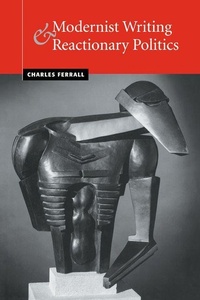
Modernist Writing and Reactionary Politics
Published on 1. October 2009
Book
Paperback/Softback
212 pages
978-0-521-12082-1 (ISBN)
Description
In Modernist Writing and Reactionary Politics, Charles Ferrall argues that the politics of Yeats, Pound, Eliot, Lawrence, and Wyndham Lewis were a response to the separation of art from an increasingly industrialised society. Fascism became attractive to these writers because it promised to reintegrate art into society while simultaneously guaranteeing its autonomy. Yet with the exception of Pound and Yeats, these writers all finally rejected fascism, preferring instead to see the aesthetic as a sphere in permanent opposition to liberal democracy, rather than the basis for a new social order. Individual chapters focus on Yeats and decolonisation, Pound and 'the Jews', Eliot and the uncanny, and Lawrence and homosexuality, and Lewis and the Cartesian primitive. Ferrall's account of why some of the greatest writers of the early twentieth century became involved in reactionary politics offers insights into the relation between modernist aesthetics, technology and avant-gardism.
Reviews / Votes
"This is a carefully researched, thoughtful exposition of the views of five influential modernists." Modernism/Modernity 11/01More details
Language
English
Place of publication
Cambridge
United Kingdom
Target group
Professional and scholarly
Product notice
Paperback (trade)
Illustrations
Worked examples or Exercises
Dimensions
Height: 229 mm
Width: 152 mm
Thickness: 13 mm
Weight
352 gr
ISBN-13
978-0-521-12082-1 (9780521120821)
Copyright in bibliographic data and cover images is held by Nielsen Book Services Limited or by the publishers or by their respective licensors: all rights reserved.
Schweitzer Classification
Person
Content
Acknowledgements; Introduction; 1. W. B. Yeats and the family romance of Irish Nationalism; 2. Ezra Pound and the poetics of literalism; 3. 'Neither Living nor Dead': T. S. Eliot and the uncanny; 4. The homosocial and Fascism in D. H. Lawrence; 5. 'Always a Deux': Wyndham Lewis and his doubles; Notes; Works cited; Index.