

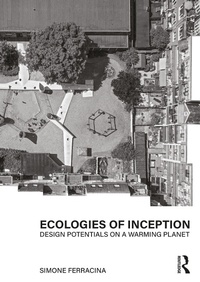
Ecologies of Inception
Design Potentials on a Warming Planet
1st Edition
Published on 31. May 2022
Book
Paperback/Softback
300 pages
978-0-367-85876-6 (ISBN)
Description
Responding to increasing levels of planetary pollution, waste generation, carbon dioxide emission and environmental collapse, Ecologies of Inception re-thinks potentiality-an object's ability to change-in architecture and design.
The book problematizes the still-prevailing modern paradigm of design practice: the technical tabula rasa, a tendency to begin from scratch and use raw, amorphous, and obedient materials that can be easily and effectively manipulated, facilitating a seamless and faithful embodiment of intentions. Instead, the philosophy of design developed in the text prompts-through a variety of case studies, thinkers, and disciplines-a collective reconsideration of value, dissociating it from the projects and signatures of any one author or generation. Whereas the merits of up-cycling and circular design are canonically defined vis-a-vis status-quo economic and socio-cultural orthodoxies, this project unpacks the theoretical assumptions that underpin these practices, showing that they perpetuate the same biases and exclusions that generate waste in the first place.
As an alternative, the book introduces a nodal and exaptive paradigm for design: a conceptual and methodological toolset for engaging the durational and anthropocenic materiality of the third millennium, and for radically prioritizing practices of maintenance, reuse, care, and co-option. This approach, which is inspired by (and builds upon) evolutionary biology, technological disobedience, queer use, adaptive reuse, experimental preservation, and improvisational practices such as collage, adhocism, bricolage, and kit-bashing, refuses to reduce pre-existing material substrates to abstract lists of properties or featureless lumps, encountering them on their own terms-as situated individuals and co-authors.
Ecologies of Inception will appeal to undergraduate and postgraduate students, educators, and professional architects and designers interested in sustainable design and seeking to develop conceptual and design tools commensurate with the magnitude and urgency of the climate emergency.
The book problematizes the still-prevailing modern paradigm of design practice: the technical tabula rasa, a tendency to begin from scratch and use raw, amorphous, and obedient materials that can be easily and effectively manipulated, facilitating a seamless and faithful embodiment of intentions. Instead, the philosophy of design developed in the text prompts-through a variety of case studies, thinkers, and disciplines-a collective reconsideration of value, dissociating it from the projects and signatures of any one author or generation. Whereas the merits of up-cycling and circular design are canonically defined vis-a-vis status-quo economic and socio-cultural orthodoxies, this project unpacks the theoretical assumptions that underpin these practices, showing that they perpetuate the same biases and exclusions that generate waste in the first place.
As an alternative, the book introduces a nodal and exaptive paradigm for design: a conceptual and methodological toolset for engaging the durational and anthropocenic materiality of the third millennium, and for radically prioritizing practices of maintenance, reuse, care, and co-option. This approach, which is inspired by (and builds upon) evolutionary biology, technological disobedience, queer use, adaptive reuse, experimental preservation, and improvisational practices such as collage, adhocism, bricolage, and kit-bashing, refuses to reduce pre-existing material substrates to abstract lists of properties or featureless lumps, encountering them on their own terms-as situated individuals and co-authors.
Ecologies of Inception will appeal to undergraduate and postgraduate students, educators, and professional architects and designers interested in sustainable design and seeking to develop conceptual and design tools commensurate with the magnitude and urgency of the climate emergency.
More details
Language
English
Place of publication
London
United Kingdom
Publishing group
Taylor & Francis Ltd
Target group
College/higher education
Illustrations
162 s/w Abbildungen, 141 s/w Photographien bzw. Rasterbilder, 21 s/w Zeichnungen
21 Line drawings, black and white; 141 Halftones, black and white; 162 Illustrations, black and white
Dimensions
Height: 174 mm
Width: 245 mm
Thickness: 20 mm
Weight
682 gr
ISBN-13
978-0-367-85876-6 (9780367858766)
Copyright in bibliographic data and cover images is held by Nielsen Book Services Limited or by the publishers or by their respective licensors: all rights reserved.
Schweitzer Classification
Other editions
Additional editions
Book
05/2022
1st Edition
Routledge
€179.81
Shipment within 15-20 days
E-Book
05/2022
1st Edition
Routledge
€49.99
Available for download
Person
Simone Ferracina is the founding director of Exaptive Design Office (EDO) and a Lecturer in Architectural Design/Detail at the Edinburgh School of Architecture and Landscape Architecture (ESALA), The University of Edinburgh.
Content
I. Introduction: Tampering with Design Potentials on a Warming Planet PART I: TABULA RASA 1. Ecologies of Inception: Orientation of Designed Objects 2. Hylomorphism Reconsidered: Matter, Form, and the Ability to Change PART II: HYPERMATERIALS 3. Purity beyond Nature and Culture: Wildfires, Hypermaterials, and Co-option 4. Circularities: Technical Nutrients, Hyperobjects, and Rooms PART III: AUTHORSHIP 5. Rasura Tabulae: From Formats to Media 6. Ecologies of Suspension: Potentiality without Intentions/Relations 7. Exaptive Design: Radical Coauthorship as Method 8. Authorship vs. Withdrawal: OOO and Architecture 9. Conclusion Bibliography Index