

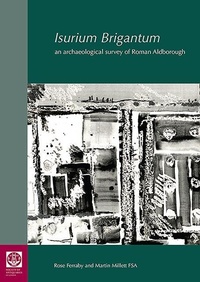
Isurium Brigantum
An Archaeological Survey of Roman Aldborough
Published on 13. April 2020
Book
Hardback
208 pages
978-0-85431-301-3 (ISBN)
Description
Modern-day Aldborough, in North Yorkshire, lies on the site of Isurium Brigantum, the former administrative capital of the Brigantes, one of the largest indigenous tribes of Roman Britain. Strategically located on Dere Street, by the second century AD it had become a key Roman town engaged with the supply of the northern frontier, with buildings and mosaics that reveal a thriving economy through to the fourth century. In the eighteenth and nineteenth centuries, the site of Isurium Brigantum was the subject of important antiquarian investigations. However, unlike some southern counterparts - for example, Calleva Atrebatum or Verulamium - in the twentieth century it attracted less archaeological attention until, in 2009, a team of archaeologists led by Dr Rose Ferraby and Professor Martin Millett began a major re-examination of the site. Large-scale geophysical surveys using both gradiometry and high-resolution ground-penetrating radar were conducted and these revealed most of the town and its surroundings, allowing its development from the second century AD to the medieval period to be mapped with great accuracy.
Bringing together for the first time the results of large-scale geophysical surveys of Isurium Brigantum with a re-evaluation of earlier antiquarian study and more recent archaeological fieldwork and excavations - some never before published - providing provides historians and archaeologists with exciting new information about the topography of a key Roman town engaged with the supply of the northern frontier of Britain, and about its development and later landscape, together with a thorough review of the town in the broader context of Roman Britain and the western Empire.
Bringing together for the first time the results of large-scale geophysical surveys of Isurium Brigantum with a re-evaluation of earlier antiquarian study and more recent archaeological fieldwork and excavations - some never before published - providing provides historians and archaeologists with exciting new information about the topography of a key Roman town engaged with the supply of the northern frontier of Britain, and about its development and later landscape, together with a thorough review of the town in the broader context of Roman Britain and the western Empire.
Reviews / Votes
The importance of the results, the clarity of thought and expression, and quality of production should garner this volume a wide readership across specialists and non-specialists alike. * Archaeological Journal * The book contains much scholarly discussion of the evidence and the competing interpretations, integrated with the broader history of Roman Britain. It is also highly readable, lavishly illustrated with photographs and plans. It will appeal to general readers, as well as specialists in the field. * ClassicsForAll *More details
Language
English
Place of publication
London
United Kingdom
Target group
Professional and scholarly
Illustrations
110
Dimensions
Height: 218 mm
Width: 304 mm
Thickness: 20 mm
Weight
1142 gr
ISBN-13
978-0-85431-301-3 (9780854313013)
Copyright in bibliographic data and cover images is held by Nielsen Book Services Limited or by the publishers or by their respective licensors: all rights reserved.
Schweitzer Classification
Persons
Dr Rose Ferraby is interested in the relationships we have with landscape. She works as an archaeologist, artist and cultural geologist, using these different approaches to explore and narrate sub-surface worlds. She is currently a Research Associate in the Faculty of Classics, at the University of Cambridge. As well as academic publications, Rose has worked on books of poetry and print, as well as writing and presenting for BBC Radio 3's 'The Essay'. Rose grew up on the edge of Aldborough, the Roman remains inspiring her future career.
Professor Martin Millett is an archaeologist whose principal research interests lie in the social and economic archaeology of Italy and the western Roman Empire. He has published widely on this subject, and has led archaeological surveys and excavations in Britain, Spain, Portugal and Italy. He is currently Laurence Professor of Classical Archaeology at the University of Cambridge and was previously Professor of Archaeology at Durham and Southampton universities. He has been the Director and the Treasurer of the Society of Antiquaries of London, and Vice-President of the British Academy.
Professor Martin Millett is an archaeologist whose principal research interests lie in the social and economic archaeology of Italy and the western Roman Empire. He has published widely on this subject, and has led archaeological surveys and excavations in Britain, Spain, Portugal and Italy. He is currently Laurence Professor of Classical Archaeology at the University of Cambridge and was previously Professor of Archaeology at Durham and Southampton universities. He has been the Director and the Treasurer of the Society of Antiquaries of London, and Vice-President of the British Academy.
Content
List of figures
Preface
Resume
Zusammenfassung
Acknowledgements
Notes on referencing and archives
Chapter 1: Introduction
Background to this study
Geographical setting
Historical background
Previous inferences on urban origins
Textual evidence
History of the town
Previous archaeological work
Organisation of this volume
Chapter 2: Previous antiquarian and archaeological work
Knowledge up to the mid eighteenth century
The later eighteenth century
The first half of the nineteenth century
From the 1850s to the 1920s
Excavations of the 1920s and 1930s
The 1940s to the 1980s
The 1990s onwards
Chapter 3: The geophysical surveys
Introduction
Methodology
Presentation of the results
Area 1: North-western intra-mural area
Area 2: North-eastern intra-mural area
Note on terracing in the southern half of the town
Area 3: Central intra-mural strip
Area 4: South-western intra-mural area
Area 5: South-eastern intra-mural area
Area 6: South-eastern extra-mural area
Area 7: Eastern extra-mural area
Area 8: South-eastern extra-mural area
Area 9: Northern extra-mural area
Area 10: Northern extra-mural area beside the river
Area 11: The northern bridgehead
Area 12: The western extra-mural area
Area 13: The south-western extra-mural area
Chapter 4: Re-evaluating the history of Isurium Brigantum
The Iron Age background
The Roecliffe fort
Earliest activity on the site of Aldborough
Town planning
The forum and the establishment of the civitas
The Town Wall
The character of the early to mid Roman town
The development of the extra-mural areas
The later Town Wall and annexes
The later Roman townscape
The transition to the Middle Ages
Epilogue: history, antiquarian development and landscape
Appendix 1: Gazetteer of archaeological interventions
Appendix 2: Concordance with RIB
Appendix 3: Concordance with CSIR
Appendix 4: Architectural stonework
Appendix 5: Stone altars
Notes
Abbreviations and bibliography
Index
Preface
Resume
Zusammenfassung
Acknowledgements
Notes on referencing and archives
Chapter 1: Introduction
Background to this study
Geographical setting
Historical background
Previous inferences on urban origins
Textual evidence
History of the town
Previous archaeological work
Organisation of this volume
Chapter 2: Previous antiquarian and archaeological work
Knowledge up to the mid eighteenth century
The later eighteenth century
The first half of the nineteenth century
From the 1850s to the 1920s
Excavations of the 1920s and 1930s
The 1940s to the 1980s
The 1990s onwards
Chapter 3: The geophysical surveys
Introduction
Methodology
Presentation of the results
Area 1: North-western intra-mural area
Area 2: North-eastern intra-mural area
Note on terracing in the southern half of the town
Area 3: Central intra-mural strip
Area 4: South-western intra-mural area
Area 5: South-eastern intra-mural area
Area 6: South-eastern extra-mural area
Area 7: Eastern extra-mural area
Area 8: South-eastern extra-mural area
Area 9: Northern extra-mural area
Area 10: Northern extra-mural area beside the river
Area 11: The northern bridgehead
Area 12: The western extra-mural area
Area 13: The south-western extra-mural area
Chapter 4: Re-evaluating the history of Isurium Brigantum
The Iron Age background
The Roecliffe fort
Earliest activity on the site of Aldborough
Town planning
The forum and the establishment of the civitas
The Town Wall
The character of the early to mid Roman town
The development of the extra-mural areas
The later Town Wall and annexes
The later Roman townscape
The transition to the Middle Ages
Epilogue: history, antiquarian development and landscape
Appendix 1: Gazetteer of archaeological interventions
Appendix 2: Concordance with RIB
Appendix 3: Concordance with CSIR
Appendix 4: Architectural stonework
Appendix 5: Stone altars
Notes
Abbreviations and bibliography
Index