

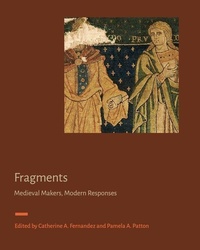
Fragments
Medieval Makers, Modern Responses
Will be published approx. on 13. January 2026
Book
Hardback
180 pages
978-0-271-10002-9 (ISBN)
Description
Fragments are central to the work of medievalists. Whether caused by destruction, decay, or the loss of context, fragmentation shapes how scholars reconstruct and interpret the Middle Ages. In the study of medieval visual culture especially, fragments evoke lost monuments, damaged manuscripts, and vanished rituals-yet their evidentiary role is often overlooked or assumed rather than critically examined.
This volume brings together seven essays that examine the risks and rewards of working with fragments in the study of medieval culture. Developed from a scholarly conference at the Index of Medieval Art, the chapters examine how incomplete material, pictorial, textual, ritual, and conceptual objects have been interpreted, reconstructed, or newly understood over time. Topics include the medieval reframing of earlier fragments, the politically motivated interpretation of fragments to rewrite a lost past or fabricate a new future, market-driven deceptions of the consumer, and the challenges of decoding how fragments of all kinds speak to those who view and study them today.
A valuable resource for scholars of medieval art, history, and material culture, this collection addresses the fundamental methodological challenges of studying the Middle Ages through incomplete evidence. Offering fresh insights into how fragments are perceived and repurposed across time, it encourages critical reflection on the fragment as both obstacle and opportunity in reconstructing medieval worlds.
In addition to the editors, the contributors include Patricia Blessing, William Diebold, Shirin Fozi, Silvia Gianolio, Gregor Kalas, Henry David Schilb, and Susanne Wittekind.
This volume brings together seven essays that examine the risks and rewards of working with fragments in the study of medieval culture. Developed from a scholarly conference at the Index of Medieval Art, the chapters examine how incomplete material, pictorial, textual, ritual, and conceptual objects have been interpreted, reconstructed, or newly understood over time. Topics include the medieval reframing of earlier fragments, the politically motivated interpretation of fragments to rewrite a lost past or fabricate a new future, market-driven deceptions of the consumer, and the challenges of decoding how fragments of all kinds speak to those who view and study them today.
A valuable resource for scholars of medieval art, history, and material culture, this collection addresses the fundamental methodological challenges of studying the Middle Ages through incomplete evidence. Offering fresh insights into how fragments are perceived and repurposed across time, it encourages critical reflection on the fragment as both obstacle and opportunity in reconstructing medieval worlds.
In addition to the editors, the contributors include Patricia Blessing, William Diebold, Shirin Fozi, Silvia Gianolio, Gregor Kalas, Henry David Schilb, and Susanne Wittekind.
More details
Series
Language
English
Place of publication
University Park
United States
Target group
College/higher education
Product notice
sewn/stitched
Illustrations
42 Halftones, color; 27 Halftones, black and white
Dimensions
Height: 210 mm
Width: 263 mm
Thickness: 18 mm
Weight
890 gr
ISBN-13
978-0-271-10002-9 (9780271100029)
Copyright in bibliographic data and cover images is held by Nielsen Book Services Limited or by the publishers or by their respective licensors: all rights reserved.
Schweitzer Classification
Persons
Catherine A. Fernandez is Art History Specialist at the Index of Medieval Art at Princeton University. She is coeditor, along with Pamela A. Patton, of Iconography Beyond the Crossroads: Image, Meaning, and Method in Medieval Art, also co-published by Penn State University Press and the Princeton Index of Medieval Art.
Pamela A. Patton is Director of the Index of Medieval Art at Princeton University. She is the author of Art of Estrangement: Redefining Jews in Reconquest Spain, also published by Penn State University Press.
Pamela A. Patton is Director of the Index of Medieval Art at Princeton University. She is the author of Art of Estrangement: Redefining Jews in Reconquest Spain, also published by Penn State University Press.