

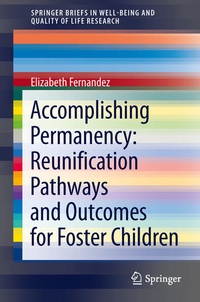
Accomplishing Permanency: Reunification Pathways and Outcomes for Foster Children
1st Edition
Published on 7. September 2012
Book
Paperback/Softback
XIV, 154 pages
978-94-007-5091-3 (ISBN)
Description
Reunification is a primary goal of foster care systems and the most common permanency planning decision. It is defined as the return of children placed in protective care to the home of their birth family and used to describe the act of restoring a child in out-of-home care back to the biological family. Yet reunification decision-making and the process of reintegrating children into birth families remains under researched.
This Brief takes a look at family reunification knowledge and research in Australia where there is evidence that most children placed in protective care are eventually reunited with their birth parents. It explores how a knowledge of reunification decision making and outcomes can contribute to strengthening practice and informing policy formulation and program planning in Child Welfare.
More details
Series
Language
English
Place of publication
Dordrecht
Netherlands
Target group
Professional and scholarly
Research
Illustrations
24 s/w Abbildungen
XIV, 154 p. 24 illus.
Dimensions
Height: 235 mm
Width: 155 mm
Thickness: 10 mm
Weight
265 gr
ISBN-13
978-94-007-5091-3 (9789400750913)
DOI
10.1007/978-94-007-5092-0
Schweitzer Classification
Other editions
Additional editions
Elizabeth Fernandez
Accomplishing Permanency: Reunification Pathways and Outcomes for Foster Children
E-Book
09/2012
1st Edition
Springer
€53.49
Available for download
Content
Chapter 1 - Introduction.-
Chapter 2 - Characteristics of parents and children.-
Chapter 3 - Reasons for children entering care.-
Chapter 4 - Assessment and intervention.-
Chapter 5 - Case plans and care management.- Chapter 6 - Care patterns and outcomes .-
Chapter 7 - Contact.-
Chapter 8 - Decisions about reunification and interventions to support children and families.-
Chapter 9 - The carers' contribution and experience.-
Chapter 10 - Parental perspectives.-
Chapter 11 - Conclusion: gaining an understanding of pre and post intervention characteristics.