

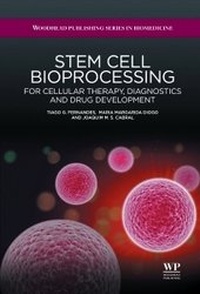
Stem Cell Bioprocessing
For Cellular Therapy, Diagnostics and Drug Development
Published on 31. October 2013
Book
Hardback
236 pages
978-1-907568-88-6 (ISBN)
Description
Stem cell bioprocessing describes the main large-scale bioprocessing strategies for both stem cell culture and purification, envisaging the application of these cells for regenerative medicine and drug screening. Bioreactor configurations are described, including their applications for stem cell expansion, and stem cell separation techniques such as isolation and purification are discussed. Basic definitions are provided concerning the different types of stem cells, from adult stem cells to the more recent induced pluripotent stem cells. The main characteristics of these different stem cell types are described, alongside the molecular mechanisms underlying their self-renewal and differentiation. The book also focuses on methodologies currently used for in vitro stem cell culture under static conditions, including the challenge of xeno-free culture conditions, as well as culture parameters that influence stem cell culture. Approaches for both stem cell culture and separation in micro-scale conditions are presented, including the use of cellular microarrays for high-throughput screening of the effect of both soluble and extracellular matrix molecules. A further section is dedicated to application of stem cells for regenerative medicine.
Reviews / Votes
"This book offers an interesting review of the current research and advances in the field of stem cell biology. It focuses on unique and complex requirements and challenges of stem cell culture and seems to target audience of stem cell researchers, but the well-written introduction to basic stem cell biology makes it accessible to a wider audience." --Doody.com, January 3, 2014More details
Series
Language
English
Place of publication
Cambridge
United Kingdom
Publishing group
Elsevier Science & Technology
Target group
College/higher education
Professional and scholarly
Dimensions
Height: 234 mm
Width: 156 mm
Weight
510 gr
ISBN-13
978-1-907568-88-6 (9781907568886)
Copyright in bibliographic data and cover images is held by Nielsen Book Services Limited or by the publishers or by their respective licensors: all rights reserved.
Schweitzer Classification
Other editions
Additional editions
Tiago Fernandes | Maria Margarida Diogo | Joaquim M. S. Cabral
Stem Cell Bioprocessing
For Cellular Therapy, Diagnostics and Drug Development
E-Book
10/2013
Woodhead Publishing Ltd
€149.00
Available for download
Persons
Dr Tiago G. Fernandes is currently a Post-doctoral research fellow at the Institute for Biotechnology and Bioengineering, Lisbon, Portugal. His research interests are focused on the development of artificial cellular niches for studying the mechanisms that affect human stem cell pluripotency, and the cellular and molecular events that regulate stem cell functions. During his doctoral studies he also worked at the Rensselaer Polytechnic Institute, NY, USA, in the development of microscale platforms for high-throughput studies of stem cell fate. Dr Maria Margarida Diogo received her PhD degree in Biotechnology from Instituto Superior Tecnico (IST) from January 2000 to April 2004. Her thesis was dedicated to the development of Bioprocesses for Production and Purification of Plasmid DNA for Gene Therapy and DNA vaccines. As a result of this work, a United States Patent was published in 2007. From April 2004 to March 2008 she received a post-doctoral fellowship to work in the field of Stem Cell Bioengineering and she is presently a Research Scientist at the Stem Cell Bioengineering Laboratory at Instituto Superior Tecnico (IST). Dr Joaquim M. S. Cabral is Professor of Biological Engineering, in the Department of Bioengineering at Instituto Superior Tecnico (IST), Technical University of Lisbon, Portugal. He was the founder and current Head of Department of Bioengineering, and the Director of the Institute for Biotechnology and Bioengineering, a Research Laboratory Associated to the Ministry of Science, Technology and Higher Education in Portugal. His research aims at contributing to biochemical engineering science through novel developments in Bioprocess Engineering and Stem Cell Bioengineering.
Author
Post-doctoral Research Fellow, Institute for Biotechnology and Bioengineering, Lisbon, Portugal
Stem Cell Bioengineering Laboratory, Instituto Superior Tecnico (IST), Technical University of Lisbon, Portugal
Professor of Biological Engineering, Department of Bioengineering and Institute for Bioengineering and Biosciences, Instituto Superior Tecnico, University of Lisbon, Portugal
Content
List of figures
List of tables
Acknowledgments
About the authors
Chapter 1: Characteristics of stem cells
Abstract:
1.1 Introduction
1.2 Stem cell specialization
1.3 Stem cell types and functions
1.4 Signaling dynamics and stem cell pluripotency
1.5 Novel technologies and clinical applications
1.6 References
Chapter 2: Stem cell culture: mimicking the stem cell niche in vitro
Abstract:
2.1 Introduction
2.2 Stem cell niches
2.3 Niche components and structures
2.4 Engineering the microenvironment
2.5 Conclusions and future directions
2.6 References
Chapter 3: Bioreactors for stem cell culture
Abstract:
3.1 Introduction
3.2 Stem cell isolation and characterization
3.3 Critical issues in stem cell bioprocess development
3.4 Bioreactor design and operation
3.5 Bioreactor configurations
3.6 Bioprocess monitoring and control
3.7 Stem cell cultivation in bioreactors
3.8 Conclusions and final remarks
3.9 References
Chapter 4: Stem cell separation
Abstract:
4.1 Introduction
4.2 Overview of cell separation techniques and strategies
4.3 Stem cell-based separation methods
4.4 Conclusions and future trends
4.5 References
Chapter 5: Microscale technologies for stem cell culture
Abstract:
5.1 Introduction
5.2 Types of microscale technologies
5.3 Microscale platforms for cell culture
5.4 High-throughput and combinatorial screening applications
5.5 Stem cell research
5.6 Conclusions and future trends
5.7 References
Chapter 6: Stem cells and regenerative medicine
Abstract:
6.1 Introduction
6.2 Sources of cells for regenerative medicine
6.3 Cell processing for regenerative medicine: regulatory guidelines
6.4 Regenerative medicine and cellular therapy applications
6.5 Conclusions and future developments
6.6 References
Conclusions
7.1 Concluding comments
7.2 References
Index
List of tables
Acknowledgments
About the authors
Chapter 1: Characteristics of stem cells
Abstract:
1.1 Introduction
1.2 Stem cell specialization
1.3 Stem cell types and functions
1.4 Signaling dynamics and stem cell pluripotency
1.5 Novel technologies and clinical applications
1.6 References
Chapter 2: Stem cell culture: mimicking the stem cell niche in vitro
Abstract:
2.1 Introduction
2.2 Stem cell niches
2.3 Niche components and structures
2.4 Engineering the microenvironment
2.5 Conclusions and future directions
2.6 References
Chapter 3: Bioreactors for stem cell culture
Abstract:
3.1 Introduction
3.2 Stem cell isolation and characterization
3.3 Critical issues in stem cell bioprocess development
3.4 Bioreactor design and operation
3.5 Bioreactor configurations
3.6 Bioprocess monitoring and control
3.7 Stem cell cultivation in bioreactors
3.8 Conclusions and final remarks
3.9 References
Chapter 4: Stem cell separation
Abstract:
4.1 Introduction
4.2 Overview of cell separation techniques and strategies
4.3 Stem cell-based separation methods
4.4 Conclusions and future trends
4.5 References
Chapter 5: Microscale technologies for stem cell culture
Abstract:
5.1 Introduction
5.2 Types of microscale technologies
5.3 Microscale platforms for cell culture
5.4 High-throughput and combinatorial screening applications
5.5 Stem cell research
5.6 Conclusions and future trends
5.7 References
Chapter 6: Stem cells and regenerative medicine
Abstract:
6.1 Introduction
6.2 Sources of cells for regenerative medicine
6.3 Cell processing for regenerative medicine: regulatory guidelines
6.4 Regenerative medicine and cellular therapy applications
6.5 Conclusions and future developments
6.6 References
Conclusions
7.1 Concluding comments
7.2 References
Index