

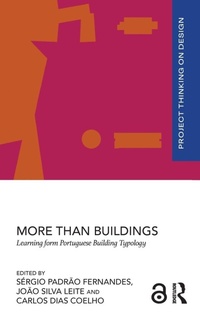
More than Buildings
Learning from Portuguese Building Typology
1st Edition
Published on 3. February 2025
Book
Hardback
216 pages
978-1-032-80078-3 (ISBN)
Description
More than Buildings studies the buildings typology in Portuguese cities and their relationship with the program (the way in which it responds to a function), the territory where it is integrated and with time and the way in which built forms evolve.
The book is structured around a set of key theoretical texts that highlight the potential of knowledge about typology (and its specific formal characteristics) in the production of new architectural objects. In this sense, the book has a didactic value based on the theoretical synthesis it produces, which allows it to expose certain spatial and formal attributes of the typologies and thus constitute a reference for new processes of architectural production. The method of analysis and decomposition of the case studies presented in each chapter provide a useful reading and interpretation key for different readers. The typology should be understood as a reference in the act of designing, demonstrating how to understand the elementary formal and spatial principles. For the municipal authorities, or other political decision-makers, the book will enable them to interpret the value of typology and its relevance in the production of cities. This data could be useful, for example, in planning actions that aim at preserving or converting urban areas of architectural value.
The book will be relevant to readers within an academic framework and in the professional field engaged in work around architecture, cities, planning, and conservation.
The book is structured around a set of key theoretical texts that highlight the potential of knowledge about typology (and its specific formal characteristics) in the production of new architectural objects. In this sense, the book has a didactic value based on the theoretical synthesis it produces, which allows it to expose certain spatial and formal attributes of the typologies and thus constitute a reference for new processes of architectural production. The method of analysis and decomposition of the case studies presented in each chapter provide a useful reading and interpretation key for different readers. The typology should be understood as a reference in the act of designing, demonstrating how to understand the elementary formal and spatial principles. For the municipal authorities, or other political decision-makers, the book will enable them to interpret the value of typology and its relevance in the production of cities. This data could be useful, for example, in planning actions that aim at preserving or converting urban areas of architectural value.
The book will be relevant to readers within an academic framework and in the professional field engaged in work around architecture, cities, planning, and conservation.
More details
Series
Language
English
Place of publication
London
United Kingdom
Publishing group
Taylor & Francis Ltd
Target group
College/higher education
Postgraduate and Undergraduate Advanced
Illustrations
51 s/w Zeichnungen, 84 s/w Abbildungen, 33 s/w Photographien bzw. Rasterbilder
51 Line drawings, black and white; 33 Halftones, black and white; 84 Illustrations, black and white
Dimensions
Height: 240 mm
Width: 161 mm
Thickness: 17 mm
Weight
517 gr
ISBN-13
978-1-032-80078-3 (9781032800783)
Copyright in bibliographic data and cover images is held by Nielsen Book Services Limited or by the publishers or by their respective licensors: all rights reserved.
Schweitzer Classification
Other editions
Additional editions
Sergio Padrao Fernandes | Joao Silva Leite | Carlos Dias Coelho
More than Buildings
Learning from Portuguese Building Typology
Book
approx. 07/2026
1st Edition
Routledge
€57.00
Not yet published
Sergio Padrao Fernandes | Joao Silva Leite | Carlos Dias Coelho
More than Buildings
Learning from Portuguese Building Typology
E-Book
02/2025
Routledge
€0.00
Available for download
Sergio Padrao Fernandes | Joao Silva Leite | Carlos Dias Coelho
More than Buildings
Learning from Portuguese Building Typology
E-Book
02/2025
Routledge
€0.00
Available for download
Persons
Sergio Padrao Fernandes is an Architect and an Associate Professor at the Lisbon School of Architecture, and an integrated researcher of CIAUD. He is also a founding member of formaurbis LAB. He was awarded, 2008, with prize of the Portuguese Academy of Fine Arts.
Joao Silva Leite is an architect with a PhD in Urbanism from the University of Lisbon, with the thesis "Emergent Streets" funded by FCT (2011-2014) and by AUSMIP Plus international program (2015, fellow at University of Tokyo). He is Assistant Professor at Lisbon School of Architecture and member of formaurbis LAB/CIAUD. In 2014 he was awarded in IX BIAU, best master thesis.
Carlos Dias Coelho has a PhD in Urban Planning and is Full Professor in Architecture and Urbanism at the Lisbon School of Architecture, where he funded and coordinates the research group formaurbis LAB and was Dean from 2019 to 2024. He was invited professor at the ESAP-La Villette (Paris), at ETSAB/ UPC (Barcelona), Universite Laval (Quebec) and he is Fellow of the University of Tokyo.
Joao Silva Leite is an architect with a PhD in Urbanism from the University of Lisbon, with the thesis "Emergent Streets" funded by FCT (2011-2014) and by AUSMIP Plus international program (2015, fellow at University of Tokyo). He is Assistant Professor at Lisbon School of Architecture and member of formaurbis LAB/CIAUD. In 2014 he was awarded in IX BIAU, best master thesis.
Carlos Dias Coelho has a PhD in Urban Planning and is Full Professor in Architecture and Urbanism at the Lisbon School of Architecture, where he funded and coordinates the research group formaurbis LAB and was Dean from 2019 to 2024. He was invited professor at the ESAP-La Villette (Paris), at ETSAB/ UPC (Barcelona), Universite Laval (Quebec) and he is Fellow of the University of Tokyo.
Content
List of figures
List of contributors
Acknowledgements
Introduction
Sergio Padrao Fernandes, Joao Silva Leite, Carlos Dias Coelho
1. The invention of an Atlas of buildings
Carlos Dias Coelho
Part I . PROGRAMME
2. Urban Blocks made up by Collective Housing
Rui Justo
3. Churches. Portuguese 16th-18th Century Uncanny buildings: Rules and Exceptions
Paulo Pereira
4. Agricultural Support Units: Buildings to Structure the Rural Territory
Gilberto Carlos
Part II . CONTEXT
5. Urban Buildings!
Sergio Padrao Fernandes
6. Passage Buildings. An interface to intimacy.
Joao Silva Leite
7. Infrastructure steps in the city.
Pablo Villalonga Munar
Part III . TIME
8. Convents reUsed. Three transformation processes
Miguel Freitas Silva
9. An imPerfect Buildings. Espirito Santo Hospital in Evora.
Pedro Martins
10. Ruinology. About wrecks, ruins and forms in industrial decommissioned buildings
Stefanos Antoniadis
11. Buildings Metabolism. From pre-existence to urban regeneration.
Julia Beltran Borras
Trajectories
Carlos Dias Coelho, Sergio Padrao Fernandes, Joao Silva Leite
Index
List of contributors
Acknowledgements
Introduction
Sergio Padrao Fernandes, Joao Silva Leite, Carlos Dias Coelho
1. The invention of an Atlas of buildings
Carlos Dias Coelho
Part I . PROGRAMME
2. Urban Blocks made up by Collective Housing
Rui Justo
3. Churches. Portuguese 16th-18th Century Uncanny buildings: Rules and Exceptions
Paulo Pereira
4. Agricultural Support Units: Buildings to Structure the Rural Territory
Gilberto Carlos
Part II . CONTEXT
5. Urban Buildings!
Sergio Padrao Fernandes
6. Passage Buildings. An interface to intimacy.
Joao Silva Leite
7. Infrastructure steps in the city.
Pablo Villalonga Munar
Part III . TIME
8. Convents reUsed. Three transformation processes
Miguel Freitas Silva
9. An imPerfect Buildings. Espirito Santo Hospital in Evora.
Pedro Martins
10. Ruinology. About wrecks, ruins and forms in industrial decommissioned buildings
Stefanos Antoniadis
11. Buildings Metabolism. From pre-existence to urban regeneration.
Julia Beltran Borras
Trajectories
Carlos Dias Coelho, Sergio Padrao Fernandes, Joao Silva Leite
Index