

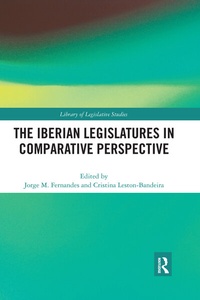
The Iberian Legislatures in Comparative Perspective
1st Edition
Published on 18. December 2020
Book
Paperback/Softback
272 pages
978-0-367-72906-6 (ISBN)
Description
This comprehensive book analyses the development of the legislatures in the Iberian countries over the past 40 years, since democracy was introduced, to comparatively understand their role in these political systems and in sustaining their democratic systems.
Sharing many historical developments and institutional characteristics, Spain and Portugal also present crucial differences, notably Spain's pure parliamentary system, a King as Head of State and a quasi-federal structure, and Portugal's semi-presidential democracy. Starting with a historical and institutional contextualization of these two legislatures, the book examines the most important organizational and behavioural features of legislative life in Iberian legislatures in a comparative perspective. It also shows how new legislatures develop resilience capacity to support lasting democratic systems as fully fledged institutionalized bodies.
This book will be of key interest to scholars and students of Spain and Portugal, legislative politics and parliamentarianism, and more broadly to European politics and comparative politics, journalists and practitioners.
Sharing many historical developments and institutional characteristics, Spain and Portugal also present crucial differences, notably Spain's pure parliamentary system, a King as Head of State and a quasi-federal structure, and Portugal's semi-presidential democracy. Starting with a historical and institutional contextualization of these two legislatures, the book examines the most important organizational and behavioural features of legislative life in Iberian legislatures in a comparative perspective. It also shows how new legislatures develop resilience capacity to support lasting democratic systems as fully fledged institutionalized bodies.
This book will be of key interest to scholars and students of Spain and Portugal, legislative politics and parliamentarianism, and more broadly to European politics and comparative politics, journalists and practitioners.
More details
Series
Language
English
Place of publication
London
United Kingdom
Publishing group
Taylor & Francis Ltd
Target group
College/higher education
Postgraduate and Undergraduate
Dimensions
Height: 234 mm
Width: 156 mm
Weight
550 gr
ISBN-13
978-0-367-72906-6 (9780367729066)
Copyright in bibliographic data and cover images is held by Nielsen Book Services Limited or by the publishers or by their respective licensors: all rights reserved.
Schweitzer Classification
Other editions
Additional editions
Jorge M. Fernandes | Cristina Leston-Bandeira
The Iberian Legislatures in Comparative Perspective
Book
05/2019
1st Edition
Routledge
€215.41
Shipment within 10-20 days
Jorge M. Fernandes | Cristina Leston-Bandeira
The Iberian Legislatures in Comparative Perspective
E-Book
05/2019
1st Edition
Routledge
€61.99
Available for download
Jorge M. Fernandes | Cristina Leston-Bandeira
The Iberian Legislatures in Comparative Perspective
E-Book
05/2019
1st Edition
Routledge
€61.99
Available for download
Persons
Jorge M. Fernandes is a Post-Doctoral Fellow at the Institute of Social Sciences, University of Lisbon, Portugal. His work has appeared, among others, in Comparative Political Studies, European Journal of Political Research, Legislative Studies Quarterly, and Party Politics. His research interests are representation, legislatures, political parties, electoral parties, and Portuguese politics. He has been a Visiting Scholar at the Center for European Studies, Harvard University and at UC San Diego.
Cristina Leston-Bandeira is a Professor of Politics at the University of Leeds, UK. She has worked on parliaments for over 20 years and is a key scholar on the Portuguese Parliament. She is Co-Director of the Centre for Democratic Engagement and the Chair of the UK Study of Parliament Group. She is also co-editor of the journal Parliamentary Affairs and a Constitution Unit Fellow.
Cristina Leston-Bandeira is a Professor of Politics at the University of Leeds, UK. She has worked on parliaments for over 20 years and is a key scholar on the Portuguese Parliament. She is Co-Director of the Centre for Democratic Engagement and the Chair of the UK Study of Parliament Group. She is also co-editor of the journal Parliamentary Affairs and a Constitution Unit Fellow.
Content
1. Introduction [Jorge M. Fernandes] Section I: Historical Background 2. The Portuguese Assembleia da Republica in Context [Eunice Goes and Cristina Leston-Bandeira] 3. The Spanish Parliament in Context [Bonnie N. Field and Caroline Gray] Section II: Internal Organization Structures 4. Parliamentary Party Groups in the Iberian Legislatures [Carlos Jalali and Juan Rodriguez Teruel] 5. Committee Systems in Portugal and Spain [Jorge M. Fernandes and Pedro Riera] Section III: Representation and Actors 6. Social Distance and Ideological Congruence between MPs and Citizens: Iberian Legislatures before and after the Great Recession [Andre Freire and Xavier Coller] 7. The Diversity Gap in the Portuguese and Spanish Parliaments: Descriptive Representation Through an Intersectional Perspective [Ana Espirito-Santo, Tania Verge, and Laura Morales] 8. Interest Groups in the Iberian Legislatures [Marco Lisi and Luz Munoz Marquez] 9. Iberian Citizens' Attitudes towards Parliament and Representation [Jose Santana-Pereira and Irene Martin] Section IV: Legislative Processes 10. The Legislative Role of Iberian Legislatures [Claudia Ribeiro, Mercedes Araujo and Sonia Rodrigues] 11. Parliamentary Accountability [Manuel Sanchez de Dios] Section V: Relations with Other Bodies 12. The Participation of the Spanish and the Portuguese Parliaments in the Activity of the European Union [Elviro Aranda Alvarez and Paulo Sande] 13. The Relationship between Regional and National Parliaments in Spain and Portugal [Pablo Onate and Ana M. Belchior] 14. Constitutional Courts and National Parliaments in Spain and Portugal [Nuno Garoupa, Joan Solanes Mullor, Teresa Violante] Conclusion [Jorge M. Fernandes]