

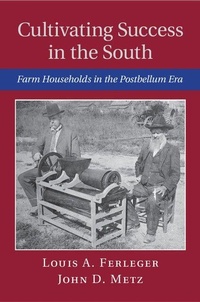
Cultivating Success in the South
Farm Households in the Postbellum Era
Published on 28. July 2014
Book
Hardback
214 pages
978-1-107-05411-0 (ISBN)
Description
This book explores changes in rural households of the Georgia Piedmont through the material culture of farmers as they transitioned from self-sufficiency to market dependence. The period between 1880 and 1910 was a time of dynamic change when Southern farmers struggled to reinvent their lives and livelihoods. Relying on primary documents, including probate inventories, tax lists, state and federal census data, and estate sale results, this study seeks to understand the variables that prompted farm households to assume greater risk in hopes of success as well as those factors that stood in the way of progress. While there are few projects of this type for the late nineteenth century, and fewer still for the New South, the findings challenge the notion of farmers as overly conservative consumers and call into question traditional views of conspicuous consumption as a key indicator of wealth and status.
Reviews / Votes
'Ferleger and Metz use an underutilized resource - probate records - to explain household-level production and consumption of yeoman farmers in three Georgia upcountry counties. They supplement probate data with census and Georgia tax data and tell a compelling story about how rural yeoman farmers faced economic and social challenges during the postbellum period. In doing so, they make a worthy contribution to the literature on subsistence farming and postbellum agriculture, introducing historians to a set of underutilized resources that offer details about household behaviors, production, and consumption.' Peggy Hargis, Georgia Southern University 'This engagingly written, deeply researched, and strongly argued work explores the economic context and material conditions of late nineteenth- and early twentieth-century Georgia farm families. Through a careful quantitative and descriptive analysis of probate, estate sale, and tax records from three Georgia counties, this book provides a rich portrait of the material lives of black and white farmers of middling rank in the New South period.' Louis Kyriakoudes, The University of Southern MississippiMore details
Series
Language
English
Place of publication
Cambridge
United Kingdom
Target group
Professional and scholarly
Illustrations
12 Halftones, unspecified
Dimensions
Height: 235 mm
Width: 157 mm
Thickness: 18 mm
Weight
518 gr
ISBN-13
978-1-107-05411-0 (9781107054110)
Copyright in bibliographic data and cover images is held by Nielsen Book Services Limited or by the publishers or by their respective licensors: all rights reserved.
Schweitzer Classification
Other editions
Additional editions
E-Book
07/2014
Cambridge University Press
€73.99
Available for download
Louis A. Ferleger | John D. Metz
Cultivating Success in the South
Farm Households in the Postbellum Era
E-Book
07/2014
1st Edition
Cambridge University Press
€73.99
Available for download
Persons
Louis Ferleger is Professor of History and chair of the History Department at Boston University. He is co-editor, co-author or editor of six books, including Agriculture and National Development: Views on the Nineteenth Century and Slavery, Secession, and Southern History. He is series editor of the Historians in Conversation series published by the University of South Carolina Press and has co-edited a special issue of The Annals devoted to globalization. He has been awarded many fellowships and grants, including two awards from the National Endowment for the Humanities, an Earhart Fellowship, and a Twentieth Century Fund research grant. John Metz is Director of Archives, Records and Collections at the Library of Virginia. He has more than twenty years of experience in historical research, education, collections management, and programming through his work as an archaeologist, historian and architectural historian for museums and cultural institutions, including the Colonial Williamsburg Foundation, Thomas Jefferson's Monticello, the Bermuda National Trust, and the Pamplin Historical Park and the National Museum of the Civil War Soldier. Metz has written and lectured extensively on Southern history, architecture, and material culture. He holds an MA in Anthropology from the College of William and Mary and a PhD in American Studies from Boston University.
Content
Introduction: contesting the myth of the backward Southern farmer; 1. Different crops, different cultures: the evolution of three Georgia counties; 2. Land, households, and race in the Georgia Piedmont: the big picture; 3. Production in the Piedmont: more than just cotton; 4. The material world of Piedmont farmers; 5. Investing for success in the Piedmont; Conclusion.