

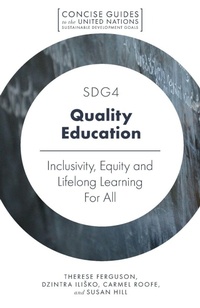
SDG4 - Quality Education
Inclusivity, Equity and Lifelong Learning For All
Published on 13. November 2018
Book
Paperback/Softback
144 pages
978-1-78769-426-2 (ISBN)
Description
Sustainable Development Goal 4 seeks to 'Ensure inclusive and equitable quality education for all and promote lifelong learning opportunities for all.' It acknowledges that quality education is a foundational necessity for sustainable development and an enhanced quality of life.
SDG4 - Quality Education: Inclusivity, Equity and Lifelong Learning For All explores the multifaceted and complex nature of the concepts of inclusivity and quality education. Drawing examples from two different country contexts (Latvia and Jamaica), the book explores how and why inclusive and quality education is critical to sustainable development. It considers the indicators of inclusive and quality education, how the concept of education for sustainable development is evolving, and the ways in which these indicators are being pursued. The book pays specific attention to the roles of teachers, teacher educators, and the curriculum in the attainment of inclusive and quality education and 21st Century skills for a sustainable society.
Concise Guides to the United Nations Sustainable Development Goals comprises 17 short books, each examining one of the UN Sustainable Development Goals. The series provides an integrated assessment of the SDGs from economic, legal, social, environmental and cultural perspectives.
SDG4 - Quality Education: Inclusivity, Equity and Lifelong Learning For All explores the multifaceted and complex nature of the concepts of inclusivity and quality education. Drawing examples from two different country contexts (Latvia and Jamaica), the book explores how and why inclusive and quality education is critical to sustainable development. It considers the indicators of inclusive and quality education, how the concept of education for sustainable development is evolving, and the ways in which these indicators are being pursued. The book pays specific attention to the roles of teachers, teacher educators, and the curriculum in the attainment of inclusive and quality education and 21st Century skills for a sustainable society.
Concise Guides to the United Nations Sustainable Development Goals comprises 17 short books, each examining one of the UN Sustainable Development Goals. The series provides an integrated assessment of the SDGs from economic, legal, social, environmental and cultural perspectives.
Reviews / Votes
This concise guide examines Sustainable Development Goal 4 (SDG4), which seeks to "ensure inclusive and equitable quality education and promote lifelong learning opportunities for all." It considers the goal in terms of sustainable development; mechanisms for monitoring the international education agenda to support attainment of the goal; the concepts of education, inclusivity, quality education, and education for sustainable development; the role of the conflict between Western scientific knowledge and indigenous or local knowledge; the role of teacher educators and teachers in the attainment of inclusive and quality education; the role of the curriculum in developing 21st-century skills for a sustainable society; and case studies of Latvia and Jamaica, to highlight the issues, complexities, and challenges involved in pursuing the goal. -- Annotation (c)2018 * (protoview.com) *More details
Series
Language
English
Place of publication
Bingley
United Kingdom
Target group
Professional and scholarly
Dimensions
Height: 198 mm
Width: 129 mm
Thickness: 8 mm
Weight
162 gr
ISBN-13
978-1-78769-426-2 (9781787694262)
Copyright in bibliographic data and cover images is held by Nielsen Book Services Limited or by the publishers or by their respective licensors: all rights reserved.
Schweitzer Classification
Other editions
Additional editions
Therese Ferguson | Dzintra Ilisko | Carmel Roofe
SDG4 - Quality Education
Inclusivity, Equity and Lifelong Learning For All
E-Book
11/2018
Emerald Publishing Limited
€44.99
Available for download
Persons
Therese Ferguson is a Lecturer in Education for Sustainable Development (ESD) in the School of Education at The University of the West Indies (Mona), Jamaica. Dzintra Ilisko is a Professor at Daugavpils University, Latvia, and Head of the Centre of Sustainable Education.
Carmel Roofe is a Teacher Educator and a Lecturer in Curriculum and Instruction at The University of the West Indies (Mona), Jamaica and a member of the ESD Working Group within the School of Education.
Susan Hill is a Management Consultant and Independent Researcher based in the United Kingdom. She is an expert in responsible and sustainable business, and pedagogic approaches to responsible management education.
Carmel Roofe is a Teacher Educator and a Lecturer in Curriculum and Instruction at The University of the West Indies (Mona), Jamaica and a member of the ESD Working Group within the School of Education.
Susan Hill is a Management Consultant and Independent Researcher based in the United Kingdom. She is an expert in responsible and sustainable business, and pedagogic approaches to responsible management education.
Content
Introduction Chapter 1. Monitoring the International Education Agenda
Chapter 2. Education
Chapter 3. Concepts of Inclusivity and Quality Education
Chapter 4. The Concept of Education for Sustainable Development
Chapter 5. Indigenous Knowledge, ESD, and Inclusivity
Chapter 6. The Role of Teacher Educators and Teachers in the Attainment of Inclusive and Quality Education
Chapter 7. The Role of the Curriculum in Developing 21st Century Skills for a Sustainable Society
Chapter 8. Case Studies
Conclusion
Chapter 2. Education
Chapter 3. Concepts of Inclusivity and Quality Education
Chapter 4. The Concept of Education for Sustainable Development
Chapter 5. Indigenous Knowledge, ESD, and Inclusivity
Chapter 6. The Role of Teacher Educators and Teachers in the Attainment of Inclusive and Quality Education
Chapter 7. The Role of the Curriculum in Developing 21st Century Skills for a Sustainable Society
Chapter 8. Case Studies
Conclusion