

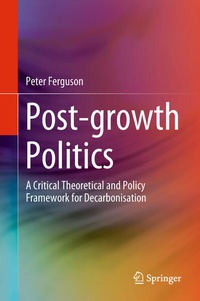
Post-growth Politics
A Critical Theoretical and Policy Framework for Decarbonisation
Published on 6. July 2018
Book
Hardback
XIII, 197 pages
978-3-319-78797-8 (ISBN)
Description
This book uses a critical political economy approach to develop an historically and politically grounded set of strategies for states to move toward a post-growth, decarbonised global economy. It begins by examining the social and ecological costs of and limits to economic growth and determines that significant decarbonisation of the global economy can only be achieved if conventional growth-based economies are replaced by an alternative post-growth economy.
Set apart from many other works in the field by its critical political economy approach to policy development, this book offers the reader three distinctive features. First, it places the analysis in historical context in order to demonstrate how the global political economy is constantly changing with respect to distributions of wealth, power and fundamental norms, and explores how states might harness and transform these contingent patterns in a post-growth direction. Second, the book is not only concerned with developing and advocating post-growth policies, but also with how these measures can be incorporated into the high-level domestic and international strategies pursued by states to ensure their political legitimacy and economic and geopolitical survival. Third, rather than proposing an idealised and politically naïve model of socioecological transformation, the proposed post-growth policy framework is highly cognisant of the geopolitical and international economic pressures facing states and demonstrates how these can be managed in the transition toward a post-growth economy.
This book represents an invaluable resource for policymakers, academics, activists and students wishing to study or contribute to the transition to a post-growth, decarbonised economy.
Set apart from many other works in the field by its critical political economy approach to policy development, this book offers the reader three distinctive features. First, it places the analysis in historical context in order to demonstrate how the global political economy is constantly changing with respect to distributions of wealth, power and fundamental norms, and explores how states might harness and transform these contingent patterns in a post-growth direction. Second, the book is not only concerned with developing and advocating post-growth policies, but also with how these measures can be incorporated into the high-level domestic and international strategies pursued by states to ensure their political legitimacy and economic and geopolitical survival. Third, rather than proposing an idealised and politically naïve model of socioecological transformation, the proposed post-growth policy framework is highly cognisant of the geopolitical and international economic pressures facing states and demonstrates how these can be managed in the transition toward a post-growth economy.
This book represents an invaluable resource for policymakers, academics, activists and students wishing to study or contribute to the transition to a post-growth, decarbonised economy.
More details
Edition
2018 ed.
Language
English
Place of publication
Cham
Switzerland
Publishing group
Springer International Publishing
Target group
Professional and scholarly
Illustrations
1 s/w Abbildung
XIII, 197 p. 1 illus.
Dimensions
Height: 241 mm
Width: 160 mm
Thickness: 18 mm
Weight
489 gr
ISBN-13
978-3-319-78797-8 (9783319787978)
DOI
10.1007/978-3-319-78799-2
Schweitzer Classification
Other editions
Additional editions
Book
12/2018
Springer
€106.99
Shipment within 7-9 days
E-Book
06/2018
1st Edition
Springer
€96.29
Available for download
Person
Dr Peter Ferguson is a Lecturer in Politics and Policy at Deakin University. His research focuses on the political barriers to moving toward a socially just and ecologically sustainable global economy.
Content
Introduction.- A brief history of the carbon economy.- Economic growth in a carbon constrained world.- Macroeconomic policy.- Microeconomic policy.- The scope and purpose of regulation.- Post-carbon geopolitics.- Conclusion.