

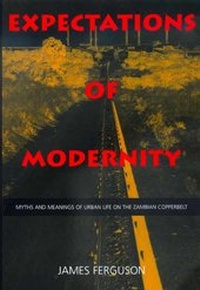
Expectations of Modernity
Myths and Meanings of Urban Life on the Zambian Copperbelt
1st Edition
Published on 1. October 1999
Book
Paperback/Softback
343 pages
978-0-520-21702-7 (ISBN)
Description
Once lauded as the wave of the African future, Zambia's economic boom in the 1960s and early 1970s was fueled by the export of copper and other primary materials. Since the mid-1970s, however, the urban economy has rapidly deteriorated, leaving workers scrambling to get by. "Expectations of Modernity" explores the social and cultural responses to this prolonged period of sharp economic decline. Focusing on the experiences of mineworkers in the Copperbelt region, James Ferguson traces the failure of standard narratives of urbanization and social change to make sense of the Copperbelt's recent history. He instead develops alternative analytic tools appropriate for an 'ethnography of decline'. Ferguson shows how the Zambian copper workers understand their own experience of social, cultural, and economic 'advance' and 'decline'. Ferguson's ethnographic study transports us into their lives - the dynamics of their relations with family and friends, as well as copper companies and government agencies.
Theoretically sophisticated and vividly written, "Expectations of Modernity" will appeal not only to those interested in Africa today, but to anyone contemplating the illusory successes of today's globalizing economy.
Theoretically sophisticated and vividly written, "Expectations of Modernity" will appeal not only to those interested in Africa today, but to anyone contemplating the illusory successes of today's globalizing economy.
Reviews / Votes
"Ferguson is an astute analyst of ideologies of development and the misunderstandings they can generate." * Foreign Affairs * "Ferguson presents a set of stimulating and important theoretical ideas." * American Ethnologust * "[A] remarkable, deeply satisfying book." * Journal of Asian and African Studies * "[Ferguson] has . . . exposed the need for a fresh set of intellectual resources to protect new generations from another set of false promises of development." * Canadian Journal of Sociology * "Ferguson stands as a strong voice against the modernization paradigm." * On Politics: Journal of the University of Victoria Undergraduates of Political Science *More details
Series
Edition
First Edition
Language
English
Place of publication
Berkerley
United States
Target group
Professional and scholarly
Product notice
Paperback (trade)
Illustrations
7 figures, 7 tables, 3 maps.
Dimensions
Height: 229 mm
Width: 152 mm
Thickness: 25 mm
Weight
544 gr
ISBN-13
978-0-520-21702-7 (9780520217027)
Copyright in bibliographic data and cover images is held by Nielsen Book Services Limited or by the publishers or by their respective licensors: all rights reserved.
Schweitzer Classification
Other editions
Additional editions

E-Book
10/1999
1st Edition
Naval Institute Press
€30.99
Available for download
Person
James Ferguson is Associate Professor of Anthropology at the University of California, Irvine, and the author of The Anti-Politics Machine: "Development," Depoliticization, and Bureaucratic Power in Lesotho (1990). He is also coeditor, with Akhil Gupta, of Anthropological Locations: Boundaries and Grounds of a Field Science (California, 1997) and Culture, Power, Place: Explorations in Critical Anthropology (1997).
Content
List of Illustrations
List of Tables
List of Cases
Acknowledgments
I. The Copperbelt in Theory
From "Emerging Africa" to the Ethnography of Decline
2. Expectations of Permanence
Mobile Workers, Modernist Narratives, and the "Full
House" of Urban-Rural Residential Strategies
3. Rural Connections, Urban Styles
Theorizing Cultural Dualism
4? "Back to the Land"?
The Micropolitical Economy of "Return" Migration
5. Expectations of Domesticity
Men, Women, and "the Modern Family"
6. Asia in Miniature
Signification, Noise, and Cosmopolitan Style
7. Global Disconnect
Abjection and the Aftermath of Modernism
Postscript: December 1998
Appendix: Mineworkers' Letters
Notes
References
Index
List of Tables
List of Cases
Acknowledgments
I. The Copperbelt in Theory
From "Emerging Africa" to the Ethnography of Decline
2. Expectations of Permanence
Mobile Workers, Modernist Narratives, and the "Full
House" of Urban-Rural Residential Strategies
3. Rural Connections, Urban Styles
Theorizing Cultural Dualism
4? "Back to the Land"?
The Micropolitical Economy of "Return" Migration
5. Expectations of Domesticity
Men, Women, and "the Modern Family"
6. Asia in Miniature
Signification, Noise, and Cosmopolitan Style
7. Global Disconnect
Abjection and the Aftermath of Modernism
Postscript: December 1998
Appendix: Mineworkers' Letters
Notes
References
Index