

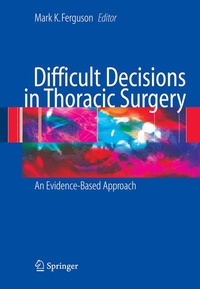
Difficult Decisions in Thoracic Surgery
An Evidence-Based Approach
Published on 28. December 2006
Book
Hardback
XX, 526 pages
978-1-84628-384-0 (ISBN)
Description
This book describes the recommended ideal approach, rather than customary care, in selected clinical situations. Brief chapters are devoted to a specific question or decision in general thoracic surgery that is difficult or controversial. The chapters contain both evidence-based recommendations and descriptions of surgeons' personal practices. Chapters are organized around clearly identified recommendations, making possible the identification of useful material at a glance. Over 50 different topics are presented. This book is a valuable reference source for practicing surgeons, surgeons in training, and educators.
More details
Edition
1st Edition.
Language
English
Place of publication
London
United Kingdom
Target group
Professional and scholarly
Practicing thoracic and general surgeons, thoracic and general surgeons in training, and educators
Illustrations
110 s/w Tabellen, 37 s/w Abbildungen
37 black & white illustrations, 110 black & white tables
Dimensions
Height: 25.4 cm
Width: 17.8 cm
Thickness: 30 mm
Weight
2760 gr
ISBN-13
978-1-84628-384-0 (9781846283840)
DOI
10.1007/978-1-84628-474-8
Schweitzer Classification
Other editions
New editions
Book
02/2025
5th Edition
Springer
€235.39
Shipment within 15-20 days
Book
01/2011
2nd Edition
Springer
€123.04
Article exhausted; check for reprint
Additional editions
Book
10/2010
1st Edition
Springer
€133.70
Article exhausted; check different version
E-Book
03/2007
1st Edition
Springer
€128.39
Available for download
Content
BACKGROUND: Introduction.- Evidence-Based Medicine: Levels of Evidence and Grades of Recommendation.- Decision Analytic Techniques.- Non-Clinical Components of Surgical Decision Making.- How Patients Make Decisions with their Surgeons: The Role of Counseling and Patient Decision Aids.- LUNG: Radiographic Staging of Lung Cancer: Computed Tomography (CT) and Positron Emission Tomography (PET) .- Routine Mediastinoscopy for Clinical Stage I Lung Cancer.- Management of Unexpected N2 Disease Discovered at Thoracotomy.- Induction Therapy for Clinical Stage I Lung Cancer.- Induction Therapy for Stage IIIA (N2) Lung Cancer.- Adjuvant postoperative therapy for completely resected stage I lung cancer.- Sleeve Lobectomy vs. Pneumonectomy for Lung Cancer Patients with Good Pulmonary Function.- Lesser Resection Versus Lobectomy for Stage I Lung Cancer in Patients with Good Pulmonary Function.-. Lesser Resection vs RT for Patients with Compromised Lung Function and STAGE I Lung Cancer.- Resection for Patients Initially Diagnosed with N3 Lung Cancer after Response to Induction Therapy.- VATS Major Lung Resections.- Surgery for Non-Small Cell Lung Cancer with Solitary M1 Disease.- Thoracoscopy Versus the Open Approach for Resection of Solitary Pulmonary Metastases.- Unilateral or bilateral approach for unilateral pulmonary metastatic disease.- Surgery for Bronchoalveolar Lung Cancer.- LVRS in the Candidate for Lung Transplantation.- Pleural Sclerosis for the Management of Initial Pneumothorax.- ESOPHAGUS: Staging for Esophageal Cancer: PET, EUS.- Induction Therapy for Resectable Esophageal Cancer.- Transthoracic versus Transhiatal Resection for Carcinoma of the Esophagus.- Minimally Invasive vs Open Esophagectomy for Cancer.- Lymph Node Dissection for Carcinoma of the Esophagus.- Intrathoracic vs Cervical Anastomosis in Esophageal Replacement.- Jejunostomy after Esophagectomy.- Gastric Emptying Procedures after Esophagectomy.- Posterior Mediastinal or Retrosternal Reconstruction Following Esophagectomy for Cancer.- Postoperative adjuvant therapy for completely resected esophageal cancer.- Celiac Lymph Nodes and Esophageal Cancer.- Partial or Total Fundoplication for GERD in the Presence of Impaired Esophageal Motility.- Botox, Balloon or Myotomy: Optimal treatment for Achalasia.- Fundoplication after Laparoscopic Myotomy for Achalasia.- Primary Repair for Delayed Recognition of Esophageal Perforation.- Lengthening Gastroplasty for Managing GERD and Stricture.- Lengthening Gastroplasty for Managing Giant Paraesophageal Hernia.- Evidenced-Based Management of Zenker's Diverticulum: Open Versus Transoral Approaches.- Management of Minimally Symptomatic Pulsion Diverticula of the Esophagus.- DIAPHRAGM: Giant Paraesophageal Hernia: Thoracic, Open Abdominal, or Laparoscopic Approach.- Management of Minimaly Symptomatic Giant Paraesophageal Hernias.- Plication for Diaphragmatic Eventration.- Pacing for Unilateral Diaphragm Paralysis.- Optimal Crural Closure Techniques for Repair of Large Hiatal Hernias.- Management of Acute Diaphragmatic Rupture: Thoracotomy versus Laparotomy.- AIRWAY: Stenting for Benign Airway Obstruction.- Tracheal Resection for Thyroid or Esophageal Cancer.- PLEURA AND PLEURAL SPACE: Pleural Sclerosis for Malignant Pleural Effusion: Optimal Sclerosing Agent.- Management of Malignant Pleural Effusion: Sclerosis or Chronic Tube drainage.- Initial Spontaneous Pneumothorax: The Role of Thoracoscopic Therapy.- Intrapleural Fibrinolytics.- Diffuse Malignant Pleural Mesothelioma: The Role of Pleurectomy.- Treatment of Malignant Pleural Mesothelioma: Is There a Benefit to Pleuropneumonectomy?.- MEDIASTINUM: Management of Myasthenia Gravis: Does Thymectomy Provide Benefit over Medical Therapy.- Thymectomy for Myathenias Gravis.- Management of Residual Disease after Therapy for Mediastinal Germ Cell Tumor and Normal Serum Markers.- Management of Malignant Pericardial Effusions.- Asymptomatic Pericardial Cyst: Observe or