

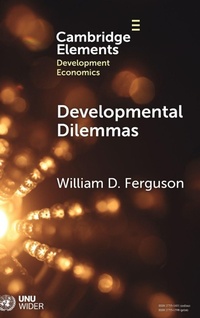
Developmental Dilemmas
The Role of Power and Agency
Will be published approx. on 31. January 2026
Book
Hardback
75 pages
978-1-009-46968-5 (ISBN)
Description
Why do well-meaning developmental policies fail? Power intervenes. Consider the recent collapse of the peace agreement between the Colombian government and FARC guerillas. Achieving inclusive development entails resolving collective-action problems of forging cooperation among agents with disparate interests and understandings. Resolution relies on developing functional informal and formal institutions. Powerful agents shape institutional evolution-because they can. This Element outlines a conceptual framework for policy-relevant inquiry. It addresses the concept of power-noting sources, instruments, manifestations, domains of operation, and strategic templates. After discussing leadership, following, and brokerage, it addresses institutional entrepreneurship. Institutional entrepreneurs develop narratives and actions to influence incentives and interpretations of social norms and identities: foundations of strategic interactions that shape institutional evolution. This approach facilitates inquiry into the roots and consequences of context-specific developmental dilemmas: background for developmental policy analysis. This title is also available as open access on Cambridge Core.
More details
Series
Language
English
Place of publication
Cambridge
United Kingdom
Illustrations
Worked examples or Exercises
Dimensions
Height: 235 mm
Width: 157 mm
Thickness: 11 mm
Weight
331 gr
ISBN-13
978-1-009-46968-5 (9781009469685)
Copyright in bibliographic data and cover images is held by Nielsen Book Services Limited or by the publishers or by their respective licensors: all rights reserved.
Schweitzer Classification
Other editions
Additional editions
Book
approx. 01/2026
Cambridge University Press
€25.30
Not yet published
Person
Content
1. Introduction; 2. Institutions and Principles of Power; 3. Foundations of Structural Change: Three Types of Agency; 4. Institutional Entrepreneurs; 5. Conflict, Power, Agency, and Developmental Dilemmas.