

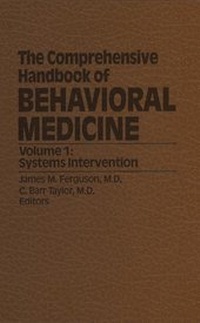
The Comprehensive Handbook of Behavioral Medicine: Systems Intervention Volume 1
Volume 1: Systems Intervention
1st Edition
Published in December 1980
Book
Hardback
303 pages
978-0-85200-540-8 (ISBN)
Description
Many of the greatest strides in medical care have neither been glamorous nor made the front page of The New York Times. They have been simple measures such as sanitation, immunization, and provision of clean, whole- some food. And even more glamorous medical breakthroughs and tech- niques like heart transplants are often last-ditch responses to largely preventable medical problems that required a lifetime to develop. Chang- ing those life styles which may cause, worsen, or exacerbate disease and uti- lizing current medical knowledge may be the most important strides medicine will make in the next few decades. To meet this challenge, tech- niques have already been developed to change eating and nutritional pat- terns that may lead to obesity and heart disease. In addition, interventions are being developed for a wide variety of medical problems. Many of these techniques are based on behavioral principles. Several years ago, one of the editors of this book gave a behavioral medi- cine seminar for psychiatry residents concerning behavioral principles and their application to medicine.
As the seminar developed, it became evident that many of the important articles on the subject were scattered through- out a wide body of literature, which encompassed a variety of disciplines and journals. No single source was available to provide the state of the art of this emerging field. This book was spawned, in part, as an attempt to overcome this deficit.
Many of the greatest strides in medical care have neither been glamorous nor made the front page of The New York Times. They have been simple measures such as sanitation, immunization, and provision of clean, whole- some food. And even more glamorous medical breakthroughs and tech- niques like heart transplants are often last-ditch responses to largely preventable medical problems that required a lifetime to develop. Chang- ing those life styles which may cause, worsen, or exacerbate disease and uti- lizing current medical knowledge may be the most important strides medicine will make in the next few decades. To meet this challenge, tech- niques have already been developed to change eating and nutritional pat- terns that may lead to obesity and heart disease. In addition, interventions are being developed for a wide variety of medical problems. Many of these techniques are based on behavioral principles. Several years ago, one of the editors of this book gave a behavioral medi- cine seminar for psychiatry residents concerning behavioral principles and their application to medicine.
As the seminar developed, it became evident that many of the important articles on the subject were scattered through- out a wide body of literature, which encompassed a variety of disciplines and journals. No single source was available to provide the state of the art of this emerging field. This book was spawned, in part, as an attempt to overcome this deficit.
As the seminar developed, it became evident that many of the important articles on the subject were scattered through- out a wide body of literature, which encompassed a variety of disciplines and journals. No single source was available to provide the state of the art of this emerging field. This book was spawned, in part, as an attempt to overcome this deficit.
Many of the greatest strides in medical care have neither been glamorous nor made the front page of The New York Times. They have been simple measures such as sanitation, immunization, and provision of clean, whole- some food. And even more glamorous medical breakthroughs and tech- niques like heart transplants are often last-ditch responses to largely preventable medical problems that required a lifetime to develop. Chang- ing those life styles which may cause, worsen, or exacerbate disease and uti- lizing current medical knowledge may be the most important strides medicine will make in the next few decades. To meet this challenge, tech- niques have already been developed to change eating and nutritional pat- terns that may lead to obesity and heart disease. In addition, interventions are being developed for a wide variety of medical problems. Many of these techniques are based on behavioral principles. Several years ago, one of the editors of this book gave a behavioral medi- cine seminar for psychiatry residents concerning behavioral principles and their application to medicine.
As the seminar developed, it became evident that many of the important articles on the subject were scattered through- out a wide body of literature, which encompassed a variety of disciplines and journals. No single source was available to provide the state of the art of this emerging field. This book was spawned, in part, as an attempt to overcome this deficit.
More details
Language
English
Place of publication
Dordrecht
Netherlands
Publishing group
Kluwer Academic Publishers Group
Target group
Professional and scholarly
Research
Illustrations
biography
Dimensions
Height: 250 mm
Width: 160 mm
Weight
690 gr
ISBN-13
978-0-85200-540-8 (9780852005408)
Copyright in bibliographic data and cover images is held by Nielsen Book Services Limited or by the publishers or by their respective licensors: all rights reserved.
Schweitzer Classification
Other editions
Additional editions
J.M. Ferguson | C. Barr Taylor
The Comprehensive Handbook of Behavioral Medicine
Volume 1: Systems Intervention
Book
03/2012
Springer
€53.49
Shipment within 15-20 days
Content
To The Cardiovascular System.- 1. Pattern A Behaviors And Heart Disease: Intervention Approaches.- 2. Behavioral and Psychophysiological Aspects Of Raynaud's Disease.- 3. Psychological Treatment Of Cardiac Arrhythmias.- 4. Behavioral Approaches To Hypertension.- 5. Cardiac Rehabilitation: Current Status and Future Prospects.- To The Musculoskeletal System.- 6. Major Trends in Exercise Physiology: Recent Findings And Their Implications For Perfection Of The Human Organism.- 7. Behavioral Approaches to Exercise Habits and Athletic Performance.- 8. Stroke and Rehabilitation.- To The Central Nervous System.- 9. How Plastic Is The Nervous System?.- 10. A Systems Approach For The Assessment and Treatment of Memory Problems.- 11. Treating The Complaint of Insomnia: Self-Management Perspectives.- To Psychoneuroendocrinology.- 12. Conditioned Endocrine Responses.- To The Genitourinary System.- 13. Enuresis.- 14. Treatment Of Common Male And Female Sexual Concerns.