

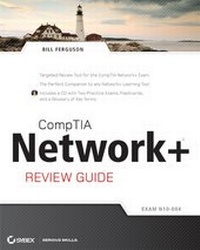
CompTIA Network+ Review Guide
(Exam: N10-004)
1st Edition
Published on 9. April 2009
Book
Paperback/Softback
264 pages
978-0-470-43099-6 (ISBN)
Description
Serving as a concise, focused study aid to help you prepare for the leading non-vendor-specific networking certification exam, this book features more review questions and study review features than any other guide, with over 120 review questions, two bonus exams, and electronic Flashcard, as well as a searchable Glossary of Terms database on CD-ROM. Fully updated for the first revision of the CompTIA Network+ exam since 2005, the book is organized by exam objectives and broken into six parts corresponding to the six domain areas of the Network+ exam: technologies, media and topologies, devices, management, tools, and security.
More details
Edition
1., Auflage
Language
English
Place of publication
Chichester
United Kingdom
Publishing group
John Wiley and Sons Ltd
Target group
Professional and scholarly
Edition type
New edition
Illustrations
Illustrations
Dimensions
Height: 23.6 cm
Width: 18.7 cm
Thickness: 15 mm
Weight
408 gr
ISBN-13
978-0-470-43099-6 (9780470430996)
Schweitzer Classification
Other editions
New editions
Book
02/2012
2nd Edition
Wiley
€28.90
Article is exhausted, reprint undefined
Previous edition

Bill Ferguson
Network+ Fast Pass
Book
05/2005
1st Edition
Sybex Inc.,U.S.
€24.90
Article exhausted; check for reprint
Person
Bill Ferguson, Network+, MCSE, MCT, has been in the computer industry for over 15 years, first as a certified technical trainer with ExecuTrain and now running his own training and consulting company. In addition to teaching classes throughout the USA and abroad, he writes and produces technical training videos for Virtual Training Company, Inc.; Specialized Solutions, Inc.; and Palaestra Training Company.
Content
Introduction.
Chapter 1 Domain 1 Network Technologies.
1.1 Explain the function of common networking protocols.
1.2 Identify commonly used TCP and UDP default ports.
1.3 Identify the following address formats: IPv6, IPv4, MAC addressing.
1.4 Given a scenario, evaluate the proper use of the following addressing technologies and addressing schemes: Classful vs. classless, NAT, PAT, SNAT, Public vs. Private, DHCP, Unicast, Multicast, Broadcast.
1.5 Identify common IPv4 and IPv6 routing protocols.
1.6 Explain the purpose and properties of routing.
1.7 Compare the characteristics of wireless communication standards.
Chapter 2 Domain 2 Network Media and Topologies.
2.1 Categorize standard cable types and their properties.
2.2 Identify common connector types.
2.3 Identify common physical network topologies.
2.4 Given a scenario, differentiate and implement appropriate wiring standards.
2.5 Categorize WAN technology types and properties.
2.6 Categorize LAN technology types and properties.
2.7 Explain common logical network topologies and their characteristics.
2.8 Install components of wiring distribution.
Chapter 3 Domain 3 Network Devices.
3.1 Install, configure, and differentiate between common network devices.
3.2 Identify the functions of specialized network devices.
3.3 Explain the advanced features of a switch.
3.4 Implement a basic wireless network.
Chapter 4 Domain 4 Network Management.
4.1 Explain the function of each layer of the OSI model.
4.2 Identify types of configuration management documentation.
4.3 Given a scenario, evaluate the network based on configuration management documentation.
4.4 Conduct network monitoring to identify performance and connectivity issues.
4.5 Explain different methods and rationales for network performance optimization.
4.6 Given a scenario, implement the following network troubleshooting methodology.
4.7 Given a scenario, troubleshoot common connectivity issues and select an appropriate solution.
Chapter 5 Domain 5 Network Tools.
5.1 Given a scenario, select the appropriate command line interface tool and interpret the output to verify functionality.
5.2 Explain the purpose of network scanners.
5.3 Given a scenario, utilize the appropriate hardware tools.
Chapter 6 Network Security.
6.1 Explain the function of hardware and software security devices.
6.2 Explain common features of a firewall.
6.3 Explain the methods of network access security.
6.4 Explain methods of user authentication.
6.5 Explain issues that affect device security.
6.6 Identify common security threats and mitigation techniques.
Index.
Chapter 1 Domain 1 Network Technologies.
1.1 Explain the function of common networking protocols.
1.2 Identify commonly used TCP and UDP default ports.
1.3 Identify the following address formats: IPv6, IPv4, MAC addressing.
1.4 Given a scenario, evaluate the proper use of the following addressing technologies and addressing schemes: Classful vs. classless, NAT, PAT, SNAT, Public vs. Private, DHCP, Unicast, Multicast, Broadcast.
1.5 Identify common IPv4 and IPv6 routing protocols.
1.6 Explain the purpose and properties of routing.
1.7 Compare the characteristics of wireless communication standards.
Chapter 2 Domain 2 Network Media and Topologies.
2.1 Categorize standard cable types and their properties.
2.2 Identify common connector types.
2.3 Identify common physical network topologies.
2.4 Given a scenario, differentiate and implement appropriate wiring standards.
2.5 Categorize WAN technology types and properties.
2.6 Categorize LAN technology types and properties.
2.7 Explain common logical network topologies and their characteristics.
2.8 Install components of wiring distribution.
Chapter 3 Domain 3 Network Devices.
3.1 Install, configure, and differentiate between common network devices.
3.2 Identify the functions of specialized network devices.
3.3 Explain the advanced features of a switch.
3.4 Implement a basic wireless network.
Chapter 4 Domain 4 Network Management.
4.1 Explain the function of each layer of the OSI model.
4.2 Identify types of configuration management documentation.
4.3 Given a scenario, evaluate the network based on configuration management documentation.
4.4 Conduct network monitoring to identify performance and connectivity issues.
4.5 Explain different methods and rationales for network performance optimization.
4.6 Given a scenario, implement the following network troubleshooting methodology.
4.7 Given a scenario, troubleshoot common connectivity issues and select an appropriate solution.
Chapter 5 Domain 5 Network Tools.
5.1 Given a scenario, select the appropriate command line interface tool and interpret the output to verify functionality.
5.2 Explain the purpose of network scanners.
5.3 Given a scenario, utilize the appropriate hardware tools.
Chapter 6 Network Security.
6.1 Explain the function of hardware and software security devices.
6.2 Explain common features of a firewall.
6.3 Explain the methods of network access security.
6.4 Explain methods of user authentication.
6.5 Explain issues that affect device security.
6.6 Identify common security threats and mitigation techniques.
Index.