

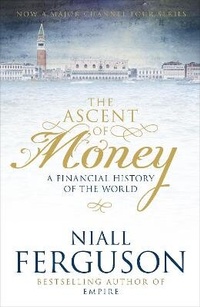
The Ascent of Money
A Financial History of the World
Published on 30. October 2008
Book
Hardback
448 pages
978-1-84614-106-5 (ISBN)
Description
Bread, cash, dosh, dough, loot: Call it what you like, it matters. To Christians, love of it is the root of all evil. To generals, it's the sinews of war. To revolutionaries, it's the chains of labour. But in The Ascent of Money, Niall Ferguson shows that finance is in fact the foundation of human progress. What's more, he reveals financial history as the essential back-story behind all history.
The evolution of credit and debt was as important as any technological innovation in the rise of civilization, from ancient Babylon to the silver mines of Bolivia. Banks provided the material basis for the splendours of the Italian Renaissance, while the bond market was the decisive factor in conflicts from the Seven Years' War to the American Civil War.
With the clarity and verve for which he is famed, Niall Ferguson explains why the origins of the French Revolution lie in a stock market bubble caused by a convicted Scots murderer. He shows how financial failure turned Argentina from the world's sixth richest country into an inflation-ridden basket case - and how a financial revolution is propelling the world's most populous country from poverty to power in a single generation.
Yet the most important lesson of the financial history is that sooner or later every bubble bursts - sooner or later the bearish sellers outnumber the bullish buyers - sooner or later greed flips into fear. And that's why, whether you're scraping by or rolling in it, there's never been a better time to understand the ascent of money.
The evolution of credit and debt was as important as any technological innovation in the rise of civilization, from ancient Babylon to the silver mines of Bolivia. Banks provided the material basis for the splendours of the Italian Renaissance, while the bond market was the decisive factor in conflicts from the Seven Years' War to the American Civil War.
With the clarity and verve for which he is famed, Niall Ferguson explains why the origins of the French Revolution lie in a stock market bubble caused by a convicted Scots murderer. He shows how financial failure turned Argentina from the world's sixth richest country into an inflation-ridden basket case - and how a financial revolution is propelling the world's most populous country from poverty to power in a single generation.
Yet the most important lesson of the financial history is that sooner or later every bubble bursts - sooner or later the bearish sellers outnumber the bullish buyers - sooner or later greed flips into fear. And that's why, whether you're scraping by or rolling in it, there's never been a better time to understand the ascent of money.
Reviews / Votes
'Niall Ferguson has written a fascinating, accessible, and important book that lives up to its rather grandiose title ... It goes from cowrie shells to mortgage-backed securities, and everything in between ... this is an exceptional book.' - Michael Casey, Irish TimesMore details
Language
English
Place of publication
London
United Kingdom
Publishing group
Penguin Books Ltd
Illustrations
16 pp colour inset, integrated b/w
Dimensions
Height: 240 mm
Width: 162 mm
Thickness: 41 mm
Weight
764 gr
ISBN-13
978-1-84614-106-5 (9781846141065)
Copyright in bibliographic data and cover images is held by Nielsen Book Services Limited or by the publishers or by their respective licensors: all rights reserved.
Schweitzer Classification
Other editions
Additional editions
E-Book
05/2016
1st Edition
Penguin Books Ltd
€9.49
Available for download
Person
Niall Ferguson is one of Britain's most renowned historians. He is the Milbank Family Senior Fellow at the Hoover Institution, Stanford University, a senior fellow of the Center for European Studies at Harvard University, and a Visiting Professor at Tsinghua University, Beijing. His books include The House of Rothschild, Empire, The War of the World, The Ascent of Money, The Great Degeneration and Kissinger, 1923-1968: The Idealist. His many prizes include the Benjamin Franklin Prize for Public Service (2010), the Hayek Prize for Lifetime Achievement (2012) and the Ludwig Erhard Prize for Economic Journalism (2013).