

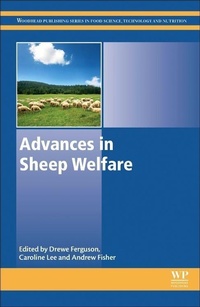
Advances in Sheep Welfare
Published on 15. August 2017
Book
Hardback
318 pages
978-0-08-100718-1 (ISBN)
Description
Advances in Sheep Welfare examines the recent advances made in sheep welfare assessment, handling and management, providing state-of-the-art coverage of the welfare needs of one of the world's most widely farmed animals.
The book begins with an introduction to sheep welfare in Part One, with chapters covering biology and natural behavior, sheep production systems, and consumer and societal expectations for sheep products. Part Two goes on to highlight new advances in sheep welfare assessment, before Part Three outlines a wide range of solutions to sheep welfare challenges. The final section looks ahead to the future, considering what sheep welfare will look like in 2030 and beyond.
This book is an essential part of the wider ranging series Advances in Farm Animal Welfare, with coverage of cattle, sheep, pigs and poultry.
With its expert editors and international team of contributors, Advances in Sheep Welfare is a key reference tool for welfare research scientists and students, veterinarians involved in welfare assessment, and indeed anyone with a professional interest in the welfare of sheep.
The book begins with an introduction to sheep welfare in Part One, with chapters covering biology and natural behavior, sheep production systems, and consumer and societal expectations for sheep products. Part Two goes on to highlight new advances in sheep welfare assessment, before Part Three outlines a wide range of solutions to sheep welfare challenges. The final section looks ahead to the future, considering what sheep welfare will look like in 2030 and beyond.
This book is an essential part of the wider ranging series Advances in Farm Animal Welfare, with coverage of cattle, sheep, pigs and poultry.
With its expert editors and international team of contributors, Advances in Sheep Welfare is a key reference tool for welfare research scientists and students, veterinarians involved in welfare assessment, and indeed anyone with a professional interest in the welfare of sheep.
Reviews / Votes
"Readers will realize the exceptional value of this contribution to biomedical sciences, particularly in ethics and welfare approaches in farm animals." --Veterinarska StanicaMore details
Series
Language
English
Place of publication
Cambridge
United Kingdom
Publishing group
Elsevier Science & Technology
Target group
Professional and scholarly
Product notice
sewn/stitched
Cloth over boards
Dimensions
Height: 236 mm
Width: 158 mm
Thickness: 25 mm
Weight
662 gr
ISBN-13
978-0-08-100718-1 (9780081007181)
Copyright in bibliographic data and cover images is held by Nielsen Book Services Limited or by the publishers or by their respective licensors: all rights reserved.
Schweitzer Classification
Other editions
New editions
Drewe Ferguson | Caroline Lee | Rebecca Doyle
Advances in Sheep Welfare
Book
04/2026
2nd Edition
Woodhead Publishing
€273.50
Shipment within 15-20 days
Additional editions
Drewe Ferguson | Caroline Lee | Andrew Fisher
Advances in Sheep Welfare
E-Book
08/2017
Woodhead Publishing
€230.00
Available for download
Persons
Drewe Ferguson leads the Livestock Systems Program within CSIRO Agriculture and Food. He is recognized for his research in advancing livestock welfare through improvements in livestock resilience and management and husbandry practices. Caroline Lee leads the animal behavior and welfare team at CSIRO, Australia. Her research interests include developing novel methods to assess affective states, assessing cognition and learning and improving welfare assessment of farm animals. Andrew Fisher is Chair of Cattle and Sheep Production Medicine and Director of the Animal Welfare Science Centre at the University of Melbourne, Australia. He has significant experience in animal welfare research, with a particular focus on production animal management, transport and pain management. He is also actively involved in the translation of animal welfare research into public and organizational policy.
Content
Part One: Introduction to Sheep Welfare
1. Advances in understanding in the biology and natural behavior of sheep
2. Overview of sheep production systems
3. Consumer and societal expectations for sheep products (meat and wool)
Part Two: New advances in sheep welfare assessment
4. New developments in our understanding of sheep cognition and emotional states
5. New physiological measures that indicate the biological cost of the challenge
Part Three: Current and future solutions to sheep welfare challenges
6. Genetic solutions
7. Reproductive management
8. Nutritional management
9. Predation control
10. Managing disease risks
11. Painful husbandry procedures
12. Transport and pre-slaughter management
13. Advanced livestock management solutions
14. Optimized welfare for sheep in research and teaching
Part Four: Sheep welfare beyond 2020
15. Future welfare challenges and potential for predicting and proactively managing emerging problems
1. Advances in understanding in the biology and natural behavior of sheep
2. Overview of sheep production systems
3. Consumer and societal expectations for sheep products (meat and wool)
Part Two: New advances in sheep welfare assessment
4. New developments in our understanding of sheep cognition and emotional states
5. New physiological measures that indicate the biological cost of the challenge
Part Three: Current and future solutions to sheep welfare challenges
6. Genetic solutions
7. Reproductive management
8. Nutritional management
9. Predation control
10. Managing disease risks
11. Painful husbandry procedures
12. Transport and pre-slaughter management
13. Advanced livestock management solutions
14. Optimized welfare for sheep in research and teaching
Part Four: Sheep welfare beyond 2020
15. Future welfare challenges and potential for predicting and proactively managing emerging problems