

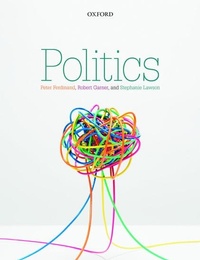
Politics
1st Edition
Published on 12. April 2018
Book
Paperback/Softback
592 pages
978-0-19-878798-3 (ISBN)
Description
With an unrivalled combination of exceptional clarity and intelligent analysis, Politics is the perfect introduction to political studies. Written especially for undergraduate students, this is the only introduction to politics to combine genuine accessibility and an analytical approach, encouraging critical study and engaged debate right from the outset of a university course.
Alongside comprehensive coverage of concepts, approaches, and ideologies, the book features chapters on all crucial elements of political studies, from institutions and states to security, political economy, civil society and the media, making it an ideal text for a broad range of modules.
Current debates and key developments in contemporary politics are taken into account, with coverage of the rise of populism, Brexit, and the Trump presidency, as well as a broad range of international case studies and examples.
Politics also features a lively and accessible design and a range of helpful learning features throughout, including key points, case studies, key debates, key thinkers, key quotes, and questions. The book is also fully supported by online resources to help students take their learning further.
For students:
- Test your knowledge of the chapters and receive instant feedback with online multiple choice questions.
- Take your learning further with relevant web links to reliable online content.
- Revise key terms and concepts from the text with a digital flashcard glossary.
- Learn more about key thinkers' ideas and backgrounds.
For registered lecturers:
- Reinforce key themes from each chapter with suggested seminar and essay questions.
- Incorporate active learning into your seminars with political scenarios, discussion questions, and teaching notes.
- Use the adaptable PowerPoint slides as the basis for lecture presentations or as hand-outs in class.
- Assess students' learning with a ready-made test bank, which can be customized to suit your needs.
Alongside comprehensive coverage of concepts, approaches, and ideologies, the book features chapters on all crucial elements of political studies, from institutions and states to security, political economy, civil society and the media, making it an ideal text for a broad range of modules.
Current debates and key developments in contemporary politics are taken into account, with coverage of the rise of populism, Brexit, and the Trump presidency, as well as a broad range of international case studies and examples.
Politics also features a lively and accessible design and a range of helpful learning features throughout, including key points, case studies, key debates, key thinkers, key quotes, and questions. The book is also fully supported by online resources to help students take their learning further.
For students:
- Test your knowledge of the chapters and receive instant feedback with online multiple choice questions.
- Take your learning further with relevant web links to reliable online content.
- Revise key terms and concepts from the text with a digital flashcard glossary.
- Learn more about key thinkers' ideas and backgrounds.
For registered lecturers:
- Reinforce key themes from each chapter with suggested seminar and essay questions.
- Incorporate active learning into your seminars with political scenarios, discussion questions, and teaching notes.
- Use the adaptable PowerPoint slides as the basis for lecture presentations or as hand-outs in class.
- Assess students' learning with a ready-made test bank, which can be customized to suit your needs.
Reviews / Votes
Extremely well-written, fluid, and easily comprehensible... This book is a lot clearer than its competitors. * Cillian McGrattan, Ulster University * A clearly written introduction to a complex subject that does not talk down to a student audience. * David Moon, University of Bath * Dealing with contemporary issues and tensions, this book provides a very engaging introduction to the subject. * Edoardo Bressanelli, King's College London * The authors' frequent references to particular states, international organizations, and non-state actors throughout certainly demonstrate its applicability to the real world. * Scott Fitzsimmons, University of Limerick *More details
Language
English
Place of publication
Oxford
United Kingdom
Target group
College/higher education
Dimensions
Height: 190 mm
Width: 246 mm
Thickness: 25 mm
Weight
980 gr
ISBN-13
978-0-19-878798-3 (9780198787983)
Copyright in bibliographic data and cover images is held by Nielsen Book Services Limited or by the publishers or by their respective licensors: all rights reserved.
Schweitzer Classification
Persons
Peter Ferdinand is Emeritus Reader in Politics and International Studies at the University of Warwick, United Kingdom.
Robert Garner is Professor of Politics at the University of Leicester, United Kingdom.
Stephanie Lawson is Professor of Politics and International Studies at Macquarie University, Australia and Senior Research Associate, Faculty of Humanities, University of Johannesburg, South Africa.
Robert Garner is Professor of Politics at the University of Leicester, United Kingdom.
Stephanie Lawson is Professor of Politics and International Studies at Macquarie University, Australia and Senior Research Associate, Faculty of Humanities, University of Johannesburg, South Africa.
Author
Emeritus Reader in Politics and International StudiesEmeritus Reader in Politics and International Studies, University of Warwick
Professor of PoliticsProfessor of Politics, University of Leicester
Professor of Politics and International StudiesProfessor of Politics and International Studies, Macquarie University
Content
1: Introduction: the nature of politics and political analysis 2: Politics and the State 3: Political Power, Authority, and the State 4: Democracy 5: Democracies, Democratization, and Authoritarian Regimes 6: Nations and Nationalism 7: The Ideal State 8: Ideologies 9: Political Economy: National and Global Perspectives 10: Institutions and States 11: Laws, Constitutions, and Federalism 12: Votes, Elections, Legislatures, and Legislators 13: Political Parties 14: Executives, Bureaucracies, Policy Studies, and Governance 15: The Media and Politics 16: Civil Society, Interest Groups, and Populism 17: Security and Insecurity 18: Governance and Organizations in Global Politics 19: Conclusion