

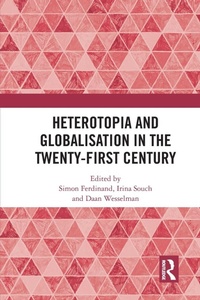
Heterotopia and Globalisation in the Twenty-First Century
1st Edition
Published on 13. December 2021
Book
Paperback/Softback
224 pages
978-1-032-23865-4 (ISBN)
Description
Can heterotopia help us make sense of globalisation? Against simplistic visions that the world is becoming one, Heterotopia and Globalisation in the Twenty-First Century shows how contemporary globalising processes are driven by heterotopian tension and complexities.
A heterotopia, in Michel Foucault's initial formulations, describes the spatial articulation of a discursive order, manifesting its own distinct logics and categories in ways that refract or disturb prevailing paradigms. While in the twenty-first century the concept of globalisation is frequently seen as a tumultuous undifferentiation of cultures and spaces, this volume breaks new ground by interrogating how heterotopia and globalisation in fact intersect in the cultural present. Bringing together contributors from disciplines including Geography, Literary Studies, Architecture, Sociology, Film Studies, and Philosophy, this volume sets out a new typology for heterotopian spaces in the globalising present. Together, the chapters argue that digital technologies, climate change, migration, and other globalising phenomena are giving rise to a heterotopian multiplicity of discursive spaces, which overlap and clash with one another in contemporary culture.
This volume will be of interest to scholars across disciplines who are engaged with questions of spatial difference, globalising processes, and the ways they are imagined and represented.
A heterotopia, in Michel Foucault's initial formulations, describes the spatial articulation of a discursive order, manifesting its own distinct logics and categories in ways that refract or disturb prevailing paradigms. While in the twenty-first century the concept of globalisation is frequently seen as a tumultuous undifferentiation of cultures and spaces, this volume breaks new ground by interrogating how heterotopia and globalisation in fact intersect in the cultural present. Bringing together contributors from disciplines including Geography, Literary Studies, Architecture, Sociology, Film Studies, and Philosophy, this volume sets out a new typology for heterotopian spaces in the globalising present. Together, the chapters argue that digital technologies, climate change, migration, and other globalising phenomena are giving rise to a heterotopian multiplicity of discursive spaces, which overlap and clash with one another in contemporary culture.
This volume will be of interest to scholars across disciplines who are engaged with questions of spatial difference, globalising processes, and the ways they are imagined and represented.
More details
Language
English
Place of publication
London
United Kingdom
Publishing group
Taylor & Francis Ltd
Target group
College/higher education
Postgraduate and Undergraduate
Illustrations
10 s/w Abbildungen
10 Illustrations, black and white
Dimensions
Height: 234 mm
Width: 156 mm
Thickness: 12 mm
Weight
351 gr
ISBN-13
978-1-032-23865-4 (9781032238654)
Copyright in bibliographic data and cover images is held by Nielsen Book Services Limited or by the publishers or by their respective licensors: all rights reserved.
Schweitzer Classification
Other editions
Additional editions
Simon Ferdinand | Irina Souch | Daan Wesselman
Heterotopia and Globalisation in the Twenty-First Century
Book
02/2020
1st Edition
Routledge
€179.51
Shipment within 15-20 days
Simon Ferdinand | Irina Souch | Daan Wesselman
Heterotopia and Globalisation in the Twenty-First Century
E-Book
01/2020
1st Edition
Routledge
€59.49
Available for download
Simon Ferdinand | Irina Souch | Daan Wesselman
Heterotopia and Globalisation in the Twenty-First Century
E-Book
01/2020
1st Edition
Routledge
€59.49
Available for download
Persons
Simon Ferdinand runs English Academic Editing (eaediting.nl). Having received his PhD cum laude from the University of Amsterdam, he is the author of Mapping Beyond Measure: Art, Cartography, and the Space of Global Modernity, and co-editor of Other Globes: Past and Peripheral Imaginations of Globalisation.
Irina Souch is Lecturer in the Department of Modern Foreign Languages and Cultures of the University of Amsterdam and Research Fellow at the Amsterdam School of Cultural Analysis (ASCA). She is author of Popular Tropes of Identity in Contemporary Russian Television and Film (Bloomsbury 2017). Her current work addresses narrative, aesthetic, and political functions of landscape in serial television drama and film.
Daan Wesselman is Lecturer in Literary and Cultural Analysis at the University of Amsterdam. Always trying to bridge the humanities and urban studies, he focuses particularly on postindustrial urban redevelopment and the material-discursive interfaces between the body, the city, and everyday life.
Irina Souch is Lecturer in the Department of Modern Foreign Languages and Cultures of the University of Amsterdam and Research Fellow at the Amsterdam School of Cultural Analysis (ASCA). She is author of Popular Tropes of Identity in Contemporary Russian Television and Film (Bloomsbury 2017). Her current work addresses narrative, aesthetic, and political functions of landscape in serial television drama and film.
Daan Wesselman is Lecturer in Literary and Cultural Analysis at the University of Amsterdam. Always trying to bridge the humanities and urban studies, he focuses particularly on postindustrial urban redevelopment and the material-discursive interfaces between the body, the city, and everyday life.
Content
Editors and Contributors; Acknowledgments; 1. Introduction. Interrupting Globalisation: Heterotopia in the Twenty-First Century Daan Wesselman, Irina Souch, and Simon Ferdinand; 2. Other Spaces for the Anthropocene: Heterotopia as Dis-Closure of the (Un)Common Lieven de Cauter; 3. H is for Heterotopia: Temporalities of the "New Nature Writing" Cathy Elliott; 4. Disruptive Elders: Enacting Heterotopias of the Riverbank Mary Gearey; 5. Agricultural Heterotopia: the Soybean Republic(s) of South America Gladys Pierpauli and Mariano Turzi; 6. "Interesting and Incompatible Relationships": Force and Form in Pedro Costa's Porous City Adam Kildare Cottrel; 7. Heterotopia and Perspective: Towards a Different Imagining of Landscape Henrietta Simson; 8. Of Tourists and Refugees: The Global Beach in the Twenty-First Century Ursula Kluwick and Virginia Richter; 9. Airbnb as an Ephemeral Space: Towards an Analysis of a Digital Heterotopia Elham Bahmanteymouri and Farzaneh Haghighi; 10. New Communication Technologies and the Transformations of Space: Lessons from Michel Serres' Thumbelina Peter Johnson; 11. The Prison as Playground: Global Scripts and Heterotopic Vertigo in Prison Escape Hanneke Stuit; 12. Dramatic Heterotopia: The Participatory Spectacle of Burning Man Graham St John; 13. Afterword Kevin Hetherington; Index