

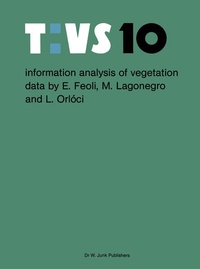
Information analysis of vegetation data
Published on 30. April 1984
Book
Hardback
153 pages
978-90-6193-950-4 (ISBN)
Description
Information analysis, a popular subject among vegetation ecologists not too many years ago, is revisited in this short monograph. The overview provided and the systematic presentation of ideas and algorithms should interest data analysts with backgrounds in this or other fields of natural science where the question of classifi- cation is addressed. The text gives the detailed descriptions and the listings of the computer programs. The authors were recipients of grant support from the Italian Consiglio Nazionale delle Ricerche "Gruppo Biologia Naturalistica" (E. Feoli) and the Canadian Na- tional Science and Engineering Research Council (L. Orl6ci) during completion of the project. The respective institutions of the University of Western Ontario and the University of Trieste provided facilities and computer time. Mrs. Stefani Tichbourne (London) typed the manuscript, Mr. Aulo Zampar (Trieste) gave computing assis- tance and Mr. Furio Poropat (Trieste) translated some programs. We are most grateful to them. E. Feoli M. Lagonegro L.
More details
Series
Language
English
Place of publication
Dordrecht
Netherlands
Publishing group
Springer
Target group
College/higher education
Professional and scholarly
Illustrations
153 p.
Dimensions
Height: 266 mm
Width: 198 mm
Thickness: 14 mm
Weight
559 gr
ISBN-13
978-90-6193-950-4 (9789061939504)
DOI
10.1007/978-94-009-6575-1
Schweitzer Classification
Other editions
Additional editions
E. Feoli | M. Lagonegro | L. Orlóci
Information analysis of vegetation data
E-Book
12/2012
Springer
€96.29
Available for download
E. Feoli | M. Lagonegro | L. Orlóci
Information analysis of vegetation data
Book
10/2011
Springer
€106.99
Shipment within 15-20 days
Content
1. Introduction.- 2. Definitions of entropy and divergence.- 3. Arrays of vegetation data.- R-dispersion arrays.- Q-dispersion arrays.- Diversity arrays.- Predictive arrays.- Notes on symbols.- 4. Measurements on the arrays.- Entropy measures and multiples.- Components of entropy.- Divergence measures.- Information measures on diversity arrays.- Hierarchically nested model of divergence.- Redundancy.- Equivocation.- 5. Application to community analysis.- Ecological connections.- Classification.- Predictivity analysis.- Comparison of classifications.- Identification.- 6. Computer programs and examples of application.- A. Characterization of programs.- B. Ranking species.- C. Computation of resemblance matrices.- D. Cluster analysis.- E. Predictivity analysis.- F. Nested model.- G. Identification.- H. Structuring data tables.- 7. Program listings.- 8. References.