

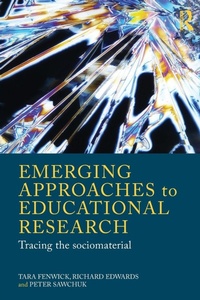
Emerging Approaches to Educational Research
Tracing the Socio-Material
1st Edition
Published on 13. July 2011
Book
Paperback/Softback
220 pages
978-0-415-57092-3 (ISBN)
Description
The last fifteen years have seen much conceptual and methodological innovation in research on education and learning across the lifecourse, bringing both fresh insights and new dilemmas. This innovation was initially fuelled by the growing influence of conceptual framings often named as either post-structural or postmodern. The works of Foucault, Derrida and Lyotard have variously found their way into the canons of educational research, and in more recent years, the influence of the work of Deleuze and Guattari has also grown. This work has proved controversial both in the challenges it has raised for the purposes and practices of education and training but also over the assumptions underpinning such work.
As part of and also in response to the influence of post-structuralism and postmodernism in the social sciences, there have emerged and developed a further range of conceptual and methodological framings which are more relational, system and practice-focussed. Several of these framings work with a non-linear understanding of causality and embrace unpredictability in the world and undecidability in our understanding of it. They also challenge any notion of a strong boundary between the social and natural sciences.
This book explores the most significant four of these framings, how they are being taken up in research in education and learning across the lifecourse, as well as their possibilities and limitations:
complexity science
cultural historical activity theory (CHAT)
actor-network theory (ANT)
spatiality theories.
Illustrated throughout with examples drawn from educational contexts across the life courses, including schooling, post-compulsory education and training, educational policy, workplace and community-based education in North America, the UK, and Australia this vital guide to understanding fresh ways of conducting and understanding educational research will prove essential reading for everyone undertaking educational research in the modern world.
As part of and also in response to the influence of post-structuralism and postmodernism in the social sciences, there have emerged and developed a further range of conceptual and methodological framings which are more relational, system and practice-focussed. Several of these framings work with a non-linear understanding of causality and embrace unpredictability in the world and undecidability in our understanding of it. They also challenge any notion of a strong boundary between the social and natural sciences.
This book explores the most significant four of these framings, how they are being taken up in research in education and learning across the lifecourse, as well as their possibilities and limitations:
complexity science
cultural historical activity theory (CHAT)
actor-network theory (ANT)
spatiality theories.
Illustrated throughout with examples drawn from educational contexts across the life courses, including schooling, post-compulsory education and training, educational policy, workplace and community-based education in North America, the UK, and Australia this vital guide to understanding fresh ways of conducting and understanding educational research will prove essential reading for everyone undertaking educational research in the modern world.
More details
Language
English
Place of publication
London
United Kingdom
Publishing group
Taylor & Francis Ltd
Target group
College/higher education
Professional and scholarly
Academic, Postgraduate, and Professional Practice & Development
Illustrations
1 s/w Abbildung
1 Illustrations, black and white
Dimensions
Height: 234 mm
Width: 156 mm
Thickness: 13 mm
Weight
360 gr
ISBN-13
978-0-415-57092-3 (9780415570923)
Copyright in bibliographic data and cover images is held by Nielsen Book Services Limited or by the publishers or by their respective licensors: all rights reserved.
Schweitzer Classification
Other editions
Additional editions
Tara Fenwick | Richard Edwards | Peter Sawchuk
Emerging Approaches to Educational Research
Tracing the Socio-Material
E-Book
04/2015
1st Edition
Routledge
€47.49
Available for download
Tara Fenwick | Richard Edwards | Peter Sawchuk
Emerging Approaches to Educational Research
Tracing the Socio-Material
E-Book
04/2015
1st Edition
Routledge
€47.49
Available for download
Tara Fenwick | Richard Edwards | Peter Sawchuk
Emerging Approaches to Educational Research
Tracing the Socio-Material
Book
07/2011
1st Edition
Routledge
€186.00
Shipment within 15-20 days
Persons
Tara Fenwick is Professor of Professional Education at the School of Education, University of Stirling, UK.
Richard Edwards is Professor of Education and Head of The School of Education at the University of Stirling, UK.
Peter Sawchuk is Associate Professor of Sociology and Equity Studies at the Ontario Institute for Studies in Education, University of Toronto, Canada.
Richard Edwards is Professor of Education and Head of The School of Education at the University of Stirling, UK.
Peter Sawchuk is Associate Professor of Sociology and Equity Studies at the Ontario Institute for Studies in Education, University of Toronto, Canada.
Content
1. Introduction: Why Socio-Materiality in Education? 2. Emergence and Perturbation: Understanding Complexity Science 3. Complexity Theory in Educational Research 4. Contradiction and Expansion: Understanding Cultural-Historical Activity Theory 5. Cultural-Historical Activity Theory in Educational Research 6. Translation and network effects: Understanding Actor-Network Theory 7. Actor-Network Theory in Educational Research 8. Spatiality and Temporality: Understanding Cultural Geography 9. Spatial Theory in Educational Research 10. Socio-Material Approaches: Contributions and Issues for Educational Research