

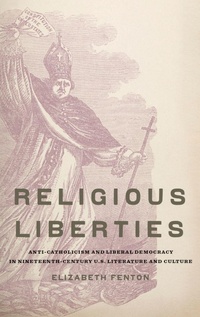
Religious Liberties
Anti-Catholicism and Liberal Democracy in Nineteenth-Century U.S. Literature and Culture
Published on 26. May 2011
Book
Hardback
192 pages
978-0-19-538409-3 (ISBN)
Description
In the late eighteenth and nineteenth centuries, U.S. literary and cultural productions often presented Catholicism not only as a threat to Protestantism but also as an enemy of democracy. Focusing on representations of the Catholic as a political force, Elizabeth Fenton argues that U.S. understandings of religious freedom grew partly, and paradoxically, out of a virulent anti-Catholicism. Depictions of Catholicism's imagined intolerance and cruelty allowed U.S. writers time and again to depict their nation as tolerant and free. As Religious Liberties shows, anti-Catholicism particularly shaped U.S. conceptions of pluralism and its relationship to issues as diverse as religious privacy, territorial expansion, female citizenship, political representation, chattel slavery, and governmental partisanship.
Religious Liberties examines a wide range of materials-from the Federalist Papers to antebellum biographies of Toussaint Louverture; from nativist treatises to Margaret Fuller's journalism; from convent exposes to novels by Charles Brockden Brown, Catharine Sedgwick, Augusta J. Evans, Nathanial Hawthorne, Harriet Beecher Stowe, Herman Melville, Henry Adams, and Mark Twain-to excavate anti-Catholicism's influence on both the liberal tradition and early U.S. culture. In concert, these texts reveal that Anti-Catholicism facilitated an alignment of U.S. nationalism with Protestantism. Religious Liberties shows that this alignment ultimately has ensured the mutual dependence, rather than the "separation " we so often take for granted, of church and state.
Religious Liberties examines a wide range of materials-from the Federalist Papers to antebellum biographies of Toussaint Louverture; from nativist treatises to Margaret Fuller's journalism; from convent exposes to novels by Charles Brockden Brown, Catharine Sedgwick, Augusta J. Evans, Nathanial Hawthorne, Harriet Beecher Stowe, Herman Melville, Henry Adams, and Mark Twain-to excavate anti-Catholicism's influence on both the liberal tradition and early U.S. culture. In concert, these texts reveal that Anti-Catholicism facilitated an alignment of U.S. nationalism with Protestantism. Religious Liberties shows that this alignment ultimately has ensured the mutual dependence, rather than the "separation " we so often take for granted, of church and state.
Reviews / Votes
The author's thesis is that anti-Catholicism was one, if not the, defining factor in the development of American national identity from the Revolution to at least the end of the 19th century. She cites numerous authors of fiction and politics to illustrate her thesis, and she concludes that anti-Catholicism eventually revealed the limits and innate contradictions of American liberal democracy... This book provides ample justification for her thesis and is a pleasure to read. * The Heythrop Review *More details
Series
Language
English
Place of publication
New York
United States
Target group
College/higher education
Dimensions
Height: 240 mm
Width: 161 mm
Thickness: 15 mm
Weight
458 gr
ISBN-13
978-0-19-538409-3 (9780195384093)
Copyright in bibliographic data and cover images is held by Nielsen Book Services Limited or by the publishers or by their respective licensors: all rights reserved.
Schweitzer Classification
Other editions
Additional editions
Elizabeth Fenton
Religious Liberties
Anti-Catholicism and Liberal Democracy in Nineteenth-Century U.S. Literature and Culture
E-Book
04/2011
1st Edition
OUP eBook
€41.49
Available for download
Elizabeth Fenton
Religious Liberties
Anti-Catholicism and Liberal Democracy in Nineteenth-Century U.S. Literature and Culture
E-Book
04/2011
1st Edition
OUP eBook
€53.49
Available for download
Person
Assistant Professor of English at the University of Vermont.
Content
Table of Contents ; Acknowledgements ; Introduction: Privacy, Pluralism, and Anti-Catholic Democracy ; 1. Catholic Canadians and Protestant Pluralism in the Early Republic ; 2. Pleas for Democracy: Federalism, Expansionism, and Nativism ; 3. Papal Persuasions: Religious Conversion and Deliberative Democracy ; 4. This is My Body Politic: Catholic Democracy and the Limits of Representation ; 5. Haitian Catholicism and the End of Pluralism ; 6. Losing Faith: Ultramontane Liberalism and Democratic Failure ; Afterword ; Index