

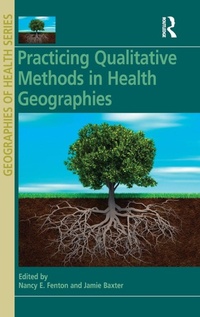
Practicing Qualitative Methods in Health Geographies
1st Edition
Published on 1. August 2016
Book
Hardback
286 pages
978-1-4724-4539-1 (ISBN)
Description
Health geographers are increasingly turning to a diverse range of interpretative methodologies to explore the complexities of health, illness, space and place to gain more comprehensive understandings of well-being and broader social models of health and health care. Drawing upon postmodernism, many health geographers are concerned with issues of representation, the body and health care policy. Also related to an emphasis on the body is the growing literature in feminist health geography that investigates the metaphorical, physical and emotional challenges of the body and disease.
Reflecting these interests, the chapters in this book set out the host of creative qualitative methods being used to explore the psychosocial experiences of individuals more directly, using such traditional methods as in-depth interviews and group discussions, participant observation, diaries and discourse analysis, but also more novel techniques such as 'go-along interviews', reflexive writing, illustrations, and photographic techniques. There are several areas of qualitative research unique to geographers which figure prominently in this volume including: health and place, comparative case study analysis, and qualitative approaches to the use of geographic information systems (GIS). This collection brings together a wide range of empirical concerns related to questions of health and shines a light on the diversity of qualitative methods in practice. Illustrating how qualitative methodologies are used in diverse health contexts this book fills an important niche for health geographers but will have wide appeal to health and geographic researchers.
Reflecting these interests, the chapters in this book set out the host of creative qualitative methods being used to explore the psychosocial experiences of individuals more directly, using such traditional methods as in-depth interviews and group discussions, participant observation, diaries and discourse analysis, but also more novel techniques such as 'go-along interviews', reflexive writing, illustrations, and photographic techniques. There are several areas of qualitative research unique to geographers which figure prominently in this volume including: health and place, comparative case study analysis, and qualitative approaches to the use of geographic information systems (GIS). This collection brings together a wide range of empirical concerns related to questions of health and shines a light on the diversity of qualitative methods in practice. Illustrating how qualitative methodologies are used in diverse health contexts this book fills an important niche for health geographers but will have wide appeal to health and geographic researchers.
More details
Series
Language
English
Place of publication
London
United Kingdom
Publishing group
Taylor & Francis Ltd
Target group
College/higher education
Professional and scholarly
Product notice
sewn/stitched
Cloth over boards
Dimensions
Height: 234 mm
Width: 157 mm
Thickness: 23 mm
Weight
522 gr
ISBN-13
978-1-4724-4539-1 (9781472445391)
Copyright in bibliographic data and cover images is held by Nielsen Book Services Limited or by the publishers or by their respective licensors: all rights reserved.
Schweitzer Classification
Other editions
Additional editions
Nancy E. Fenton | Jamie Baxter
Practicing Qualitative Methods in Health Geographies
Book
09/2020
1st Edition
Routledge
€65.60
Shipment within 15-20 days
Nancy E. Fenton | Jamie Baxter
Practicing Qualitative Methods in Health Geographies
E-Book
07/2016
Routledge
€58.99
Available for download
Nancy E. Fenton | Jamie Baxter
Practicing Qualitative Methods in Health Geographies
E-Book
07/2016
Routledge
€59.49
Available for download
Persons
Nancy E. Fenton is Adjunct Professor in the School of Public Health and Health Systems at the University of Waterloo, Canada, involved in interdisciplinary qualitative health research investigating the relationship between the environment and health as it relates to risk perception, particularly among children and youth.
Jamie Baxter is Associate Professor in the Department of Geography at Western University, Canada. His research interests include: the social construction of risks from technological hazards, community responses to hazards, environment and health, noxious facility siting and social science research methodology.
Jamie Baxter is Associate Professor in the Department of Geography at Western University, Canada. His research interests include: the social construction of risks from technological hazards, community responses to hazards, environment and health, noxious facility siting and social science research methodology.
Content
1. Praxis in Qualitative Health Geography
Jamie Baxter and Nancy E. Fenton
PART 1: REPRESENTATION, ETHICS AND POWER
2. Placing Narrative Correspondence in the Geographer's Toolbox: Insights from Care Research in New Zealand
Christine Milligan
3. Photo Elicitation as Method: A Participatory Approach
Tara Coleman
4. Ethics and Activism in Environment and Health Research
Sarah A. Mason, Chad Walker, Jamie Baxter, Isaac Luginaah
PART 2: REPRESENTATION, SELF AND COMMUNITY
5. Writing Illness through Feminist Autobiographical Analysis
Pamela Moss
6. Community Capacity Building through Qualitative Methodologies
Sarah A. Lovell, Mark W. Rosenberg
7. Walking in Their Shoes: Utilizing Go-Along Interviews to Explore Participant Engagement with Local Space
Jennifer Dean
PART 3: REPRESENTATION THROUGH VISUAL MEDIA
8. What Can Participant-Generated Drawing Add to Health Geography's Qualitative Palette?
Stephanie E. Coen
9. Applying Decolonizing Methodologies in Environment-Health Research: A Community-Based Film Project with Anishinabe Communities
Chantelle A.M. Richmond
10. Not Another Interview! Using Photovoice and Digital Stories as Props in Participatory Health Geography Research
Heather Castleden, Vanessa Sloan Morgan, Aaron Franks
11 Media and Framing: Processes and Challenges
S. Michelle Driedger, Theresa Garvin
PART 4: (NON)REPRESENTATION, AFFECT AND SOCIAL LIFE
12. From The Pump to Senescence: Two Musical Acts of More-Than-Representational 'Acting Into' and 'Building New' Life
Gavin J. Andrews, Eric Drass
13. Managing and Overcoming the Challenges of Qualitative Research on Palliative Family Caregivers
Allison Williams
14. Informal Caregiving on the Move: Examining the Experiences of Canadian Medical Tourists' Caregiver-Companions from Patients' Perspectives
Valerie A. Crooks, Victoria Casey, Rebecca Whitmore
15 Conclusion
Robin Kearns
Jamie Baxter and Nancy E. Fenton
PART 1: REPRESENTATION, ETHICS AND POWER
2. Placing Narrative Correspondence in the Geographer's Toolbox: Insights from Care Research in New Zealand
Christine Milligan
3. Photo Elicitation as Method: A Participatory Approach
Tara Coleman
4. Ethics and Activism in Environment and Health Research
Sarah A. Mason, Chad Walker, Jamie Baxter, Isaac Luginaah
PART 2: REPRESENTATION, SELF AND COMMUNITY
5. Writing Illness through Feminist Autobiographical Analysis
Pamela Moss
6. Community Capacity Building through Qualitative Methodologies
Sarah A. Lovell, Mark W. Rosenberg
7. Walking in Their Shoes: Utilizing Go-Along Interviews to Explore Participant Engagement with Local Space
Jennifer Dean
PART 3: REPRESENTATION THROUGH VISUAL MEDIA
8. What Can Participant-Generated Drawing Add to Health Geography's Qualitative Palette?
Stephanie E. Coen
9. Applying Decolonizing Methodologies in Environment-Health Research: A Community-Based Film Project with Anishinabe Communities
Chantelle A.M. Richmond
10. Not Another Interview! Using Photovoice and Digital Stories as Props in Participatory Health Geography Research
Heather Castleden, Vanessa Sloan Morgan, Aaron Franks
11 Media and Framing: Processes and Challenges
S. Michelle Driedger, Theresa Garvin
PART 4: (NON)REPRESENTATION, AFFECT AND SOCIAL LIFE
12. From The Pump to Senescence: Two Musical Acts of More-Than-Representational 'Acting Into' and 'Building New' Life
Gavin J. Andrews, Eric Drass
13. Managing and Overcoming the Challenges of Qualitative Research on Palliative Family Caregivers
Allison Williams
14. Informal Caregiving on the Move: Examining the Experiences of Canadian Medical Tourists' Caregiver-Companions from Patients' Perspectives
Valerie A. Crooks, Victoria Casey, Rebecca Whitmore
15 Conclusion
Robin Kearns