

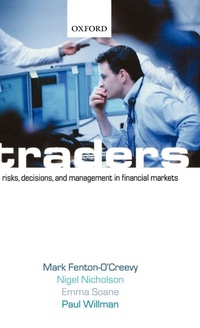
Traders
Risks, Decisions, and Management in Financial Markets
Published on 16. September 2004
Book
Hardback
256 pages
978-0-19-926948-8 (ISBN)
Description
This is a book about traders in financial markets: what they do, the kind of people they are, how they perceive the world they inhabit, how they make decisions and take risks. This is also a book about how traders are managed - the best and the worst examples - and about the institutions they inhabit: firms, markets, cultures, and theories of how the world works. How these institutions function, how traders are managed, and how traders view the world, all have profound effects on the wider financial environment. This book explores these relationships and their implications theoretically and empirically.
The data discussed in this book draw on a three-year project researching the psychological and social influences on the behaviour and performance of traders in investment banks. 118 traders and managers in four leading organizations participated. Data were collected through semi-structured interviews supplemented by questionnaires, measures of personality, risk propensity and a novel computer based measure designed to assess illusion of control and other cognitive biases.
The authors' approach to writing this book is explicitly interdisciplinary. They draw on sociology, psychology and economics in order to illuminate the work of traders and the world they inhabit.
The book is a significant contribution to the growing body of research and literature which suggests that if we are to effectively understand financial markets and the actors who inhabit them, the insights of neo-classical financial economics need supplementing with a broader range of social science approaches.
The book will be of value to researchers interested in the functioning of financial institutions and markets, to those with an interest in market regulation and to practitioners wishing to benefit from an analytical perspective on the challenges facing traders and their managers.
The data discussed in this book draw on a three-year project researching the psychological and social influences on the behaviour and performance of traders in investment banks. 118 traders and managers in four leading organizations participated. Data were collected through semi-structured interviews supplemented by questionnaires, measures of personality, risk propensity and a novel computer based measure designed to assess illusion of control and other cognitive biases.
The authors' approach to writing this book is explicitly interdisciplinary. They draw on sociology, psychology and economics in order to illuminate the work of traders and the world they inhabit.
The book is a significant contribution to the growing body of research and literature which suggests that if we are to effectively understand financial markets and the actors who inhabit them, the insights of neo-classical financial economics need supplementing with a broader range of social science approaches.
The book will be of value to researchers interested in the functioning of financial institutions and markets, to those with an interest in market regulation and to practitioners wishing to benefit from an analytical perspective on the challenges facing traders and their managers.
Reviews / Votes
Review from previous edition A truly worthwhile read. Provides a framework to understand the complex world of trading and the trader. For the professional it puts down in print what we have all instinctively understood in the depths of our minds about traders. * John Wall, Managing Director, Global Head, Equity Trading, UBS Investment Bank * Although financial economists have endlessly theorized the decision making of market participants, very few actually asked traders about these decisions. This book captures the authentic voices of professional traders, their theories of risk, and their trading biases. The authors lift the veil of myth that surrounds this version of homo economicus. * Mitchel Abolafia, Associate Professor in Public Administration and Policy, University at Albany * In this unique volume the authors report on an original study of traders' behavior. This is an exciting book that employs a broad social science approach to the study of trading, bringing in perspectives from economics, finance, organizational behavior, and psychology. * Zur Shapira, William Berkley Professor of Management, Stern School of Business, New York University * There is much, much more in this book than can be absorbed in a single reading. It is a pleasure to see true scholarship brought to a topic that is under-researched, yet of great interest. The authors manage to impose coherence on wide-ranging material drawn from financial economics, sociology, psychology, and behavioral science. It is likely to engage bhavioral researchers and finance professinals for years. * Werner De Bondt, Richard Driehaus Professor of Finance at DePaul University, and Director of the Driehaus Center for Behavioral Finance *More details
Language
English
Place of publication
Oxford
United Kingdom
Target group
Professional and scholarly
Academics, Researchers, and MBA and Advanced Students in Business and Finance, with a particular interest in financial markets and institutions, decision-making and managers, and risk management, Practitioners involved in financial markets.
Dimensions
Height: 222 mm
Width: 145 mm
Thickness: 19 mm
Weight
497 gr
ISBN-13
978-0-19-926948-8 (9780199269488)
Copyright in bibliographic data and cover images is held by Nielsen Book Services Limited or by the publishers or by their respective licensors: all rights reserved.
Schweitzer Classification
Other editions
Additional editions
Mark Fenton-O'Creevy | Nigel Nicholson | Emma Soane
Traders
Risks, Decisions, and Management in Financial Markets
Book
09/2007
Oxford University Press
€76.75
Shipment within 15-20 days
Persons
Mark Fenton O'Creevy is Professor of Organisational Behaviour, and Director, Programmes and Curriculum, at the Open University Business School.
Nigel Nicholson is Professor of Organizational Behaviour at the London Business School. He has been honoured by the American Academy of Management with an award for his contribution to theory and method, and is a Fellow of both the British Psychological Society and the British Academy of Management.
Emma Soane is a Reader at Kingston Business School. She is a Chartered Occupational Psychologist.
Paul Willman is a Professorial Fellow of Balliol College, Oxford, and the inaugural Ernest Butten Professor of Management Studies in the Saeid Business School. He is Editor in Chief of Human Relations and a Fellow of the Centre for Economic Performance, London School of Economics and Political Science.
Nigel Nicholson is Professor of Organizational Behaviour at the London Business School. He has been honoured by the American Academy of Management with an award for his contribution to theory and method, and is a Fellow of both the British Psychological Society and the British Academy of Management.
Emma Soane is a Reader at Kingston Business School. She is a Chartered Occupational Psychologist.
Paul Willman is a Professorial Fellow of Balliol College, Oxford, and the inaugural Ernest Butten Professor of Management Studies in the Saeid Business School. He is Editor in Chief of Human Relations and a Fellow of the Centre for Economic Performance, London School of Economics and Political Science.
Author
Professor of Organizational Behaviour, and Director, Programmes and Curriculum, Open Business School
Professor of Organizational Behaviour, London Business School
Senior Lecturer, Kingston Business School
Professor in Employment Relations and Organisational Behaviour, London School of Economics and Political Science
Content
1. Introduction ; 2. The Growth of Financial Markets and the Role of Traders ; 3. The Nature of Markets: Economic, Psychological, and Social Explanations of Market Behaviour ; 4. Traders and Markets ; 5. Traders, Decisions, and Biases ; 6. Individual Differences ; 7. Becoming a Trader: Learning Socialization and Error ; 8. Traders and Management ; 9. Conclusions