

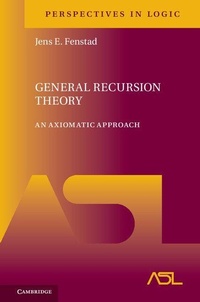
General Recursion Theory
An Axiomatic Approach
Published on 2. March 2017
Book
Hardback
238 pages
978-1-107-16816-9 (ISBN)
Description
Since their inception, the Perspectives in Logic and Lecture Notes in Logic series have published seminal works by leading logicians. Many of the original books in the series have been unavailable for years, but they are now in print once again. In this volume, the tenth publication in the Perspectives in Logic series, Jens E. Fenstad takes an axiomatic approach to present a unified and coherent account of the many and various parts of general recursion theory. The main core of the book gives an account of the general theory of computations. The author then moves on to show how computation theories connect with and unify other parts of general recursion theory. Some mathematical maturity is required of the reader, who is assumed to have some acquaintance with recursion theory. This book is ideal for a second course in the subject.
More details
Series
Language
English
Place of publication
Cambridge
United Kingdom
Target group
Professional and scholarly
Illustrations
1 Line drawings, black and white
Dimensions
Height: 240 mm
Width: 161 mm
Thickness: 19 mm
Weight
569 gr
ISBN-13
978-1-107-16816-9 (9781107168169)
Copyright in bibliographic data and cover images is held by Nielsen Book Services Limited or by the publishers or by their respective licensors: all rights reserved.
Schweitzer Classification
Other editions
Additional editions
E-Book
03/2017
Cambridge University Press
€112.99
Available for download
Person
Jens E. Fenstad works in the Department of Mathematics at the University of Oslo.
Content
Pons Asinorum; On the choice of correct notations for general theory; Part I. General Theory: 1. General theory: combinatorial part; 2. General theory: subcomputations; Part II. Finite Theories: 3. Finite theories on one type; 4. Finite theories on two types; Part III. Infinite Theories: 5. Admissible prewellorderings; 6. Degree structure; Part IV. Higher Types: 7. Computations over two types; 8. Set recursion and higher types; References; Notation; Author index; Subject index.