

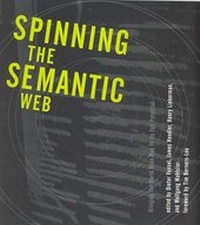
Spinning the Semantic Web
Bringing the World Wide Web to Its Full Potential
Published on 27. January 2003
Book
Hardback
272 pages
978-0-262-06232-9 (ISBN)
Description
As the World Wide Web continues to expand, it becomes increasingly difficult for users to obtain information efficiently. Because most search engines read format languages such as HTML or SGML, search results reflect formatting tags more than actual page content, which is expressed in natural language. Spinning the Semantic Web describes an exciting new type of hierarchy and standardization that will replace the current "web of links" with a "web of meaning." Using a flexible set of languages and tools, the Semantic Web will make all available information -- display elements, metadata, services, images, and especially content -- accessible. The result will be an immense repository of information accessible for a wide range of new applications.This first handbook for the Semantic Web covers, among other topics, software agents that can negotiate and collect information, markup languages that can tag many more types of information in a document, and knowledge systems that enable machines to read Web pages and determine their reliability. The truly interdisciplinary Semantic Web combines aspects of artificial intelligence, markup languages, natural language processing, information retrieval, knowledge representation, intelligent agents, and databases.
More details
Series
Language
English
Place of publication
Cambridge, Mass.
United States
Publishing group
MIT Press Ltd
Target group
Professional and scholarly
Interest Age: From 18 years
Illustrations
98 illus.
Dimensions
Height: 229 mm
Width: 203 mm
Thickness: 25 mm
Weight
1084 gr
ISBN-13
978-0-262-06232-9 (9780262062329)
Copyright in bibliographic data and cover images is held by Nielsen Book Services Limited or by the publishers or by their respective licensors: all rights reserved.
Schweitzer Classification
Persons
Wolfgang Wahlster is Director and CEO of the German Research Center for Artificial Intelligence and Professor of Computer Science at the Universität des Saarlandes, Saarbrücken.
Henry Lieberman is Research Scientist at the MIT Media Laboratory.
Dieter Fensel is Professor of Mathematics and Computer Science at the University of Innsbruck, Austria
Henry Lieberman is Research Scientist at the MIT Media Laboratory.
Dieter Fensel is Professor of Mathematics and Computer Science at the University of Innsbruck, Austria