

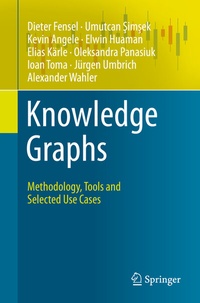
Knowledge Graphs
Methodology, Tools and Selected Use Cases
Published on 1. February 2020
Book
Paperback/Softback
XVI, 148 pages
978-3-030-37438-9 (ISBN)
Description
This book describes methods and tools that empower information providers to build and maintain knowledge graphs, including those for manual, semi-automatic, and automatic construction; implementation; and validation and verification of semantic annotations and their integration into knowledge graphs. It also presents lifecycle-based approaches for semi-automatic and automatic curation of these graphs, such as approaches for assessment, error correction, and enrichment of knowledge graphs with other static and dynamic resources.
Chapter 1 defines knowledge graphs, focusing on the impact of various approaches rather than mathematical precision. Chapter 2 details how knowledge graphs are built, implemented, maintained, and deployed. Chapter 3 then introduces relevant application layers that can be built on top of such knowledge graphs, and explains how inference can be used to define views on such graphs, making it a useful resource for open and service-oriented dialog systems. Chapter 4 discusses applications of knowledge graph technologies for e-tourism and use cases for other verticals. Lastly, Chapter 5 provides a summary and sketches directions for future work. The additional appendix introduces an abstract syntax and semantics for domain specifications that are used to adapt schema.org to specific domains and tasks.
To illustrate the practical use of the approaches presented, the book discusses several pilots with a focus on conversational interfaces, describing how to exploit knowledge graphs for e-marketing and e-commerce. It is intended for advanced professionals and researchers requiring a brief introduction to knowledge graphs and their implementation.
Chapter 1 defines knowledge graphs, focusing on the impact of various approaches rather than mathematical precision. Chapter 2 details how knowledge graphs are built, implemented, maintained, and deployed. Chapter 3 then introduces relevant application layers that can be built on top of such knowledge graphs, and explains how inference can be used to define views on such graphs, making it a useful resource for open and service-oriented dialog systems. Chapter 4 discusses applications of knowledge graph technologies for e-tourism and use cases for other verticals. Lastly, Chapter 5 provides a summary and sketches directions for future work. The additional appendix introduces an abstract syntax and semantics for domain specifications that are used to adapt schema.org to specific domains and tasks.
To illustrate the practical use of the approaches presented, the book discusses several pilots with a focus on conversational interfaces, describing how to exploit knowledge graphs for e-marketing and e-commerce. It is intended for advanced professionals and researchers requiring a brief introduction to knowledge graphs and their implementation.
More details
Edition
2020 ed.
Language
English
Place of publication
Cham
Switzerland
Publishing group
Springer International Publishing
Target group
Professional and scholarly
Illustrations
8 s/w Abbildungen, 8 farbige Abbildungen
XVI, 148 p. 16 illus., 8 illus. in color.
Dimensions
Height: 235 mm
Width: 155 mm
Thickness: 10 mm
Weight
260 gr
ISBN-13
978-3-030-37438-9 (9783030374389)
DOI
10.1007/978-3-030-37439-6
Schweitzer Classification
Other editions
Additional editions
Dieter Fensel | Umutcan Simsek | Kevin Angele
Knowledge Graphs
Methodology, Tools and Selected Use Cases
E-Book
01/2020
1st Edition
Springer
€69.54
Available for download
Persons
Dieter Fensel
is the director of the STI Innsbruck research group at the University of Innsbruck's Department of Computer Science. He has written over 300 scientific publications, including books, journals and conference papers, and workshop contributions. As one of the pioneers of research in the Semantic Web, he co-founded major scientific events such as the Extended Semantic Web Conference (ESWC) and the International Semantic Web Conference (ISWC). His research interests currently focus on the development of knowledge graphs and various aspects of the knowledge graph lifecycle. He has successfully applied his research in industry by co-founding companies like seekda (now part of Kognitiv) and Onlim, which are active in conversational interfaces and knowledge graphs. The book has been co-authored under his guidance, by his team of researchers at STI Innsbruck (Kevin Angele, Elwin Huaman, Elias Kärle, Oleksandra Panasiuk and Umutcan Simsek) and Onlim GmbH(Alexander Wahler, Jürgen Umbrich and Ioan Toma).
Content
Introduction: What is a Knowledge Graph?.- How to build a Knowledge Graph.- How to use a Knowledge Graph.- Why we need Knowledge Graphs: Applications.- Conclusions.- References.- Appendix.- Index.