

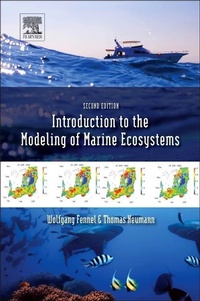
Introduction to the Modelling of Marine Ecosystems: Volume 72
Volume 72
2nd Edition
Published on 28. August 2014
Book
Hardback
372 pages
978-0-444-63363-7 (ISBN)
Description
Introduction to the Modelling of Marine Ecosystems, Second Edition provides foundational information on the construction of chemical and biological models - from simple cases to more complex biogeochemical models and life cycle resolving model components. This step-by-step approach to increasing the complexity of the models allows readers to explore the theoretical framework and become familiar with the models even when they have limited experience in mathematical modeling. Introduction to the Modelling of Marine Ecosystems shows how biological model components can be integrated into three dimensional circulation models and how such models can be used for numerical experiments.
More details
Series
Edition
2nd edition
Language
English
Place of publication
Oxford
United Kingdom
Publishing group
Elsevier Science & Technology
Target group
Professional and scholarly
Oceanographers and marine biologists
Product notice
sewn/stitched
Cloth over boards
Illustrations
Approx. 140 black & white and 30 color
Dimensions
Height: 236 mm
Width: 154 mm
Thickness: 22 mm
Weight
747 gr
ISBN-13
978-0-444-63363-7 (9780444633637)
Copyright in bibliographic data and cover images is held by Nielsen Book Services Limited or by the publishers or by their respective licensors: all rights reserved.
Schweitzer Classification
Other editions
Additional editions
W. Fennel | T. Neumann
Introduction to the Modelling of Marine Ecosystems: Volume 72
(with MATLAB programs on accompanying CD-ROM)
Book
10/2018
2nd Edition
Elsevier
€76.74
The article will not be published
W. Fennel | T. Neumann
Introduction to the Modelling of Marine Ecosystems
E-Book
09/2014
Elsevier
€76.95
Available for download
Previous edition

W. Fennel | T. Neumann
Introduction to the Modelling of Marine Ecosystems: Volume 72
(with MATLAB programs on accompanying CD-ROM)
Book
08/2004
Elsevier
€148.56
Article exhausted; check for reprint
Persons
Dr. Wolfgang Fennel is professor emeritus of physical oceanography at the University of Rostock and he was head of the section of physical oceanography of the Baltic Sea Research Institute, (IOW). His background is theoretical oceanography and he is a specialist in oceanic circulation and wave processes. He is also working on the coupling of physics and marine biology. Wolfgang Fennel was President of SCOR (2008-2012) and is now Past SCOR President until 2016. He promoted interdisciplinary co-operation. Dr. Thomas Neumann is senior scientist working in the section of physical oceanography in the Baltic Sea Research Institute, (IOW). After an initial oceanographic career in small scale processes in the sea he turned his scientific interests in the 1990ties to coupled physical and biological modeling. He is one of the leading experts in coupled physical biogeochemical models.
Content
Preface
Preface of the First Edition
Chapter 1: Introduction
1.1 Models of marine ecosystems
1.2 Models from nutrients to fish
Chapter 2: Chemical-Biological Models
2.1 Chemical-biological processes
2.2 Simple models
2.3 Simple plankton models for the ocean
Chapter 3: More Complex Models
3.1 Competition
3.2 Several functional groups
3.3 N2 fixation
3.4 Denitrification
Chapter 4: Modelling Life Cycles of Copepods and Fish
4.1 Growth and stage duration
4.2 Stage-resolving models of copepods
4.3 Experimental simulations
4.4 A fish model
Chapter 5: Physical-Biological Interaction
5.1 Irradiance
5.2 Coastal ocean dynamics
5.3 Advection-diffusion equation
5.4 Upscaling and downscaling
5.5 Resolution of processes
Chapter 6: Coupled Models
6.1 Introduction
6.2 Regional to global models
6.3 Circulation models
6.4 Baltic sea
6.5 Description of the model system
6.6 Simulation of the annual cycle
6.7 Simulation of the decade 1980-1990
6.8 A load reduction experiment
6.9 Projection of future changes
6.10 Tracking of elements
6.11 Discussion
Chapter 7: Circulation Model, Copepods and Fish
7.1 Recruitment (Match-Mismatch)
7.2 Copepods in the baltic sea model
7.3 Three-dimensional simulations
7.4 Modelling of behavioural aspects
7.5 Fish in a three-dimensional model
7.6 Ergom: A Biogeochemical Model for Regional Seas
Chapter 8: A Brief Introduction to MATLAB
8.1 Fundamentals
8.2 Ordinary differential equations
8.3 Miscellaneous
Appendix: Content of the Booksite
Bibliography
Index
Preface of the First Edition
Chapter 1: Introduction
1.1 Models of marine ecosystems
1.2 Models from nutrients to fish
Chapter 2: Chemical-Biological Models
2.1 Chemical-biological processes
2.2 Simple models
2.3 Simple plankton models for the ocean
Chapter 3: More Complex Models
3.1 Competition
3.2 Several functional groups
3.3 N2 fixation
3.4 Denitrification
Chapter 4: Modelling Life Cycles of Copepods and Fish
4.1 Growth and stage duration
4.2 Stage-resolving models of copepods
4.3 Experimental simulations
4.4 A fish model
Chapter 5: Physical-Biological Interaction
5.1 Irradiance
5.2 Coastal ocean dynamics
5.3 Advection-diffusion equation
5.4 Upscaling and downscaling
5.5 Resolution of processes
Chapter 6: Coupled Models
6.1 Introduction
6.2 Regional to global models
6.3 Circulation models
6.4 Baltic sea
6.5 Description of the model system
6.6 Simulation of the annual cycle
6.7 Simulation of the decade 1980-1990
6.8 A load reduction experiment
6.9 Projection of future changes
6.10 Tracking of elements
6.11 Discussion
Chapter 7: Circulation Model, Copepods and Fish
7.1 Recruitment (Match-Mismatch)
7.2 Copepods in the baltic sea model
7.3 Three-dimensional simulations
7.4 Modelling of behavioural aspects
7.5 Fish in a three-dimensional model
7.6 Ergom: A Biogeochemical Model for Regional Seas
Chapter 8: A Brief Introduction to MATLAB
8.1 Fundamentals
8.2 Ordinary differential equations
8.3 Miscellaneous
Appendix: Content of the Booksite
Bibliography
Index