

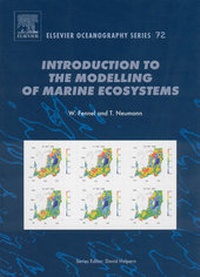
Introduction to the Modelling of Marine Ecosystems: Volume 72
(with MATLAB programs on accompanying CD-ROM)
Published on 24. August 2004
Book
Paperback/Softback
308 pages
978-0-444-51704-3 (ISBN)
Description
Modelling of marine ecosystems is a rapidly developing branch of interdisciplinary oceanographic research. Introduction to the Modelling of Marine Ecosystems is the first consistent and comprehensive introduction to the development of models of marine ecosystems. It begins with simple first steps of modelling and develops more and more complex models. This step-by-step approach to increasing the complexity of the models is intended to allow students of biological oceanography and interested scientists with only limited experience in mathematical modelling to explore the theoretical framework and familiarize oneself with the methods. The book describes how biological model components can be integrated into three dimensional circulation models and how such models can be used for 'numerical experiments'.
The book illustrates the mathematical aspects of modelling and gives application examples. The tutorial aspect of the book is supported by a set of MATLAB programs, which are provided on an accompanying CD-Rom and which can be used to reproduce many of the results presented in the book.
Also available in paperback, ISBN 0-444-51704-9
The book illustrates the mathematical aspects of modelling and gives application examples. The tutorial aspect of the book is supported by a set of MATLAB programs, which are provided on an accompanying CD-Rom and which can be used to reproduce many of the results presented in the book.
Also available in paperback, ISBN 0-444-51704-9
Reviews / Votes
T. Tyrrell this book is a valuable contribution that helps fill a gap in the literature; this is to my knowledge the first book-length primer for ecosystem modelling in the sea. Estaurine, Coastal and Shelf Science, 2005More details
Series
Language
English
Place of publication
Oxford
United Kingdom
Publishing group
Elsevier Science & Technology
Target group
Professional and scholarly
Dimensions
Height: 262 mm
Width: 192 mm
Weight
750 gr
ISBN-13
978-0-444-51704-3 (9780444517043)
Copyright in bibliographic data and cover images is held by Nielsen Book Services Limited or by the publishers or by their respective licensors: all rights reserved.
Schweitzer Classification
Other editions
New editions
W. Fennel | T. Neumann
Introduction to the Modelling of Marine Ecosystems: Volume 72
(with MATLAB programs on accompanying CD-ROM)
Book
10/2018
2nd Edition
Elsevier
€76.74
The article will not be published
Book
08/2014
2nd Edition
Elsevier
€93.00
Shipment within 15-20 days
Additional editions
W. Fennel | T. Neumann
Introduction to the Modelling of Marine Ecosystems
(With MATLAB Programs on Accompanying CD-ROM)
E-Book
05/2014
Elsevier
€143.00
Available for download
Persons
Dr. Wolfgang Fennel is professor emeritus of physical oceanography at the University of Rostock and he was head of the section of physical oceanography of the Baltic Sea Research Institute, (IOW). His background is theoretical oceanography and he is a specialist in oceanic circulation and wave processes. He is also working on the coupling of physics and marine biology. Wolfgang Fennel was President of SCOR (2008-2012) and is now Past SCOR President until 2016. He promoted interdisciplinary co-operation. Dr. Thomas Neumann is senior scientist working in the section of physical oceanography in the Baltic Sea Research Institute, (IOW). After an initial oceanographic career in small scale processes in the sea he turned his scientific interests in the 1990ties to coupled physical and biological modeling. He is one of the leading experts in coupled physical biogeochemical models.
Content
1. Introduction. 2. Chemical Biological-Models. 3. More Complex Models. 4. Modelling Life Cycles. 5. Physiological Biological Interaction. 6. Coupled Models. 7. Circulation Model and Copepods. 8. A Brief Introduction to MATLAB.