

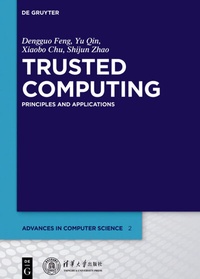
Trusted Computing
Principles and Applications
1st Edition
Published on 18. December 2017
Book
Hardback
XI, 300 pages
978-3-11-047604-0 (ISBN)
Description
The book summarizes key concepts and theories in trusted computing, e.g., TPM, TCM, mobile modules, chain of trust, trusted software stack etc, and discusses the configuration of trusted platforms and network connections. It also emphasizes the application of such technologies in practice, extending readers from computer science and information science researchers to industrial engineers.
More details
Series
Language
English
Place of publication
Berlin/Boston
Germany
Target group
Professional and scholarly
US School Grade: College Graduate Student
Illustrations
50 Abbildungen, 10 s/w Tabellen
50 ill., 10 tbl.
Dimensions
Height: 246 mm
Width: 175 mm
Thickness: 23 mm
Weight
714 gr
ISBN-13
978-3-11-047604-0 (9783110476040)
Schweitzer Classification
Other editions
Additional editions
E-Book
12/2017
1st Edition
De Gruyter
€149.95
Available for download
E-Book
12/2017
1st Edition
De Gruyter
€149.95
Available for download
Persons
Dengguo Feng , Institute of Software, Chinese Academy of Sciences, Beijing, China
Content
Table of Content:
Chapter 1 Introduction
1.1 Latest development
1.2 Overview on credible terminal configuration, remote attestation, trusted network connect
1.3 Challenges 12
Chapter 2 Trusted platform module
2.1 Goal for module design
2.2 TPM security chip
2.3 TCM security chip
2.4 Mobile trusted module
2.5 Developments for new technologies - dynamic root credibility, virtual technology
2.6 Summary
References
Chapter 3 Configuration for chain of trust
3.1 Trusted root
3.2 Chain of trust
3.3 Static Chain of Trust
3.4 Dynamic chain of trust
3.5 Chain of trust in virtual platform
3.6 Summary
References
Chapter 4 Trusted software stack
4.1 Trusted software stack architecture and features
4.2 Trusted Software Stack interface
4.3 Applications
4.4 Open source software stack
4.5 Summary
References
Chapter 5 Trusted platform
5.1 Overview
5.2 For personal computer
5.3 Server
5.4 Trusted Mobile Platform
5.5 Virtualized trusted platform
5.6 Applications
5.7 Summary
References
Chapter 6 Assessment
6.1 Compliance test for trusted platform module
6.2 Security mechanisms for trusted computing and analysis
6.3 Trusted computing assessment and certification
6.4 Analysis for overall perfermance
6.5 Summary
References
Chapter 7 Remote attestation
7.1 Principles for remote attestation
7.2 Current studies on remote attestation
7.3 Platform identification
7.4 Binary-based remote attestation, attribute-based remote attestation
7.5 Systems and applications
7.6 Summary
References
Chapter 8 Trusted network connection
8.1 Background
8.2 Access and interfaces
8.3 Network extension - Trust@FHH
8.3.3ISCAS trusted network access system
8.4 Application
8.5 Summary
References
Appendix - encryption algorithms and protocol
Chapter 1 Introduction
1.1 Latest development
1.2 Overview on credible terminal configuration, remote attestation, trusted network connect
1.3 Challenges 12
Chapter 2 Trusted platform module
2.1 Goal for module design
2.2 TPM security chip
2.3 TCM security chip
2.4 Mobile trusted module
2.5 Developments for new technologies - dynamic root credibility, virtual technology
2.6 Summary
References
Chapter 3 Configuration for chain of trust
3.1 Trusted root
3.2 Chain of trust
3.3 Static Chain of Trust
3.4 Dynamic chain of trust
3.5 Chain of trust in virtual platform
3.6 Summary
References
Chapter 4 Trusted software stack
4.1 Trusted software stack architecture and features
4.2 Trusted Software Stack interface
4.3 Applications
4.4 Open source software stack
4.5 Summary
References
Chapter 5 Trusted platform
5.1 Overview
5.2 For personal computer
5.3 Server
5.4 Trusted Mobile Platform
5.5 Virtualized trusted platform
5.6 Applications
5.7 Summary
References
Chapter 6 Assessment
6.1 Compliance test for trusted platform module
6.2 Security mechanisms for trusted computing and analysis
6.3 Trusted computing assessment and certification
6.4 Analysis for overall perfermance
6.5 Summary
References
Chapter 7 Remote attestation
7.1 Principles for remote attestation
7.2 Current studies on remote attestation
7.3 Platform identification
7.4 Binary-based remote attestation, attribute-based remote attestation
7.5 Systems and applications
7.6 Summary
References
Chapter 8 Trusted network connection
8.1 Background
8.2 Access and interfaces
8.3 Network extension - Trust@FHH
8.3.3ISCAS trusted network access system
8.4 Application
8.5 Summary
References
Appendix - encryption algorithms and protocol