

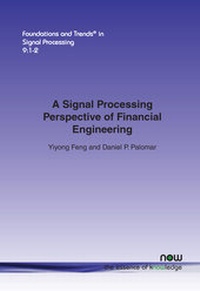
A Signal Processing Perspective of Financial Engineering
1st Edition
Published on 11. August 2016
Book
Paperback/Softback
256 pages
978-1-68083-118-4 (ISBN)
Description
Despite the different nature of financial engineering and electrical engineering, both areas are intimately connected on a mathematical level. The foundations of financial engineering lie on the statistical analysis of numerical time series and the modeling of the behavior of the financial markets in order to perform predictions and systematically optimize investment strategies. Similarly, the foundations of electrical engineering, for instance, wireless communication systems, lie on statistical signal processing and the modeling of communication channels in order to perform predictions and systematically optimize transmission strategies. Both foundations are the same in disguise.
It is often the case in science that the same or very similar methodologies are developed and applied independently in different areas. A Signal Processing Perspective of Financial Engineering is about investment in financial assets treated as a signal processing and optimization problem. It explores such connections and capitalizes on the existing mathematical tools developed in wireless communications and signal processing to solve real-life problems arising in the financial markets in an unprecedented way.
A Signal Processing Perspective of Financial Engineering provides straightforward and systematic access to financial engineering for researchers in signal processing and communications so that they can understand problems in financial engineering more easily and may even apply signal processing techniques to handle some financial problems.
It is often the case in science that the same or very similar methodologies are developed and applied independently in different areas. A Signal Processing Perspective of Financial Engineering is about investment in financial assets treated as a signal processing and optimization problem. It explores such connections and capitalizes on the existing mathematical tools developed in wireless communications and signal processing to solve real-life problems arising in the financial markets in an unprecedented way.
A Signal Processing Perspective of Financial Engineering provides straightforward and systematic access to financial engineering for researchers in signal processing and communications so that they can understand problems in financial engineering more easily and may even apply signal processing techniques to handle some financial problems.
More details
Series
Language
English
Place of publication
Hanover
United States
Target group
College/higher education
Professional and scholarly
Dimensions
Height: 234 mm
Width: 156 mm
Thickness: 14 mm
Weight
365 gr
ISBN-13
978-1-68083-118-4 (9781680831184)
DOI
10.1561/2000000072
Copyright in bibliographic data and cover images is held by Nielsen Book Services Limited or by the publishers or by their respective licensors: all rights reserved.
Schweitzer Classification
Content
1. Introduction
Part I. Financial Modeling and Order Execution
2. Modeling of Financial Time Series
3. Modeling Fitting: Mean and Covariance Matrix Estimators
4. Order Execution
Part II. Portfolio Optimization (Risk-Return Trade-off)
5. Portfolio Optimization with Known Parameters
6. Robust Portfolio Optimization
7. Multi-Portfolio Optimization
8. Index Tracking
9. Risk Parity Portfolio Optimization
Part III. Statistical Arbitrage (Mean-Reversion)
10. Statistical Arbitrage
Abbreviations and Notation
Acknowledgments
References
Part I. Financial Modeling and Order Execution
2. Modeling of Financial Time Series
3. Modeling Fitting: Mean and Covariance Matrix Estimators
4. Order Execution
Part II. Portfolio Optimization (Risk-Return Trade-off)
5. Portfolio Optimization with Known Parameters
6. Robust Portfolio Optimization
7. Multi-Portfolio Optimization
8. Index Tracking
9. Risk Parity Portfolio Optimization
Part III. Statistical Arbitrage (Mean-Reversion)
10. Statistical Arbitrage
Abbreviations and Notation
Acknowledgments
References