

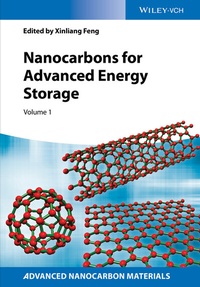
Nanocarbons for Advanced Energy Storage
1st Edition
Published on 22. April 2015
Book
Hardback
XXII, 466 pages
978-3-527-33665-4 (ISBN)
Description
This first volume in the series on nanocarbons for advanced applications presents the latest achievements in the design, synthesis, characterization, and applications of these materials for electrochemical energy storage. The highly renowned series and volume editor, Xinliang Feng, has put together an internationally acclaimed expert team who covers nanocarbons such as carbon nanotubes, fullerenes, graphenes, and porous carbons. The first two parts focus on nanocarbon-based anode and cathode materials for lithium ion batteries, while the third part deals with carbon material-based supercapacitors with various applications in power electronics, automotive engineering and as energy storage elements in portable electric devices.
This book will be indispensable for materials scientists, electrochemists, physical chemists, solid state physicists, and those working in the electrotechnical industry.
This book will be indispensable for materials scientists, electrochemists, physical chemists, solid state physicists, and those working in the electrotechnical industry.
More details
Edition
1. Auflage
Language
English
Place of publication
Berlin
Germany
Target group
Professional and scholarly
Illustrations
300
200 s/w Abbildungen, 100 farbige Abbildungen
Dimensions
Height: 24.4 cm
Width: 17 cm
Thickness: 2.9 cm
Weight
1192 gr
ISBN-13
978-3-527-33665-4 (9783527336654)
Schweitzer Classification
Other editions
Additional editions
Xinliang Feng
Nanocarbons for Advanced Energy Storage
E-Book
03/2015
1st Edition
Wiley-VCH
€151.99
Available for download
Xinliang Feng
Nanocarbons for Advanced Energy Storage
E-Book
03/2015
1st Edition
Wiley-VCH
€151.99
Available for download
Person
Xinliang Feng is a full professor at the Technische Universität Dresden since 2014 and adjunct distinguished professor at the Shanghai Jiao Tong University since 2011 as well as Director for the Institute of Advanced Organic Materials. His current scientific interests include the graphene, two-dimensional nanomaterials, organic conjugated materials, and carbon-rich molecules and materials for electronic and energy-related applications.
Content
Preface
Nanostructured Activated Carbons for Supercapacitors
Nanocarbon Hybrids with Silicon, Sulfur, or Paper/Textile for High-Energy Lithium Ion Batteries
Precursor-Controlled Synthesis of Nanocarbons for Lithium Ion Batteries
Nanocarbon/Metal Oxide Hybrids for Lithium Ion Batteries
Supbercapattery with Hybrids of Redox Active Polmyers and Nanostructured Carbons
Carbon-Based Supercapacitors Produced by Activation of Graphene
Supercapacitors Based on Graphene and Related Materials
Self-Assembly of Graphene for Electrochemical Capacitors
Carbon Nanotube-Based Thin Films for Flexible Supercapacitors
Graphene and Porous Nanocarbon Materials for Supercapacitor Applications
Aligned Carbon Nanotubes and their Hybrids for Electrochemical Capacitors
Theoretic Insights into Porous Carbon-Based Supercapacitors
Nanocarbon-Based Materials for Asymmetric Supercapacitors
Nanoporous Carbide-Derived Carbons as Electrode Materials in Electrochemical Double-Layer Capacitors
Index
Nanostructured Activated Carbons for Supercapacitors
Nanocarbon Hybrids with Silicon, Sulfur, or Paper/Textile for High-Energy Lithium Ion Batteries
Precursor-Controlled Synthesis of Nanocarbons for Lithium Ion Batteries
Nanocarbon/Metal Oxide Hybrids for Lithium Ion Batteries
Supbercapattery with Hybrids of Redox Active Polmyers and Nanostructured Carbons
Carbon-Based Supercapacitors Produced by Activation of Graphene
Supercapacitors Based on Graphene and Related Materials
Self-Assembly of Graphene for Electrochemical Capacitors
Carbon Nanotube-Based Thin Films for Flexible Supercapacitors
Graphene and Porous Nanocarbon Materials for Supercapacitor Applications
Aligned Carbon Nanotubes and their Hybrids for Electrochemical Capacitors
Theoretic Insights into Porous Carbon-Based Supercapacitors
Nanocarbon-Based Materials for Asymmetric Supercapacitors
Nanoporous Carbide-Derived Carbons as Electrode Materials in Electrochemical Double-Layer Capacitors
Index