

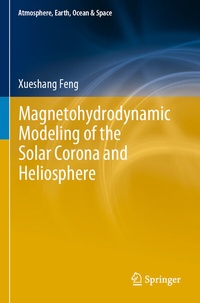
Magnetohydrodynamic Modeling of the Solar Corona and Heliosphere
Published on 28. August 2020
Book
Paperback/Softback
XIX, 772 pages
978-981-13-9083-8 (ISBN)
Description
The book covers intimately all the topics necessary for the development of a robust magnetohydrodynamic (MHD) code within the framework of the cell-centered finite volume method (FVM) and its applications in space weather study. First, it presents a brief review of existing MHD models in studying solar corona and the heliosphere. Then it introduces the cell-centered FVM in three-dimensional computational domain. Finally, the book presents some applications of FVM to the MHD codes on spherical coordinates in various research fields of space weather, focusing on the development of the 3D Solar-InterPlanetary space-time Conservation Element and Solution Element (SIP-CESE) MHD model and its applications to space weather studies in various aspects. The book is written for senior undergraduates, graduate students, lecturers, engineers and researchers in solar-terrestrial physics, space weather theory, modeling, and prediction, computational fluid dynamics, and MHD simulations. It helps readers to fully understand and implement a robust and versatile MHD code based on the cell-centered FVM.
More details
Series
Edition
2020 ed.
Language
English
Place of publication
Singapore
Singapore
Target group
Professional and scholarly
Illustrations
58 s/w Abbildungen, 141 farbige Abbildungen
XIX, 772 p. 199 illus., 141 illus. in color.
Dimensions
Height: 235 mm
Width: 155 mm
Thickness: 43 mm
Weight
1177 gr
ISBN-13
978-981-13-9083-8 (9789811390838)
DOI
10.1007/978-981-13-9081-4
Schweitzer Classification
Other editions
Additional editions
Book
08/2019
Springer
€149.79
Shipment within 15-20 days
Person
Xueshang Feng received his Ph.D. degree from Lanzhou University, People's Republic of China. Then, he worked as a postdoctoral researcher at Beijing University of Aeronautics and Astronautics. He is currently a Professor and the Deputy-Director of the State Key Laboratory of Space Weather, National Space Science Center, Chinese Academy of Sciences. For more than two decades, he has worked extensively on developing numerical methods of space weather modeling and prediction. In 2007, he developed the three-dimensional Solar-Interplanetary space-time Conservation Element and Solution Element (SIP-CESE) MHD model that was validated by employing to simulate the steady-state solar wind, the extrapolation of coronal magnetic field with nonlinear force-free model, and the evolution of coronal mass ejections in the heliosphere. In 2010, he proposed the six-component grid system that consists of six identical component meshes to cover a spherical surface with partial overlap on their boundariesand can avoid mesh convergence and singularities at the pole regions in the common spherical coordinates. He has published more than 300 research papers. He received a Second Class Prize of the National Natural Science Award of China in 2002.
Content
Current status of MHD simulations for space weather.- Finite Volume Methods.- A Finite Volume MHD Code in Spherical Coordinates for Background solar Wind.- 3D SIP-CESE MHD Model on Triangular Prism Grids.- 3D SIP-CESE MHD Model on Six-component Overset Grid System.- AMR Implementation of 3D SIP-CESE MHD Model on Six-component Overset Grid System.- Data-Driven Modeling of Solar Wind.- Coronal Force-Free Field Extrapolations.- Data-Driven MHD Modeling of Coronal Magnetic Evolutions and Eruptions.- Numerical Study of Coronal Mass Ejections.- Future Avenue.