

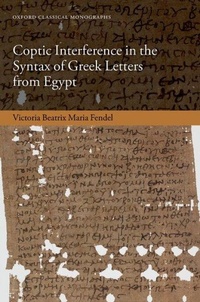
Coptic Interference in the Syntax of Greek Letters from Egypt
Published on 15. September 2022
Book
Hardback
552 pages
978-0-19-286917-3 (ISBN)
Description
Egypt in the early Byzantine period was a bilingual country where Greek and Egyptian (Coptic) were used alongside each other. Historical studies along with linguistic studies of the phonology and lexicon of early Byzantine Greek in Egypt testify to this situation. In order to describe the linguistic traces that the language-contact situation left behind in individuals' linguistic output, Coptic Interference in the Syntax of Greek Letters from Egypt analyses the syntax of early Byzantine Greek texts from Egypt. The primary object of interest is bilingual interference in the syntax of verbs, adverbial phrases, clause linkage as well as in semi-formulaic expressions and formulaic frames. The study is based on a corpus of Greek and Coptic private letters on papyrus, which date from the fourth to mid-seventh centuries, originate from Egypt and belong to bilingual, Greek-Coptic, papyrus archives.
More details
Series
Language
English
Place of publication
Oxford
United Kingdom
Target group
Professional and scholarly
Product notice
sewn/stitched
Cloth over boards
Dimensions
Height: 226 mm
Width: 168 mm
Thickness: 53 mm
Weight
998 gr
ISBN-13
978-0-19-286917-3 (9780192869173)
Copyright in bibliographic data and cover images is held by Nielsen Book Services Limited or by the publishers or by their respective licensors: all rights reserved.
Schweitzer Classification
Other editions
Additional editions
Victoria Beatrix Maria Fendel
Coptic Interference in the Syntax of Greek Letters from Egypt
E-Book
08/2022
1st Edition
OUP eBook
€82.99
Available for download
Victoria Beatrix Maria Fendel
Coptic Interference in the Syntax of Greek Letters from Egypt
E-Book
08/2022
1st Edition
OUP eBook
€82.99
Available for download
Person
Victoria Beatrix Maria Fendel is a Leverhulme Early Career Fellow at the Faculty of Classics, University of Oxford. She completed her undergraduate studies in Classical civilisations in 2012 at the University of Basel, Switzerland, followed by an MA in Greek and Ancient Near East Studies in 2015. For both she held a scholarship by the Studienstiftung des Deutschen Volkes. Fendel then completed her DPhil in Classical languages and literature at the University of Oxford, Lady Margaret Hall, for which she held a Clarendon scholarship (2015-2018). Fendel also completed an MPhil in Theoretical and Applied Linguistics (focusing on French linguistics) at the University of Cambridge, Peterhouse in 2019, for which she held an AHRC scholarship.
Content
I. Setting the scene
1: Introduction
2: Concepts, contexts, corpora
3: The basics of Coptic grammar
4: The grammar of the corpus (standard & variation)
II. Analysis
5: Verb prases: the syntax of arguments
6: Adverbial phrases: the syntax of adjuncts
7: Discourse markers: The syntax of clause-linkage
8: Formulaic language: the syntax of the epistolary frame
9: Semi-formulaic phrases: the syntax of signposts and hedges
III. Contextualising Deviations
10: Summary and Conclusion
Appendix
Bibliography
Appendix: corpus of texts
1: Introduction
2: Concepts, contexts, corpora
3: The basics of Coptic grammar
4: The grammar of the corpus (standard & variation)
II. Analysis
5: Verb prases: the syntax of arguments
6: Adverbial phrases: the syntax of adjuncts
7: Discourse markers: The syntax of clause-linkage
8: Formulaic language: the syntax of the epistolary frame
9: Semi-formulaic phrases: the syntax of signposts and hedges
III. Contextualising Deviations
10: Summary and Conclusion
Appendix
Bibliography
Appendix: corpus of texts