

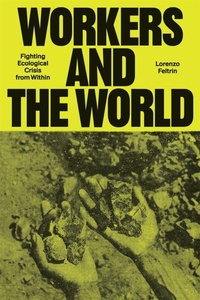
Workers and the World
Fighting Ecological Crisis from Within
Published on 2. June 2026
Book
Paperback/Softback
240 pages
978-1-80429-782-7 (ISBN)
Description
Workers are not doomed to be merely the victims of environmental devastation. As Lorenzo Feltrin shows, they can be key actors in preventing it. Because labour supports an unsustainable system of endless growth, it holds a central place in any strategy for our long-term survival.
Bringing Italian workerist theory into dialogue with a range of traditions from dependency theory to ecofeminism, Feltrin examines the intersection of labour and nature across the globe. By addressing several urgent dimensions of the ecological crisis, such as automation, precarious employment, imperialism and social reproduction, he offers a new framework for understanding how labour struggles and environmental justice are intertwined.
Bringing Italian workerist theory into dialogue with a range of traditions from dependency theory to ecofeminism, Feltrin examines the intersection of labour and nature across the globe. By addressing several urgent dimensions of the ecological crisis, such as automation, precarious employment, imperialism and social reproduction, he offers a new framework for understanding how labour struggles and environmental justice are intertwined.
Reviews / Votes
Lorenzo Feltrin shows us that there are many alternatives to the authoritarian rule of fossil capital, but also to capital as a social relation, since workers essentially reproduce capital. Organised workers and local communities are at the core of struggles for environmental justice and an ecological transition from below. Workers and the World shows the relevance of operaismo. A must read! -- Ulrich Brand, University of Vienna and co-author of the books <i>Imperial Mode of Living</i> and <i>Capitalism at the Limit</i> Can workers win the world for humanity? In this synthesis of shop floor and study, Lorenzo Feltrin makes the most compelling case yet for the ecological potentials of working-class politics. A handbook and treatise, this is a treat for trade union organisers, militant environmentalists and connoisseurs of operaismo alike -- Andreas Malm, co-author of <i>The Long Heat</i>More details
Edition
Paperback original
Language
English
Place of publication
London
United Kingdom
Dimensions
Height: 208 mm
Width: 138 mm
Thickness: 17 mm
Weight
230 gr
ISBN-13
978-1-80429-782-7 (9781804297827)
Copyright in bibliographic data and cover images is held by Nielsen Book Services Limited or by the publishers or by their respective licensors: all rights reserved.
Schweitzer Classification
Person
Lorenzo Feltrin is a researcher at Ca' Foscari University of Venice. He grew up in Treviso, close to Venice and its industrial hub, Porto Marghera. In Treviso, he took part in the occupations that established the Django Social Centre. He is active in international social movement networks mobilising on labour and environmental issues, such as the Ex GKN Florence's autoworkers struggle for a just transition.
Content
Preface
1-Introduction: Workers and the ecological crisis
Environmental justice and labour
Capitalist noxiousness
From noxious deindustrialisation to working-class environmentalism
2-Automation and noxious deindustrialisation: The political composition of capital
The prime mover of the ecological crisis
Deindustrial decline with industrial noxiousness
Grangemouth, UK: Glowing fires, vanishing jobs
3-The surplus working class: Precarity in environmental degradation
The pincer movement
Dispossession by accumulation
Kerkennah, Tunisia: Oil, gas, and blue crabs
4-The international division of labour and noxiousness: Wage, profit and rent in the ecological transition from above
The mysteries of the Trinity formula
The 'green' plan of capital
Ventanas, Chile: Noxious deindustrialisation in extractivism
5-Against noxiousness: Working-class environmentalism from the hidden abodes of production and reproduction
An ecological turn in class composition analysis
Operaismo versus capitalist noxiousness
Marghera vs Marghera, Italy
6-Conclusion: The ecological transition from below
1-Introduction: Workers and the ecological crisis
Environmental justice and labour
Capitalist noxiousness
From noxious deindustrialisation to working-class environmentalism
2-Automation and noxious deindustrialisation: The political composition of capital
The prime mover of the ecological crisis
Deindustrial decline with industrial noxiousness
Grangemouth, UK: Glowing fires, vanishing jobs
3-The surplus working class: Precarity in environmental degradation
The pincer movement
Dispossession by accumulation
Kerkennah, Tunisia: Oil, gas, and blue crabs
4-The international division of labour and noxiousness: Wage, profit and rent in the ecological transition from above
The mysteries of the Trinity formula
The 'green' plan of capital
Ventanas, Chile: Noxious deindustrialisation in extractivism
5-Against noxiousness: Working-class environmentalism from the hidden abodes of production and reproduction
An ecological turn in class composition analysis
Operaismo versus capitalist noxiousness
Marghera vs Marghera, Italy
6-Conclusion: The ecological transition from below