

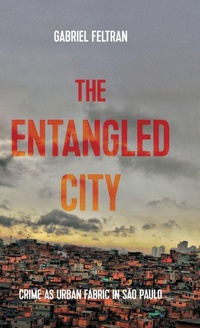
The Entangled City
Crime as Urban Fabric in Sao Paulo
Published on 2. March 2020
Book
Hardback
288 pages
978-1-5261-3824-8 (ISBN)
Description
Based on 15 years of ethnographic fieldwork, the book understands the increasing violence seen in cities as a product of the emergence of transnational illegal markets since the 1970's, followed by the suppression of unskilled workers, in many places racialised young men from poor neighbourhoods. The book gives flesh and blood to these transformations through a careful study of Sao Paulo's case in Brazil. The first part of the book is based on the trajectories of three families, featuring young men affiliated with illegal markets such as drug dealing and car theft, although in very different situations. The clash between the everyday life patterns of these black families, compared to Sao Paulo's white middle classes, gives plausibility to the city's social conflict, most violent after the 80's, when transnational markets arrive and incarceration grows. Sao Paulo's case offers more: this conflict is 70% less lethal in 2017 than it was in the 2000, mostly due to the actions of the PCC (the main criminal group in Brazil, a transnational one) discussed in the second part of the book. The "world of crime" is stronger , yet at the same time homicide rates are falling. The final argument demonstrates that informality, illegality and criminal violence are produced entangling legal and illegal markets and formal/informal institutions, not only in Sao Paulo. -- .
Reviews / Votes
'This book combines parts of Feltran's Irmaos: Uma Historia do PCC (2018) in translation with related material from decades of ethnographic work in the periphery of Sao Paulo. The study is framed by the actions of the Primeiro Comando da Capital (PCC), a criminal organization founded in the prisons of Sao Paulo state that has challenged police forces and is credited with lowering homicide rates through its insistence on mediation within the criminal world. Feltran (Federal Univ. of Sao Carlos, Brazil) approaches this topic through the story of Ivete (a migrant from northeastern Brazil), her children, and her grandchildren, whom he witnessed come of age during his research. Tracing their paths through both criminal and non-criminal worlds provides a de-sensationalized perspective on the ramifications of the PCC's use of non-hierarchical debates to limit violence in and out of prison. Though indiscriminate murder has declined, kidnappings, robberies, and drug trafficking continue, and the cost of business, whether bribes or other payments, has increased. Feltran's juxtaposition of distinct systems of authority-that of the state, the PCC, and others-suggests the world of crime is not an aberration of modernity but rather an integral component of that historical process.'J. M. Rosenthal, Western Connecticut State University -- .
More details
Language
English
Place of publication
Manchester
United Kingdom
Target group
College/higher education
Professional and scholarly
Dimensions
Height: 222 mm
Width: 145 mm
Thickness: 21 mm
Weight
540 gr
ISBN-13
978-1-5261-3824-8 (9781526138248)
Copyright in bibliographic data and cover images is held by Nielsen Book Services Limited or by the publishers or by their respective licensors: all rights reserved.
Schweitzer Classification
Other editions
Additional editions
E-Book
03/2020
1st Edition
Manchester University Press
€36.49
Available for download
E-Book
03/2020
1st Edition
Manchester University Press
€55.99
Available for download
Person
Gabriel Feltran is Professor at the Department of Sociology of the Federal University of Sao Carlos, Scientific Director of the Centre for Metropolitan Studies (CEM, Sao Paulo) and researcher at the Centre for Urban Ethnography at the Brazilian Centre for Analysis and Planning (CEBRAP) -- .
Content
Foreword by Brodwyn Fischer
Introduction
1 Boundaries of difference: on essence and deconstruction
2 Legitimacy in dispute: the boundaries of the 'world of crime' in Sao Paulo
3 Coexistence
4 Crime and punishment in the city: repertories of justice and homicides in Sao Paulo
5 Violence and its management
6 Government produces crime, crime produces government: Sao Paulo's apparatus for homicide
management
Conclusion
References
Index -- .
Introduction
1 Boundaries of difference: on essence and deconstruction
2 Legitimacy in dispute: the boundaries of the 'world of crime' in Sao Paulo
3 Coexistence
4 Crime and punishment in the city: repertories of justice and homicides in Sao Paulo
5 Violence and its management
6 Government produces crime, crime produces government: Sao Paulo's apparatus for homicide
management
Conclusion
References
Index -- .