

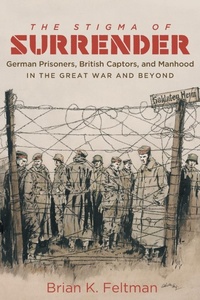
The Stigma of Surrender
German Prisoners, British Captors, and Manhood in the Great War and Beyond
Published on 30. August 2016
Book
Paperback/Softback
280 pages
978-1-4696-3351-0 (ISBN)
Description
Approximately 9 million soldiers fell into enemy hands from 1914 to 1918, but historians have only recently begun to recognize the prisoner of war's significance to the history of the Great War. Examining the experiences of the approximately 130,000 German prisoners held in the United Kingdom during World War I, historian Brian K. Feltman brings wartime captivity back into focus.
Many German men of the Great War defined themselves and their manhood through their defense of the homeland. They often looked down on captured soldiers as potential deserters or cowards--and when they themselves fell into enemy hands, they were forced to cope with the stigma of surrender. This book examines the legacies of surrender and shows that the desire to repair their image as honorable men led many former prisoners toward an alliance with Hitler and Nazism after 1933. By drawing attention to the shame of captivity, this book does more than merely deepen our understanding of German soldiers' time in British hands. It illustrates the ways that popular notions of manhood affected soldiers' experience of captivity, and it sheds new light on perceptions of what it means to be a man at war.
Many German men of the Great War defined themselves and their manhood through their defense of the homeland. They often looked down on captured soldiers as potential deserters or cowards--and when they themselves fell into enemy hands, they were forced to cope with the stigma of surrender. This book examines the legacies of surrender and shows that the desire to repair their image as honorable men led many former prisoners toward an alliance with Hitler and Nazism after 1933. By drawing attention to the shame of captivity, this book does more than merely deepen our understanding of German soldiers' time in British hands. It illustrates the ways that popular notions of manhood affected soldiers' experience of captivity, and it sheds new light on perceptions of what it means to be a man at war.
Reviews / Votes
Feltman's discussion of the psychological struggles of captivity applies to more than just these POWs . . . it is nuanced enough to be a useful guide to understanding the psychological effect being prisoners of al-Qaeda in the Maghreb for almost a hundred days in 2008-09 had on the Canadian diplomats Bob Fowler and Louis Guay.--Times Literary Supplement|Provides a new perspective on the German concept of Heldentod (the hero's death) by exploring those who avoided such a fate through surrender.--H-Net Reviews
|Provides useful signposts on the path for further research.--Revista Universitaria de Historia Militar
|[This] well written, carefully researched study persuasively clarifies the elusive and intricate definitions of manhood at the grass roots level of soldiers' everyday lives.--Michigan War Studies Review
|The research sparkles with primary sources, and the writing flows extremely well . . . . A wonderful contribution to both POW and WW I studies."" --CHOICE
|[A] welcome addition to First World War scholarship.--Military History
More details
Language
English
Place of publication
Chapel Hill
United States
Product notice
Paperback (trade)
Unsewn / adhesive bound
Illustrations
15 - 14 halftones
Dimensions
Height: 229 mm
Width: 156 mm
Thickness: 20 mm
Weight
422 gr
ISBN-13
978-1-4696-3351-0 (9781469633510)
Copyright in bibliographic data and cover images is held by Nielsen Book Services Limited or by the publishers or by their respective licensors: all rights reserved.
Schweitzer Classification
Other editions
Additional editions
Brian K. Feltman
The Stigma of Surrender
German Prisoners, British Captors, and Manhood in the Great War and Beyond
E-Book
03/2015
The University of North Carolina Press
€19.49
Available for download
Person
Brian K. Feltman is assistant professor of history at Georgia Southern University.