

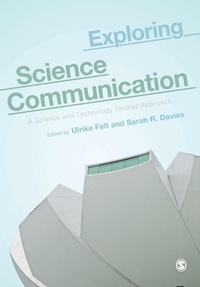
Exploring Science Communication
A Science and Technology Studies Approach
1st Edition
Published on 20. February 2020
Book
Paperback/Softback
264 pages
978-1-5264-6440-8 (ISBN)
Description
Exploring Science Communication demonstrates how science and technology studies approaches can be explicitly integrated into effective, powerful science communication research. Through a range of case studies, from climate change and public parks to Facebook, museums, and media coverage, it helps you to understand and analyse the complex and diverse ways science and society relate in today's knowledge intensive environments. Notable features include:
A focus on showing how to bring academic STS theory into your own science communication research
Coverage of a range of topics and case studies illustrating different analyses and approaches
Speaks to disciplines across Media & Communication, Science & Technology Studies, Health Sciences, Environmental Sciences and related areas.
With this book you will learn how science communication can be more than just about disseminating facts to the public, but actually generative, leading to new understanding, research, and practices.
A focus on showing how to bring academic STS theory into your own science communication research
Coverage of a range of topics and case studies illustrating different analyses and approaches
Speaks to disciplines across Media & Communication, Science & Technology Studies, Health Sciences, Environmental Sciences and related areas.
With this book you will learn how science communication can be more than just about disseminating facts to the public, but actually generative, leading to new understanding, research, and practices.
Reviews / Votes
Exploring Science Communication brilliantly demonstrates how Science Communication can be enhanced and elaborated through an engagement with Science and Technology Studies. Analytically and empirically, the volume traces the complex roles of Science Communication in the making and doing of science, publics and politics. Essential reading for both analysts and practitioners. -- Mike Michael Science communication emerges as much more than getting new knowledge 'out' to larger society. Through a series of insightful contributions, science communication is revealed as shaping both science and society, re-imagining our socio-technical futures and creating narratives of governance, responsibility and change. Seen from an STS perspective, science communication 'matters' in important, challenging and unexpected ways. -- Alan IrwinMore details
Language
English
Place of publication
London
United Kingdom
Target group
Professional and scholarly
Dimensions
Height: 244 mm
Width: 170 mm
Thickness: 15 mm
Weight
462 gr
ISBN-13
978-1-5264-6440-8 (9781526464408)
Copyright in bibliographic data and cover images is held by Nielsen Book Services Limited or by the publishers or by their respective licensors: all rights reserved.
Schweitzer Classification
Other editions
Additional editions
Ulrike Felt | Sarah R. Davies
Exploring Science Communication
A Science and Technology Studies Approach
Book
02/2020
1st Edition
SAGE Publications Ltd
€180.90
Shipment within 15-20 days
Ulrike Felt | Sarah R. Davies
Exploring Science Communication
A Science and Technology Studies Approach
E-Book
01/2020
1st Edition
SAGE Publications Ltd
€88.49
Available for download
Ulrike Felt | Sarah R. Davies
Exploring Science Communication
A Science and Technology Studies Approach
E-Book
01/2020
1st Edition
SAGE Publications Ltd
€88.49
Available for download
Ulrike Felt | Sarah R. Davies
Exploring Science Communication
A Science and Technology Studies Approach
E-Book
01/2020
1st Edition
SAGE Publications Ltd
€88.49
Available for download
Persons
Ulrike Felt is Professor and Head of the Department of Science and Technology Studies as well as of the research platform Responsible Research and Innovation in Academic Practice at the University of Vienna, Austria.
Sarah R. Davis is Professor of Media, Cognition and Communication at the Norwegian University of Science and Technology, with a research interest in public engagement and public understanding of science.
Sarah R. Davis is Professor of Media, Cognition and Communication at the Norwegian University of Science and Technology, with a research interest in public engagement and public understanding of science.
Content
Chapter 1. Introduction
Part I - STS Concepts and Sensitivities
Chapter 2. Conceptual Framings: STS Research for Science Communication
Chapter 3. What does an STS approach to Science Communication Look Like?
Part II - Mobilizing STS Concepts and Sensitivities: The Case Studies
Chapter 4. Object Biographies: The Life of a Hacked Gene Gun - Tybjerg, Karin; Whiteley, Louise; Davies, Sarah R.
Chapter 5. Public Science and Public Space: Communicating Ecologies through Landscape Design - Owens, Marcus
Chapter 6. Visual Climate Communication: Making Facts and Concerns in Popular Science Magazines - Born, Dorothea
Chapter 7. Public Health Communication: Anecdotal Evidence and Responsibility in Print Media Accounts of Obesity - Felt, Ulrike
Chapter 8. Constructing Science in Public: Framing Synthetic Yeast in News Media - Szymanski, Erika
Chapter 9. Science, Emotion, and Identity Online: Constructing Science and Selves on "I Fucking Love Science" - Marsh, Oliver
Chapter 10. Coproducing Knowledge and Nation States: Nutrition Communication and the making of Citizens - Ben Shachar, Teharlev Erela; Davidovitch, Nadav
Chapter 11. Communicating Forensic Genetics: "Enthusiastic" Publics and the Management of Expectations - Amelung, Nina; Granja, Rafaela; Machado, Helena
Part III - Concluding Thoughts
Chapter 12. Connections, Assemblages, and Open Ends
Part I - STS Concepts and Sensitivities
Chapter 2. Conceptual Framings: STS Research for Science Communication
Chapter 3. What does an STS approach to Science Communication Look Like?
Part II - Mobilizing STS Concepts and Sensitivities: The Case Studies
Chapter 4. Object Biographies: The Life of a Hacked Gene Gun - Tybjerg, Karin; Whiteley, Louise; Davies, Sarah R.
Chapter 5. Public Science and Public Space: Communicating Ecologies through Landscape Design - Owens, Marcus
Chapter 6. Visual Climate Communication: Making Facts and Concerns in Popular Science Magazines - Born, Dorothea
Chapter 7. Public Health Communication: Anecdotal Evidence and Responsibility in Print Media Accounts of Obesity - Felt, Ulrike
Chapter 8. Constructing Science in Public: Framing Synthetic Yeast in News Media - Szymanski, Erika
Chapter 9. Science, Emotion, and Identity Online: Constructing Science and Selves on "I Fucking Love Science" - Marsh, Oliver
Chapter 10. Coproducing Knowledge and Nation States: Nutrition Communication and the making of Citizens - Ben Shachar, Teharlev Erela; Davidovitch, Nadav
Chapter 11. Communicating Forensic Genetics: "Enthusiastic" Publics and the Management of Expectations - Amelung, Nina; Granja, Rafaela; Machado, Helena
Part III - Concluding Thoughts
Chapter 12. Connections, Assemblages, and Open Ends