

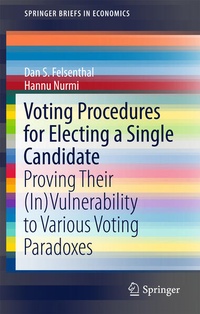
Voting Procedures for Electing a Single Candidate
Proving Their (In)Vulnerability to Various Voting Paradoxes
Published on 26. January 2018
Book
Paperback/Softback
XV, 134 pages
978-3-319-74032-4 (ISBN)
Description
This book deals with 18 voting procedures used or proposed for use in elections resulting in the choice of a single winner. These procedures are evaluated in terms of their ability to avoid paradoxical outcomes. Together with a companion volume by the same authors,
Monotonicity Failures Afflicting Procedures for Electing a Single Candidate
, published by Springer in 2017, this book aims at giving a comprehensive overview of the most important advantages and disadvantages of procedures thereby assisting decision makers in the choice of a voting procedure that would best suit their purposes.
More details
Series
Edition
1st ed. 2018
Language
English
Place of publication
Cham
Switzerland
Publishing group
Springer International Publishing
Target group
Professional and scholarly
Illustrations
XV, 134 p.
Dimensions
Height: 235 mm
Width: 155 mm
Thickness: 9 mm
Weight
242 gr
ISBN-13
978-3-319-74032-4 (9783319740324)
DOI
10.1007/978-3-319-74033-1
Schweitzer Classification
Other editions
Additional editions
Dan S. Felsenthal | Hannu Nurmi
Voting Procedures for Electing a Single Candidate
Proving Their (In)Vulnerability to Various Voting Paradoxes
E-Book
01/2018
Springer
€53.49
Available for download
Persons
Dan Felsenthal
is emeritus professor of political science at the University of Haifa. Currently he is also Research Associate at the Centre for the Philosophy of Natural and Social Science, London School of Economics and Political Science. His main research areas are measurement of voting power, voting theory and voting behavior, social choice theory, and various applications of game theory to politics. He has published many papers on these subjects as well as two books:
Topics in Social Choice: Sophisticated Voting, Efficacy, and Proportional Representation
(New York: Praeger, 1990), and (jointly with Moshé Machover)
The Measurement of Voting Power: Theory and Practice, Problems and Paradoxes
(Cheltenham, UK: Edward Elgar Publishing Ltd., 1998). In addition, he edited (jointly with Moshé Machover) the book
Electoral Systems: Paradoxes, Assumptions, and Procedures
(Berlin Heidelberg: Springer, 2012).
Hannu Nurmi was the Associate Professor of Methodology of Social Sciences in University of Turku 1974 - 1995. Thereafter he became the chair holder of Political Science in the same university until his retirement in 2012.During the academic year 1972-73 he was a Fulbright-Hayes Scholar at the Johns Hopkins University. In 1978 Nurmi held a British Academy Wolfson Fellowship at University of Essex and from 1991 till 1996 he was the Dean of the Faculty of Social Sciences in University of Turku. In 1998 he was a Visiting Professor at University of Minnesota. Nurmi was nominated the Academy Professor of Academy of Finland for the period 2003-2008. He is a member of Academia Scientiarum Fennica (the Finnish Academy of Sciences and Letters) from 1982. From 2008 till 2011 he was the Director of Centre of Excellence in Public Choice Research of University of Turku. From 2012 he is Professor Emeritus in the same university. Nurmi's research interests include the theory of voting and electoral systems, applied game theory and causal modeling.
Hannu Nurmi was the Associate Professor of Methodology of Social Sciences in University of Turku 1974 - 1995. Thereafter he became the chair holder of Political Science in the same university until his retirement in 2012.During the academic year 1972-73 he was a Fulbright-Hayes Scholar at the Johns Hopkins University. In 1978 Nurmi held a British Academy Wolfson Fellowship at University of Essex and from 1991 till 1996 he was the Dean of the Faculty of Social Sciences in University of Turku. In 1998 he was a Visiting Professor at University of Minnesota. Nurmi was nominated the Academy Professor of Academy of Finland for the period 2003-2008. He is a member of Academia Scientiarum Fennica (the Finnish Academy of Sciences and Letters) from 1982. From 2008 till 2011 he was the Director of Centre of Excellence in Public Choice Research of University of Turku. From 2012 he is Professor Emeritus in the same university. Nurmi's research interests include the theory of voting and electoral systems, applied game theory and causal modeling.
Content
Introduction.- Voting Paradoxes.- Voting Procedures Designed to Elect a Single Candidate.- The (In)Vulnerability of Non-Ranked Voting Procedures to Various Paradoxes.- The (In)Vulnerability of Ranked Voting Procedures that are Not Condorcet-Consistent to Various Paradoxes.- The (In)Vulnerability of the Ranked Condorcet-Consistent Procedures to Various Paradoxes.- Summary.