

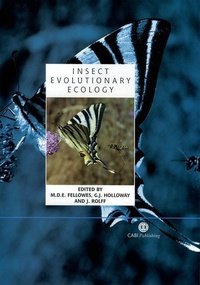
Insect Evolutionary Ecology
Proceedings of the Royal Entomological Society's 22nd Symposium
Published on 20. September 2005
Book
Hardback
448 pages
978-0-85199-812-1 (ISBN)
Description
Insects provide excellent model systems for understanding evolutionary ecology. They are abundant, small, and relatively easy to rear, and these traits facilitate both field and laboratory experiments. This book has been developed from the Royal Entomological Society's 22nd international symposium, held in Reading in 2003. Topics include speciation and adaptation; life history, phenotype plasticity and genetics; sexual selection and reproductive biology; insect-plant interactions; insect-natural enemy interactions; and social insects.
More details
Series
Language
English
Place of publication
Wallingford
United Kingdom
Target group
Professional and scholarly
Product notice
sewn/stitched
Cloth over boards
Dimensions
Height: 249 mm
Width: 178 mm
Thickness: 33 mm
Weight
1352 gr
ISBN-13
978-0-85199-812-1 (9780851998121)
Copyright in bibliographic data and cover images is held by Nielsen Book Services Limited or by the publishers or by their respective licensors: all rights reserved.
Schweitzer Classification
Persons
Edited by M Fellowes, University of Reading; G Holloway, University of Reading; J Rolff, University of Sheffield, UK
Content
1: Genetics, Relatedness and Social Behaviour in Insect SocietiesA F G Bourke, Zoological Society of London, UK 2: Do Insect Sexual Ornaments Demonstrate Heightened Condition-Dependence? S Cotton, and A Pomiankowski,University College London, UK 3: Sperm Competition in Butterflies and Moths, N Wedell,University of Leeds, Leeds, UK 4: Alternative Mating Tactics and Fatal Fighting in Male FigWasps, J M Cook, Imperial College London, UK 5: Seasonal Plasticity, Host Plants, and the Origin ofButterfly Biodiversity, S Nylin, K Gotthard andG H Nygren, Stockholm University, Sweden 6: Life Histories and Parasite Pressure Across the MajorGroups of Social Insects, J J Boosma, University of Copenhagen, Denmark, P Schmid-Hempel, ETH Zurich,Switzerland and W O H Hughes, University of Copenhagen,Denmark 7: Cascading Effects of Plant Genetic Variation onHerbivore Communities, R S Fritz, Vassar College,Poughkeepsie, New York USA and C G Hochwender,University of Evansville, Indiana, USA 8: The Role of Insect Reproduction in the Diversification of Insect Reproductive Processes, G DD Hurst, UniversityCollege London, UK, K M Webberley and R Knell, University of London, UK 9: The Evolution of Imperfect Mimicry, F Gilbert,Nottingham University, UK 10: Evolutionary Ecology of Insect Host-Parasite Interactions:and Ecological Immunology Perspective,K Wilson, Lancaster University, UK 11: Adaptive Plasticity in Response to Predators in DragonflyLarvae and Other Aquatic Insects, F Johansson, UmeaUniversity, Sweden and R Stoks, University of Leuven,Belgium 12: The Peppered Moth: Decline of a Darwinian Disciple,M E N Majerus, University of Cambridge, UK 13: Insecticide Resistance in the Mosquito Culex Pipiens:Towards an Understanding of the Evolution of AceGenes, M Weill, P Labbe, O Duron, N Pasteur, M Raymond, Universite Montpellier II, France, P Fort, CNRS, Montpellier,France 14: Molecular and Ecological Differentiation of Species Interactions Across Large Geographic Regions: Californiaand the Pacific Northwest, J N Thompson , University of California, Santa Cruz, USA and R Calsbeek, University ofCalifornia, Los Angeles, USA 15: The Genetic Basis of Speciation in a Grasshopper HybridZone, D M Shuker, University of Edinburgh, UK, T M King,University of Otago, Dunedin, New Zealand, J L Bella,Universidad Autonoma de Madrid, Spain and R K Butlin,University of Sheffield, UK 16: Assortative Mating and Speciation as Pleiotropic Effectsof Ecological Adaptation: Examples in Moths and Butterflies, CD Jiggins, University of Edinburgh, UK, I Emelianov, Rothamsted Research, Harpenden, and J Mallet, University College London, UK 17: Evolutionary Changes In Expanding Butterfly Populations,J K Hill, C Dytham and C L Hughes, University of York, UK 18: Specialisations and Host Associations of Social Parasitesof Ants, J A Thomas, K Schoenrogge and G W Elmes,Winfrith Technology Centre, Dorset, UK