

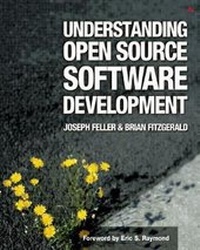
Understanding Open Source Software Development
Published on 19. December 2001
Book
Paperback/Softback
224 pages
978-0-201-73496-6 (ISBN)
Description
Open Source Software Development offers the first serious (and academically rigorous) study of the OSS phenomenon. The authors examine several key aspects of OSS, for example:
Definitions of OSS and Free Software, including a comprehensive guide to both OSS and non-OSS software licences.
Profiles of key OSS products, projects, companies and organisations.
Analysis of the technological motivations for OSS development, with explicit reference to the possibility of OSS addressing the "software crisis."
Definitions of OSS and Free Software, including a comprehensive guide to both OSS and non-OSS software licences.
Profiles of key OSS products, projects, companies and organisations.
Analysis of the technological motivations for OSS development, with explicit reference to the possibility of OSS addressing the "software crisis."
Reviews / Votes
Information Research - a paper that, incidentally, has attracted almost 2,000 'hits' since last July. There is, as a result, a certain degree of familiarity with everything about this book - both subject and authorship!Raymond, in the Foreword, comments that this is the first attempt to pull together the various strands in the development of open source software that the pioneers of this approach have not had time, or perhaps the inclination, to put together themselves. This, indeed, appears to be the case. The authors have clear objectives: they note, in the introduction that they wished to produce a book that would be useful to both academic and professional readers:
On the academic side, we have endeavoured to provide... a thorough sythesis and analysis of the OSS research that has appeared to date... On the professional side, we wanted to disseminate the significant volume of rigorous academic reearch into OSS development practices back into the development community. The authors define Open Source Software by reference to the
Apache, which has an OSD licence, and is the most used server software in the world, with (at November 2001) 56.5% of the market. Key among the terms of the licence are; that the vendor must maintain the integrity of the author's source code by providing 'patches' that make changes when the software is 'built' on the user's machine, rather than my modifying it before distribution; that there should be no discrimination against persons or groups of persons; and that the user should be able to modify the source code and share those modifications with the author and with others. The fact that companies like Red Hat, seller of the Linux programming language, Netscape and even IBM are happy to beome involved with OSS suggests that the process must bring benefits.
The authors describe the process that gives the benefits, noting that the process is parallel, with many developers simultaneously involved in the process, rather than a single software team in a commercial sofware company, that there is genuine peer review of suggestions and code in the process of creation, that there is increased user involvement, and that the process uses a succession of rapid releases of new versions, ensuring that users always have the latest version available quickly. The also explore also the weaknesses and problems of OSS, and en route, discuss the organizations involved in the OSS movement and how the development process in managed. They also suggest that the key issues in OSS are not technological, but sociological, in that the process explores a new way of working that may well extend into other fields of endeavour.
This book is well written, clear in its exposition, well illustrated with quotations from people in the OSS 'movement' and from other industry leaders and will serve as a useful text on this mode of software development.
The first author, Feller, maintains a Web site on open source software, which provides resources and links to supplement this text.
More details
Language
English
Place of publication
Harlow
United Kingdom
Publishing group
Pearson Education Limited
Target group
Professional and scholarly
Dimensions
Height: 233 mm
Width: 186 mm
Thickness: 9 mm
Weight
410 gr
ISBN-13
978-0-201-73496-6 (9780201734966)
Copyright in bibliographic data and cover images is held by Nielsen Book Services Limited or by the publishers or by their respective licensors: all rights reserved.
Schweitzer Classification
Persons
Dr. Joseph Feller is a College Lecturer in Business Information Systems, University College Cork. Previously, he was an Adjunct Professor at the Ringling School of Art and Design, in Florida. He was awarded the PhD by National University of Ireland, University College Cork.
Dr. Brian Fitzgerald is a Statutory Lecturer in Business Information Systems, University College Cork. He was awarded the PhD by the University of London and has published papers on systems development methodologies in a number of international academic journals, including IEEE Software, Information & Management, Journal of Information Technology, and The Information Systems Journal, and has presented systems development research at over 20 international conferences
Dr. Brian Fitzgerald is a Statutory Lecturer in Business Information Systems, University College Cork. He was awarded the PhD by the University of London and has published papers on systems development methodologies in a number of international academic journals, including IEEE Software, Information & Management, Journal of Information Technology, and The Information Systems Journal, and has presented systems development research at over 20 international conferences
Content
Introduction
a. Why Study Open Source Software?
i. The Software Crisis
ii. Market Penetration/Industrial Buy-In
iii. Compelling Theoretical Issues
b. How to Use the Book
i. Intended Audiences (Course-based, Research-based, Professional)
ii. Online Supplements (OPEN reSOURCEs, Contacting the Authors)
iii. Structure of the Book
Section One: Background
1. Overview of Open Source Software
2. The History of Open Source and Free Software
3. The Landscape of Open Source Software
4. Deriving an Analytical Framework
5. Characterising Open Source Software
6. The Open Source Software Development Process
7. Open Source Software Development Tools
8. Technological Motivations for Open Source Software
9. Economic Motivations for Open Source Software
10. Psycho-Social Motivations for Open Source Software
11. When (and Why) Open Source Fails
12. Challenges and Opportunities: The Future of Open Source Software
Appendix: Recommendations for Researchers
Bibliography
Index
a. Why Study Open Source Software?
i. The Software Crisis
ii. Market Penetration/Industrial Buy-In
iii. Compelling Theoretical Issues
b. How to Use the Book
i. Intended Audiences (Course-based, Research-based, Professional)
ii. Online Supplements (OPEN reSOURCEs, Contacting the Authors)
iii. Structure of the Book
Section One: Background
1. Overview of Open Source Software
2. The History of Open Source and Free Software
3. The Landscape of Open Source Software
4. Deriving an Analytical Framework
5. Characterising Open Source Software
6. The Open Source Software Development Process
7. Open Source Software Development Tools
8. Technological Motivations for Open Source Software
9. Economic Motivations for Open Source Software
10. Psycho-Social Motivations for Open Source Software
11. When (and Why) Open Source Fails
12. Challenges and Opportunities: The Future of Open Source Software
Appendix: Recommendations for Researchers
Bibliography
Index