

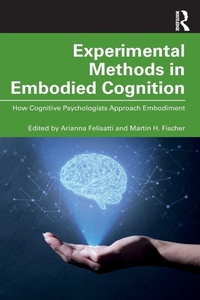
Experimental Methods in Embodied Cognition
How Cognitive Psychologists Approach Embodiment
1st Edition
Published on 11. October 2023
Book
Paperback/Softback
200 pages
978-1-032-25613-9 (ISBN)
Description
Experimental Methods in Embodied Cognition presents a timely introduction to methodologies of cognitive science from a theoretical perspective.
Embodied approaches to cognition are becoming increasingly prevalent in teaching and research globally, but until now a comprehensive book combining theoretical principles and practical methods for embodied cognition has been missing. Embracing this theoretical principle, the book introduces and compares different psychological methods from theoretical, technical, and methodological points of view. Informed by the direct experiences of a specialised group of authors, the text also offers a taxonomy of methods, including technical hands-on descriptions to support student learning. Each chapter includes suggestions for their use, enabling readers to compare methodologies and to find the most suitable approach for their specific research questions. Finally, the book also addresses the effects of different cultural immersions and learning experiences, offering an overview of other, non-psychological approaches to embodied cognition research, including comparative research with animals and humanoid robots.
This is an essential read for students and researchers of embodied cognition across various fields, ranging from psychology and cognitive neuroscience to philosophy, linguistics, economics, and sport science.
Embodied approaches to cognition are becoming increasingly prevalent in teaching and research globally, but until now a comprehensive book combining theoretical principles and practical methods for embodied cognition has been missing. Embracing this theoretical principle, the book introduces and compares different psychological methods from theoretical, technical, and methodological points of view. Informed by the direct experiences of a specialised group of authors, the text also offers a taxonomy of methods, including technical hands-on descriptions to support student learning. Each chapter includes suggestions for their use, enabling readers to compare methodologies and to find the most suitable approach for their specific research questions. Finally, the book also addresses the effects of different cultural immersions and learning experiences, offering an overview of other, non-psychological approaches to embodied cognition research, including comparative research with animals and humanoid robots.
This is an essential read for students and researchers of embodied cognition across various fields, ranging from psychology and cognitive neuroscience to philosophy, linguistics, economics, and sport science.
Reviews / Votes
'This is the book all researchers and students in psychology and cognitive (neuro)science were missing. An updated introduction to the main methods - methods of all sorts: behavioral and neuroscientific, questionnaires, methods based on new technologies such as virtual reality and robotics, and many others. A very dense but accessible book with a strong interdisciplinary flavor, which helps everyone understand the most complex and sophisticated aspects of our discipline. A must-read for everyone interested in the body's role in cognition and overall cognition, and more generally, for everyone wanting to know more about how to conduct research.'Professor Anna M. Borghi, Associate Professor of Psychology, Sapienza University of Rome and ISTC-CNR, Rome, Italy
'Experimental Methods in Embodied Cognition" is a wealth of ideas and practical advice. It is an exploration of human cognition that blends interdisciplinary theory and practical research techniques. An essential guide for anyone journeying through the fascinating landscape of embodied cognition.'
Professor Tatjana Nazir, Research Director of SCALab, University of Lille, France
'This is a must-read book for all wondering how the body has an impact on our cognition and how we can measure this. Arianna Felisatti and Martin H. Fischer edited the first comprehensive volume on how we use experimental methods in embodied cognition. The book is written by experts in the field and addresses answers to both students and researchers alike. In a nutshell it's timely, relevant and an outstanding source on how cognitive psychologists approach embodiment.'
Professor Markus Raab, Head of the Institute of Psychology and the Department of Performance Psychology at the German Sport University Cologne and Research Professor at the London South Bank University, UK
More details
Language
English
Place of publication
London
United Kingdom
Publishing group
Taylor & Francis Ltd
Target group
College/higher education
Postgraduate and Undergraduate Advanced
Illustrations
20 s/w Zeichnungen, 3 s/w Tabellen, 23 s/w Abbildungen, 3 s/w Photographien bzw. Rasterbilder
3 Tables, black and white; 20 Line drawings, black and white; 3 Halftones, black and white; 23 Illustrations, black and white
Dimensions
Height: 234 mm
Width: 156 mm
Thickness: 12 mm
Weight
342 gr
ISBN-13
978-1-032-25613-9 (9781032256139)
Copyright in bibliographic data and cover images is held by Nielsen Book Services Limited or by the publishers or by their respective licensors: all rights reserved.
Schweitzer Classification
Other editions
Additional editions
Arianna Felisatti | Martin H. Fischer
Experimental Methods in Embodied Cognition
How Cognitive Psychologists Approach Embodiment
E-Book
10/2023
1st Edition
Routledge
€51.49
Available for download
Arianna Felisatti | Martin H. Fischer
Experimental Methods in Embodied Cognition
How Cognitive Psychologists Approach Embodiment
E-Book
10/2023
1st Edition
Routledge
€51.49
Available for download
Arianna Felisatti | Martin H. Fischer
Experimental Methods in Embodied Cognition
How Cognitive Psychologists Approach Embodiment
Book
10/2023
1st Edition
Routledge
€206.20
Shipment within 10-20 days
Persons
Arianna Felisatti is a cognitive scientist with a background in neuroscience and neuropsychological rehabilitation. Her main research interests are numerical cognition in humans and animals, mental arithmetic, finger counting, embodied cognition, and hemispheric asymmetry.
Martin H. Fischer is a professor of cognitive sciences with a background in attention research and motor control. He is the leader of the Potsdam Embodied Cognition Group.
Martin H. Fischer is a professor of cognitive sciences with a background in attention research and motor control. He is the leader of the Potsdam Embodied Cognition Group.
Content
PART I Introduction; 1 The embodied cognition approach: Principles and research questions; 2 A taxonomy of methods in embodied cognition research; PART II Behavioral methods; 3 Chronometric methods: Reaction times and movement times; 4 Continuous methods: Eye tracking, hand tracking, and grip force recording, 5 Physiological methods: Heart rate, breathing, electrodermal activity; PART III Neuroscientific methods; 6 Correlational methods: EEG, fMRI, fNIRS and neurofeedback, 7 Non-invasive brain stimulation methods: Transcranial magnetic stimulation, transcranial electric stimulation, transcutaneous vagus nerve stimulation; 8 Neuropsychological methods: Patient studies; PART IV Other methods and interdisciplinary approaches; 9 Non-experimental psychological methods: Questionnaires, tests, and rating studies; 10 Virtual reality as experimental method in embodied cognition; 11 Interdisciplinary approaches to embodied cognition research