

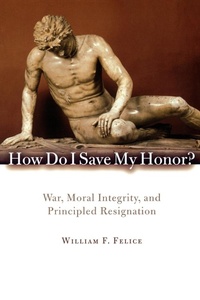
How Do I Save My Honor?
War, Moral Integrity, and Principled Resignation
Published on 16. August 2009
Book
Paperback/Softback
240 pages
978-0-7425-6667-5 (ISBN)
Description
How Do I Save My Honor? is a powerful exploration of individual moral responsibility in a time of war. When people decide that the actions of their government have violated basic norms of ethics and justice, what are they to do? Are there degrees of moral responsibility that public officials, soldiers, and private citizens bear for unethical actions of their leaders and government? William F. Felice considers these central ethical questions through the compelling stories of individuals in the U.S. and British government and military who struggled to protect their moral integrity during the Iraq war and occupation. Some came to the difficult conclusion that resignation from their post was necessary to maintain their responsibility to the truth and to uphold their honor. Others decided to work from within to try to correct what they perceived as misguided policies. Examining the struggles of these contemporary men and women, as well as of historical figures facing similar dilemmas, William Felice weighs the profound difficulties of overcoming the intense pressures of misguided loyalty, patriotism, and groupthink that predominate during war.
Reviews / Votes
Felice's book represents a clear, committed, even passionate cry for moral integrity, particularly with respect to the public right to know in instances of war, belligerence, or states of emergency. His analysis refers to a range of philosophical approaches including realism, utilitarian consequentialism, and deontological theories of reason and right. He stresses the importance of moral obligation in all circumstances involving hierarchical command, combat, and war. His reflections on deontology and human rights, civil disobedience, and Machiavellian notions, and 'dirty hands' provide useful guideposts toward a deeper philosophical understanding of the central issues at play. . . . Felice has written a clear and well argued presentation that outlines the costs to a democratic polity for a dishonorable loyalty and the need for deliberative politics that is renewed by the honor of moral integrity expressed through principles of resignation in protest. * Human Rights Quarterly * [Felice's] scholarly backdrop cites just war theory, philosophers from Aristotle to Kant and Thoreau, and his own interview with ethicist Peter Singer, but he relies on case studies of American and British officials and soldiers who resigned, or refused to fight, to carry the argument. * Publishers Weekly * We think of a soldier's honor in terms of military discipline and service to a cause. But William Felice's book How Do I Save My Honor? focuses on the times when refusing to serve might be the honorable thing to do. . . . A challenging, thoughtful look at a highly complex question. * St. Petersburg Times * Weighty and informative. . . . Among How Do I Save My Honor?'s most compelling arguments is the author's juxtaposition of Powell's post-Vietnam vow to resist half-baked, poorly understood, and insufficiently supported reasons for war with his role in facilitating the 2003 invasion of Iraq as secretary of state. . . . Political scientists, military professionals, and citizens would do well to discuss, debate, and reflect on the validity of Felice's blistering critique of Powell's distinction between 'ethical' and 'policy' reservations. . . . [A] serious book . . . [that] deserves the attention of political scientists and, especially, military professionals. * Perspectives on Politics * This analysis makes an important contribution to the literature on international ethics, providing both a philosophical exploration of wartime moral obligations and illustrations of how individuals have sought to address incompatible moral claims. . . . Recommended. * Choice Reviews * Felice's analysis draws our attention to an individual-level morality-virtue and moral integrity-as opposed to concepts such as rules, rights or duties which demarcate the general structure of the moral world. Chapter 3, 'Ethical Theory and War,' articulates the limits of this world in an exposition of admirable clarity. * International Studies Review * William F. Felice . . . makes a powerful, persuasive, and at times quite poignant case. . . . Should we wish to avoid further fiascos, we would be wise to consider Felice's counsel to cultivate an ethic of principled resignation, one that would lower if not eliminate entirely the costs of exit and voice in our nation's government and military, most especially during time of war. * International Journal Of Intelligence Ethics * A fascinating and urgently needed exploration of moral responsibility in wartime, focusing on the complex realities and demands since 9/11. This engagingly written and well-researched study challenges each of us to honor our better selves. -- Richard A. Falk, Albert G. Milbank Professor of International Law Emeritus, Princeton University Felice has written the most important moral analysis yet of the Bush-Blair years. He exposes the limits of those who argue from 'moral certainty' and recovers the deeply held democratic principle of 'loyal opposition.' I hope every young and aspiring leader will read this book and ponder its lessons. -- Joel H. Rosenthal, president, Carnegie Council for Ethics in International Affairs This book provides a brilliant journey through the ethical labyrinth of principled resignation in the face of political pressure, loyalty and war. -- Anthony R. Brunello, Eckerd CollegeMore details
Language
English
Place of publication
United States
Publishing group
Bloomsbury Publishing Plc
Dimensions
Height: 229 mm
Width: 152 mm
Thickness: 14 mm
Weight
396 gr
ISBN-13
978-0-7425-6667-5 (9780742566675)
Copyright in bibliographic data and cover images is held by Nielsen Book Services Limited or by the publishers or by their respective licensors: all rights reserved.
Schweitzer Classification
Other editions
Additional editions
E-Book
08/2009
1st Edition
Rowman & Littlefield Publishers
€53.19
Available for download
E-Book
08/2009
Rowman & Littlefield Publishers
€47.49
Available for download
Person
William F. Felice is professor of political science at Eckerd College.
Content
Introduction
Chapter 1: The Moral Obligations of Civil Servants and Soldiers
Chapter 2: Ethical Theory and War
Chapter 3: Staying-In: Colin Powell and Wayne White
Chapter 4: Getting-Out: Brady Kiesling, John Brown, and Ann Wright
Chapter 5: The Ethical Soldier: Ehren Watada and Aidan Delgado
Chapter 6: Britain: Resignations from the Blair Government
Chapter 7: Individual Moral Responsibility in a Time of War
Chapter 1: The Moral Obligations of Civil Servants and Soldiers
Chapter 2: Ethical Theory and War
Chapter 3: Staying-In: Colin Powell and Wayne White
Chapter 4: Getting-Out: Brady Kiesling, John Brown, and Ann Wright
Chapter 5: The Ethical Soldier: Ehren Watada and Aidan Delgado
Chapter 6: Britain: Resignations from the Blair Government
Chapter 7: Individual Moral Responsibility in a Time of War