

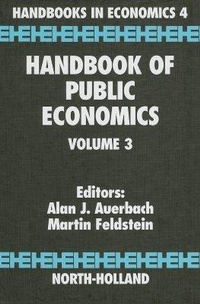
Handbook of Public Economics: Volume 3
Volume 3
Published on 25. January 2002
Book
Hardback
674 pages
978-0-444-82314-4 (ISBN)
Description
The Field of Public Economics has been changing rapidly in recent years, and the sixteen chapters contained in this Handbook survey many of the new developments. As a field, Public Economics is defined by its objectives rather than its techniques and much of what is new is the application of modern methods of economic theory and econometrics to problems that have been addressed by economists for over two hundred years. More generally, the discussion of public finance issues also involves elements of political science, finance and philosophy. These connections are evidence in several of the chapters that follow.
Public Economics is the positive and normative study of government's effect on the economy. We attempt to explain why government behaves as it does, how its behavior influences the behavior of private firms and households, and what the welfare effects of such changes in behavior are. Following Musgrave (1959) one may imagine three purposes for government intervention in the economy: allocation, when market failure causes the private outcome to be Pareto inefficient, distribution, when the private market outcome leaves some individuals with unacceptably low shares in the fruits of the economy, and stabilization, when the private market outcome leaves some of the economy's resources underutilized. The recent trend in economic research has tended to emphasize the character of stabilization problems as problems of allocation in the labor market. The effects that government intervention can have on the allocation and distribution of an economy's resources are described in terms of efficiency and incidence effects. These are the primary measures used to evaluate the welfare effects of government policy.
Public Economics is the positive and normative study of government's effect on the economy. We attempt to explain why government behaves as it does, how its behavior influences the behavior of private firms and households, and what the welfare effects of such changes in behavior are. Following Musgrave (1959) one may imagine three purposes for government intervention in the economy: allocation, when market failure causes the private outcome to be Pareto inefficient, distribution, when the private market outcome leaves some individuals with unacceptably low shares in the fruits of the economy, and stabilization, when the private market outcome leaves some of the economy's resources underutilized. The recent trend in economic research has tended to emphasize the character of stabilization problems as problems of allocation in the labor market. The effects that government intervention can have on the allocation and distribution of an economy's resources are described in terms of efficiency and incidence effects. These are the primary measures used to evaluate the welfare effects of government policy.
More details
Series
Language
English
Place of publication
United States
Publishing group
Elsevier Science & Technology
Target group
Professional and scholarly
Product notice
sewn/stitched
Cloth over boards
Dimensions
Height: 246 mm
Width: 173 mm
Thickness: 33 mm
Weight
1524 gr
ISBN-13
978-0-444-82314-4 (9780444823144)
Copyright in bibliographic data and cover images is held by Nielsen Book Services Limited or by the publishers or by their respective licensors: all rights reserved.
Schweitzer Classification
Other editions
Additional editions
Martin Feldstein | A. J. Auerbach
Handbook of Public Economics
E-Book
01/2002
Elsevier
€131.00
Available for download
Persons
Content
Part 1. Capital income taxation. Taxation, risk taking and household portfolio behaviour (J.M. Poterba). Taxation and saving (B.D. Bernheim, B. Douglas). Taxation and corporate financial policy (A. J. Auerbach). Tax policy and business investment (K.A.Hassett, R.G. Hubbard). Part 2. Theory of taxation. Taxation and economic efficiency (A.J. Auerbach, J.R. Hines Jr.). Tax avoidance, evasion and administration (J. Slemrod, S. Yitzhaki). Environmental taxation and regulation (A.L. Bovenburg, L.H. Goulder). Part 3. Theory of government. Political economics and public finance (T.Persson, G.Tabellini). Economic analysis and the law (L. Kaplow, S Shavell).