

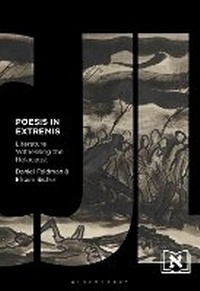
Poesis in Extremis
Literature Witnessing the Holocaust
Published on 8. February 2024
Book
Hardback
272 pages
979-8-7651-0018-9 (ISBN)
Description
A Choice Outstanding Academic Title of 2025
How can genocide be witnessed through imaginative literature? How can the Holocaust affect readers who were not there?
Reading the work of major figures such as Elie Wiesel, Paul Celan, Avrom Sutzkever, Ida Fink, Wladyslaw Szlengel, Itzhak Katzenelson, and Czeslaw Milosz, Poesis in Extremis poses fundamental questions about how prose and poetry are written under extreme conditions, either in real time or immediately after the Holocaust.
Framed by discussion of literary testimony, with Wiesel's literary memoir Night as an entry point, this innovative study explores the blurred boundary of fact and fiction in Holocaust literature. It asks whether there is a poetics of the Holocaust and what might be the criteria for literary witnessing. Wartime writing in particular tests the limits of "poesis in extremis" when poets faced their own annihilation and wrote in the hope that their words, like a message in a bottle, would somehow reach readers. Through Poesis in Extremis, Daniel Feldman and Efraim Sicher probe the boundaries of Holocaust literature, as well as the limits of representation.
How can genocide be witnessed through imaginative literature? How can the Holocaust affect readers who were not there?
Reading the work of major figures such as Elie Wiesel, Paul Celan, Avrom Sutzkever, Ida Fink, Wladyslaw Szlengel, Itzhak Katzenelson, and Czeslaw Milosz, Poesis in Extremis poses fundamental questions about how prose and poetry are written under extreme conditions, either in real time or immediately after the Holocaust.
Framed by discussion of literary testimony, with Wiesel's literary memoir Night as an entry point, this innovative study explores the blurred boundary of fact and fiction in Holocaust literature. It asks whether there is a poetics of the Holocaust and what might be the criteria for literary witnessing. Wartime writing in particular tests the limits of "poesis in extremis" when poets faced their own annihilation and wrote in the hope that their words, like a message in a bottle, would somehow reach readers. Through Poesis in Extremis, Daniel Feldman and Efraim Sicher probe the boundaries of Holocaust literature, as well as the limits of representation.
Reviews / Votes
A long overdue analysis and cogent discussion of Holocaust literature as literary testimony ... This is essential reading for anyone interested in 20th-century literature and history. * Choice * It is not only by focusing on poetry, but also by insisting on its evidentiary value, that Feldman and Sicher's volume becomes a timely and original contribution to a relatively neglected area of Holocaust research, the study of verse. Poesis in Extremis is thoroughly researched, erudite, and engaging, with each chapter providing helpful historical and biographical contextualization, and deftly interweaving these paratextual details with close literary analysis. -- Helena Duffy, University of Wroclaw * Modern Language Review * Well researched and insightful, this book closes a major gap in Holocaust studies by discussing the role of literature, and particularly that of poetry, as testimony in the spiritual lives of victims during as well as after the Holocaust. * Leona Toker, Professor of English, The Hebrew University of Jerusalem, Israel * This inspiring study gives a new slant on the vexed question of literary art of the Holocaust era. Through detailed readings of works by such writers as Elie Wiesel and Wladyslaw Szlengel, Ida Fink and Miklos Radnoti, Feldman and Sicher compellingly argue that poetic rather than documentary testimony was the most 'radical outlet' for witnesses' grief and horror. This important book reaffirms the crucial role of poetry after Auschwitz. * Sue Vice, Professor of English Literature, University of Sheffield, UK * The volume brings a welcome comparative perspective to literature written in the Holocaust ... [It] is an important volume that brings together close reading of Holocaust poetry with ongoing questions about poetics in extremis. * Journal of Modern Jewish Studies *More details
Series
Language
English
Place of publication
New York
United States
Publishing group
Bloomsbury Publishing Plc
Target group
Professional and scholarly
College/higher education
Dimensions
Height: 232 mm
Width: 160 mm
Thickness: 20 mm
Weight
540 gr
ISBN-13
979-8-7651-0018-9 (9798765100189)
Copyright in bibliographic data and cover images is held by Nielsen Book Services Limited or by the publishers or by their respective licensors: all rights reserved.
Schweitzer Classification
Other editions
Additional editions
E-Book
02/2024
1st Edition
Bloomsbury Academic USA
€32.99
Available for download
Persons
Daniel Feldman is Senior Lecturer of English Literature at Bar-Ilan University, Israel, with a focus on Holocaust literature and children's literature. His scholarship has been recognized with the Children's Literature Association Honor Article, the Children's Literature Association Judith Plotz Emerging Scholar Honor Award, and two research grants from the Israel Science Foundation. He is the author of a series of articles on the depiction of the Holocaust in Polish, German, Hebrew, and English poetry and prose. His research has appeared in Comparative Literature, Partial Answers, Children's Literature in Education, Children's Literature, Lion and the Unicorn, and Children's Literature Association Quarterly.
Efraim Sicher is Emeritus Professor of English and Comparative Literature at Ben-Gurion University, Israel, and is author of The Holocaust Novel (2005) and editor of the Dictionary of Literary Biography volume on Holocaust Novelists (2004). His most recent books include The Jew's Daughter: A Cultural History of a Conversion Narrative (2017), Re-envisioning Jewish Identities: Reflections on Contemporary Israeli and Diaspora Culture (2021), and Postmodern Love in the Contemporary Jewish Imagination: Negotiating Identities and Spaces (2022).
Efraim Sicher is Emeritus Professor of English and Comparative Literature at Ben-Gurion University, Israel, and is author of The Holocaust Novel (2005) and editor of the Dictionary of Literary Biography volume on Holocaust Novelists (2004). His most recent books include The Jew's Daughter: A Cultural History of a Conversion Narrative (2017), Re-envisioning Jewish Identities: Reflections on Contemporary Israeli and Diaspora Culture (2021), and Postmodern Love in the Contemporary Jewish Imagination: Negotiating Identities and Spaces (2022).
Content
Acknowledgments
Introduction (Daniel Feldman and Efraim Sicher)
Part I
1. Elie Wiesel's Night: Literature as Testimony (Efraim Sicher)
Part II
2. A Poetics of the Holocaust?: Celan, Sutzkever, Milosz (Efraim Sicher)
3. Writing Nothing: Negation and Subjectivity in the Holocaust Poetry of Paul Celan and Dan Pagis (Daniel Feldman)
4. Miklos Radnoti: Postcards from a Death March (Efraim Sicher)
5. Wladymir Szlengel's Ghetto Poems: Writing to the Dead (Daniel Feldman)
6. "Poem in a Bottle": Itzhak Katzenelson's Song of the Murdered Jewish People (Daniel Feldman)
Part III
7. Translating Oral Memory in Ida Fink's "Traces" (Daniel Feldman)
Postscript (Daniel Feldman and Efraim Sicher)
Notes
Bibliography
Index
Introduction (Daniel Feldman and Efraim Sicher)
Part I
1. Elie Wiesel's Night: Literature as Testimony (Efraim Sicher)
Part II
2. A Poetics of the Holocaust?: Celan, Sutzkever, Milosz (Efraim Sicher)
3. Writing Nothing: Negation and Subjectivity in the Holocaust Poetry of Paul Celan and Dan Pagis (Daniel Feldman)
4. Miklos Radnoti: Postcards from a Death March (Efraim Sicher)
5. Wladymir Szlengel's Ghetto Poems: Writing to the Dead (Daniel Feldman)
6. "Poem in a Bottle": Itzhak Katzenelson's Song of the Murdered Jewish People (Daniel Feldman)
Part III
7. Translating Oral Memory in Ida Fink's "Traces" (Daniel Feldman)
Postscript (Daniel Feldman and Efraim Sicher)
Notes
Bibliography
Index