

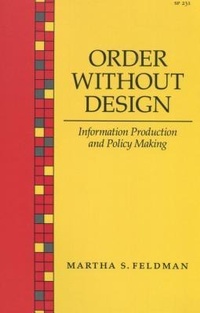
Order without Design
Information Production and Policy Making
Published on 1. January 1989
Book
Paperback/Softback
215 pages
978-0-8047-1724-3 (ISBN)
Description
In this lively and, ultimately, disturbing study of policy analysts who are employed in bureaucracies, the author finds a startling paradox. The analysts know that the papers they so painstakingly prepare will not be used; as one analyst remarked, 'Either it won't get done in time, or it won't be good enough, or the person who wanted it done will have left and no one will know what to do with it, or the issue will no longer exist.' Yet the analysts continue to work hard at producing these papers. The means of producing information is at the heart of the paradox. The process systematically produces information that is difficult to use directly in decision making. Yet analysts can do little to alter the constraints of the process. They continue to produce papers because it is their job, they value doing it, and it is their major means of influencing policy. In so doing, they make a unique, though indirect, contribution to policy making.
Drawing on eighteen months of observation and participation in the work of the policy office of the US Department of Energy, the author fully investigates the conditions that create the paradox and the positive as well as the negative implications of the process of information production.<
Drawing on eighteen months of observation and participation in the work of the policy office of the US Department of Energy, the author fully investigates the conditions that create the paradox and the positive as well as the negative implications of the process of information production.<
More details
Language
English
Place of publication
Palo Alto
United States
Target group
College/higher education
Professional and scholarly
Illustrations
bibliography, index
Dimensions
Height: 224 mm
Width: 145 mm
Thickness: 17 mm
Weight
415 gr
ISBN-13
978-0-8047-1724-3 (9780804717243)
Copyright in bibliographic data and cover images is held by Nielsen Book Services Limited or by the publishers or by their respective licensors: all rights reserved.
Schweitzer Classification
Content
Part I. Introduction: 1. The paradox of producing information; 2. Interpretation in decision making and policy making; 3. Method and data; Part II. What Bureaucratic Analysts Do: 4. Report writing; 5. tasks that contribute to report writing; 6. The work of bureaucratic analysts; Part III. Contribution to Policy Making: 7. Rationality, interpretation, and inventories; 8. Properties of the inventory; 9. Problem sovling versus interpretation: from the bureaucratic analysts' perspective; Part VI. Implications: 10. Bureaucratic analysts and their work; 11. Organizing analysts; 12. The production of information; Appendices; Bibliography; Index.