

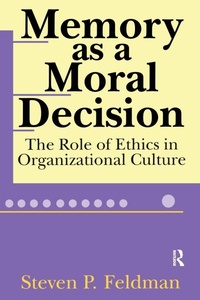
Memory as a Moral Decision
The Role of Ethics in Organizational Culture
1st Edition
Published on 28. February 2004
Book
Paperback/Softback
249 pages
978-0-7658-0586-7 (ISBN)
Description
The notion of organizational culture has become a matter of central importance with the great increase in the size of organizations in the twentieth century and the need for managers to run them. Like morale in the military, organizational culture is the great invisible force that decides the difference between success and failure and serves as the key to organizational change, productivity, effectiveness, control, innovation, and communication. Memory as a Moral Decision, provides a historical review of the literature on organizational culture. Its goal is to investigate the kind of world conceptualized by those who have described organizations and the kind of moral world they have in fact constructed, through its ideals and images, for the men and women who work in organizations.Feldman builds his analysis around a historically grounded concept of moral tradition. He demonstrates a central insight: when those who have written on organizational culture have addressed issues of ethics, they have ignored the past as a foundation to stabilize and maintain moral commitments. Instead, they have fluctuated between attempts to base ethics on executive rationality and attempts to escape the suffocating logic of rationalism. After an opening chapter defining the concept of moral tradition, Feldman focuses on early works on organizational management by Chester Barnard and Melville Dalton. These define the tension between ethical rationalism and ethical relativism. He then turns to contemporary frameworks, analyzing critical organizational theory and the "new institutionalism." In the final chapters, Feldman considers ethical relativism in contemporary thinking, including postmodern organization theory, the exaggerated drive for diversity, and such concepts as power/knowledge and deconstructionism.Memory as a Moral Decision is unique in its understanding of organizational culture as it relates to past, present, and future systems. Its interdisciplinary approach uses the insights of sociology, psychology, and culture studies to create an invaluable framework for the study of ethics in organizations.
Reviews / Votes
"In this defiant, provocative, and impressive collection of essays...Feldman has offered Western cultural elites a stern reminder of the importance of moral leadership." - Robin Stanley Snell, International Journal of Organizational Analysis; "Feldman's work here is complex and sophisticated.... It will have to be read by every graduate student in organization theory who wants to think of his education as being complete, or for that matter even adequate." - Howard S. Schwartz, Business Ethics Quarterly; "Memory as a Moral Decision is a fine book: clearly written, richly insightful and provocative. It is a fine example to all academics of a writer who has the courage to stake out a position and engage others from it." - Aidan MacQuade, Organization Studies"More details
Language
English
Place of publication
Somerset
United Kingdom
Publishing group
Taylor & Francis Inc
Target group
College/higher education
Professional and scholarly
Dimensions
Height: 229 mm
Width: 152 mm
Weight
340 gr
ISBN-13
978-0-7658-0586-7 (9780765805867)
Copyright in bibliographic data and cover images is held by Nielsen Book Services Limited or by the publishers or by their respective licensors: all rights reserved.
Schweitzer Classification
Other editions
Additional editions
E-Book
01/2019
Routledge
€64.49
Available for download
E-Book
01/2019
1st Edition
Routledge
€64.49
Available for download
Book
01/2002
1st Edition
Transaction Publishers
€156.24
Article not available at the moment
Person
Steve Feldman
Content
Part 1: Introduction 1. The Chain of Memory: On the Relations Between Moral Culture, the Individual, and the Past 3 Part 2: Establishing Traditions 2. The Disinheritance of Management Ethics: Rational Individualism in Barnard's The Functions of the Executive 37 3. The Ethics of Shifting Ties: Moral Relativism in Melville Dalton's Men Who Manage 57 Part 3: Ethical Rationalism 4. Management Ethics Without the Past: Rationalism and Individualism in Critical Organizational Theory 83 5. Micro Matters: The Aesthetics of Power in NASA's Flight Readiness Review 109 Part 4: Ethical Relativism 6. The Revolt Against Cultural Authority: Power/Knowledge as an Assumption in Organization Theory 7. Playing with the Pieces: Deconstruction and the Loss of Moral Culture 155 8. The Leveling of Organizational Culture: Egalitarianism in Critical Postmodern Organization Theoiy 181 9. Conclusion: Sanctuaries Against the Modem World 203